
 A SCHOLARLY BOOK REPOSITORY
8 start with E start with E
"Breadth and subtlety, wisdom and insight . . . Gustafson is a first-rate theologian."—Commonweal
"The two-volume work, now complete, will be a benchmark for discussions of Christian ethics for years to come. With it Gustafson becomes one of the thinkers by whom others can, by agreement or divergence, define their own ethics."—Roger L. Shinn, Christianity and Crisis
"Gustafson's theocentrism is an original and creative contribution to modern ethical discussion."—Douglas Sturm, Ethics

In this comprehensive anthology, twenty-seven outstanding scholars from North America and Europe address every major aspect of Thomas Aquinas's understanding of morality and comment on his remarkable legacy. While there has been a revival of interest in recent years in the ethics of St. Thomas, no single work has yet fully examined the basic moral arguments and content of Aquinas' major moral work, the Second Part of the Summa Theologiae. This work fills that lacuna.
The first chapters of The Ethics of Aquinas introduce readers to the sources, methods, and major themes of Aquinas's ethics. The second part of the book provides an extended discussion of ideas in the Second Part of the Summa Theologiae, in which contributors present cogent interpretations of the structure, major arguments, and themes of each of the treatises. The third and final part examines aspects of Thomistic ethics in the twentieth century and beyond.
These essays reflect a diverse group of scholars representing a variety of intellectual perspectives. Contributors span numerous fields of study, including intellectual history, medieval studies, moral philosophy, religious ethics, and moral theology. This remarkable variety underscores how interpretations of Thomas's ethics continue to develop and evolve—and stimulate fervent discussion within the academy and the church.
This volume is aimed at scholars, students, clergy, and all those who continue to find Aquinas a rich source of moral insight.
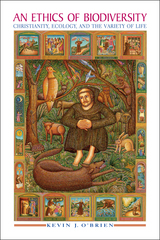
Life on earth is wildly diverse, but the future of that diversity is now in question. Through environmentally destructive farming practices, ever-expanding energy use, and the development and homogenization of land, human beings are responsible for unprecedented reductions in the variety of life forms around us. Estimates suggest that species extinctions caused by humans occur at up to 1,000 times the natural rate, and that one of every twenty species on the planet could be eradicated by 2060.
An Ethics of Biodiversity argues that these facts should inspire careful reflection and action in Christian churches, which must learn from earth’s vast diversity in order to help conserve the natural and social diversity of our planet. Bringing scientific data into conversation with theological tradition, the book shows that biodiversity is a point of intersection between faith and ethics, social justice and environmentalism, science and politics, global problems and local solutions. An Ethics of Biodiversity offers a set of tools for students, environmentalists, and people of faith to think critically about how human beings can live with and as part of the variety of life in God’s creation.
The republication of We Hold These Truths is but one indication of the continuing importance of the thought of John Courtney Murray for the Catholic Church in the United States. More than any other American theologian in this century, Fr. Murray developed a new understanding of the healthy relationship between religion and politics, church and state, in a democratic context.
Until now, however, the evolution of Murray's own thought in these matters has not been fully understood. Beginning with Murray's first forays into the public arena in the 1940s, Leon Hooper carefully plots Murray's movement away from the classical concepts of conscience and rights toward a more historical understanding of moral agency and of the church's necessary engagement with a pluralistic world.
Along the way, Fr. Hooper reveals in detail for the first time the importance of Bernard Lonergan's thought in moving Murray toward and then beyond his vital contribution to Vatican II's Declaration on Religious Liberty.
In this book, William O'Neill, SJ, offers an interpretation of the nature and scope of practical reasoning in light of postmodern philosophical criticism. He charts a via media between the abstract formalism of neo-Kantian morality and relativist interpretations of neo-Aristotelian ethics.
The three parts of the book treat the eclipse of the classical Aristotelian conception of practical reason; the Kantian heritage in the modern moral theories of John Rawls and R.M. Hare; and the hermeneutical retrieval of a moral interpretation of the world. Drawing upon the philosophical hermeneutics of Hans-Georg Gadamer, modern analytical philosophy, and the discourse ethics of Jürgen Habermas, O'Neill offers a critical reconstruction of practical reason which upholds the primacy of moral community while recognizing the ethical import of historical and cultural difference.
The final chapter applies the preceding hermeneutical critique to the question of the distinctiveness of Christian ethics in the writings of Karl Barth, Hans Urs von Balthasar, Josef Fuchs, and Bruno Schüller. This original contribution will be of special interest to students and teachers of moral philosophy and theology.
In the twenty-first century the basic questions of ethics are no longer the abstract terms of ethical theory, but the concrete and burning issues related to the influence of life sciences, the impact of a globalized economy, and the consequences of present decisions for the future of humankind. Ethics: The Fundamental Questions of Our Lives analyzes twenty ethical issues that address education and culture, labor and economy, the environment and sustainability, democracy and cosmopolitanism, peace and war, and life and death. Each chapter describes a concrete example showing the relevance of the fundamental ethical question, then provides an explanation of how one can think through possible responses and reactions. Huber emphasizes the connections between personal, professional, and institutional ethics and demonstrates how human relationships lie at the center of our ethical lives. His aim is to articulate a theology of what he calls "responsible freedom" that transcends individualistic self-realization and includes communal obligations.
In this book, Stephen J. Pope argues that contemporary scientifically-based theories of the evolution of altruism provide important insights into one of the fundamental moral problems of Christian ethics, the natural basis of love and its ordering. He explores the contributions evolutionary theory makes to our understanding of the biological foundations of kin preference and reciprocal care, the limits of love, and the need for an ordering of love—issues relevant to any ethic that accords a central role to the deeply natural affections found in friendship, marriage, and the family. He proposes that understanding human nature in its broader evolutionary context brings to ethics a needed balance between the personal and biological dimensions of human nature.
In the context of Catholic ethics, Pope points out functional similarities between Thomas Aquinas's use of then-available scientific theories in his interpretation of the natural basis of primary relationships and Pope's own efforts to avoid the deficiencies that characterize contemporary Catholic interpretations of love based on personalism and existentialism. He concludes with a call for a multidimensional interpretation of love, one that incorporates scientifically-based theories about human nature together with an appreciation of the significance of motives, intentions, and freedom, for the ordering of human affections and moral responsibility. This book will be of interest to moral theologians, especially those concerned with the topics of love, justice, and natural law ethics.
READERS
Browse our collection.
PUBLISHERS
See BiblioVault's publisher services.
STUDENT SERVICES
Files for college accessibility offices.
RECENTLY PUBLISHED





UChicago Accessibility Resources
home | accessibility | search | about | contact us
BiblioVault ® 2001 - 2025
The University of Chicago Press