
 A SCHOLARLY BOOK REPOSITORY
7 start with D start with D

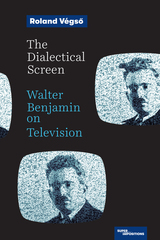
Exploring the meanings of media technologies through Walter Benjamin’s thought
Walter Benjamin’s prime years as a cultural critic coincided with the rise of televised broadcasting in Europe and North America, a unique period of rapid expansion in a new technological medium. So why would such a subtle and sensitive critic of media, known for his cultural criticism across genres, seem to have ignored or even missed the entire phenomenon of television? This book reveals how television, as a concept and a metaphor, in fact structures Benjamin’s philosophy.
Through a careful reading of Benjamin’s work across various media—literature, photography, cinema, radio, and television—Roland Végső reconstructs a powerful vision of media technologies as not merely tools of communication but as forces that shape how we imagine and construct the world as a conceptual totality. The Dialectical Screen provides a timely and provocative framework for understanding how media continue to shape our political, cultural, and existential horizons, recasting Benjamin's understanding of historical materialism in fundamentally tele-visual terms as a theoretical orientation that makes visible the perishing of the world itself.
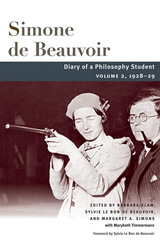
Presented for the first time in translation, this fully annotated first volume of the Diary includes essays from Barbara Klaw and Margaret A. Simons that address its philosophical, historical, and literary significance. It remains an invaluable resource for tracing the development of Beauvoir’s independent thinking and her influence on philosophy, feminism, and the world.
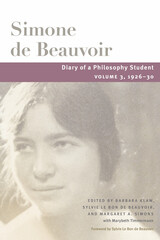
In addition, the editors include a wealth of important supplementary material. Barbara Klaw provides a detailed consideration of the Diary’s role in the development of Beauvoir’s writing style by exploring her use of metanarrative and other literary techniques, part of a process of literary creation that saw Beauvoir use the notebooks to cultivate her talent. Margaret A. Simons’s essay places the assault by Sartre within an appraisal of Beauvoir’s complicated legacy for #MeToo while suggesting readers engage with the diary through the lens of trauma.

Sprawled in his favorite armchair, Dr. Freud notices a peculiar phrase in pages of his notebook: “preaching to the fishes.” What could he have meant by this? If there’s one thing he has learned working as a psychoanalyst, it’s that the best way to make sense of yourself is through your dreams—and so he settles down for a nice long nap. But no sooner does his head hit the pillow than he begins to hear voices! A frightened fish with a childhood memory lodged in its throat coaxes Dr. Freud into the cold water, where his ideas come to life through an unforgettable cast of characters, including a loquacious carp and three frogs—Id, Ego, and Superego—locked in fierce competition for a single waterlily.
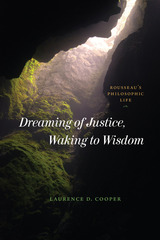
Dreaming of Justice, Waking to Wisdom reveals what could be thought of as the capstone of Rousseau’s thought, even if that capstone has been nearly invisible to readers. Despite criticizing philosophy for its corrosive effects on both natural goodness and civic virtue, Rousseau, argues Laurence D. Cooper, held the philosophic life as an ideal. Cooper expertly unpacks Rousseau’s vivid depiction of the philosophic life and the case for that life as the most natural, the freest, or, in short, the best or most choice-worthy of lives. Cooper focuses especially on a single feature, arguably the defining feature of the philosophic life: the overcoming of the ordinary moral consciousness in favor of the cognitivist view of morality. Cooper shows that Rousseau, with his particular understanding and embrace of the philosophic life, proves to be a kind of latter-day Socratic. Thorough and thought-provoking, Dreaming of Justice, Waking to Wisdom provides vital insight into Rousseau.
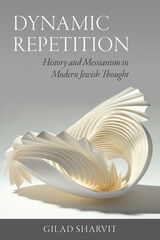
Dynamic Repetition proposes a new understanding of modern Jewish theories of messianism across the disciplines of history, theology, and philosophy. The book explores how ideals of repetition, return, and the cyclical occasioned a new messianic impulse across an important swath of late nineteenth- and early twentieth-century German Jewish thought. To grasp the complexities of Jewish messianism in modernity, the book focuses on diverse notions of “dynamic repetition” in the works of Franz Rosenzweig, Walter Benjamin, Franz Kafka, and Sigmund Freud, and their interrelations with basic trajectories of twentieth-century philosophy and critical thought.
READERS
Browse our collection.
PUBLISHERS
See BiblioVault's publisher services.
STUDENT SERVICES
Files for college accessibility offices.
RECENTLY PUBLISHED






UChicago Accessibility Resources
home | accessibility | search | about | contact us
BiblioVault ® 2001 - 2026
The University of Chicago Press