logo for Georgetown University Press
Defending Probabilism
The Moral Theology of Juan Caramuel
Julia Fleming. Foreword by Charles E. Curran
Georgetown University Press, 2006

Through the centuries, at the heart of Catholic moral theology is a fundamental question: How do we behave responsibly in the face of moral uncertainty? Attempts to resolve problems of everyday life led to the growth of a variety of moral systems, one of which emerged in the early 17th century and was known as "probabilism." This method of solving difficult moral cases allowed the believer to rely upon a view that was judged defensible in terms of its arguments or the authorities behind it, even if the opposite opinion was supported by stronger arguments or more authorities. The theologian Juan Caramuel, a Spanish Cistercian monk whom Alphonso Liguori famously characterized as "the prince of laxists," has been regarded as one of the more extreme—and notorious—proponents of probabilism. As the only full-length English study of Caramuel's theological method, Defending Probabilism seeks to reappraise Caramuel's legacy, claiming that his model of moral thinking, if better understood, can actually be of help to the Church today.

Considered one of the most erudite theologians of his age, a scientist and scholar who published works on everything from astronomy and architecture to printing and Gregorian chant, Caramuel strove throughout his life to understand probabilism's theological and philosophical foundations as part of his broader analysis of the nature of human knowledge.

In applying Caramuel's legacy to our own time, Defending Probabilism calls for a reconsideration of the value of provisional moral knowledge. Fleming's study shows that history matters, and that to attain any position on moral certitude is a difficult and painstaking process.

[more]

logo for Georgetown University Press
Democracy on Purpose
Justice and the Reality of God
Franklin I. Gamwell
Georgetown University Press

Western moral and political theory in the last two centuries has widely held that morality and politics are independent of a divine reality. Claiming that this consensus is flawed, prominent theologian Franklin I. Gamwell argues that there is a necessary relation between moral worth and belief in God. Without appealing to the beliefs of any specific religion, Gamwell defends a return to the view that moral and political principles depend on a divine purpose.

To separate politics from the divine misrepresents the distinctive character of human freedom, Gamwell maintains, and thus prevents a full understanding of the nature of justice. Principles of justice define "democracy on purpose" as the political form in which we pursue the divine good.

Engaging in a dialogue with such major representatives of the dominant consensus as Kant, Habermas, and Rawls, and informed by the philosophical writings of Alfred North Whitehead, this book makes the case for a neoclassical metaphysics that restores a religious sensibility to our political life.

[more]

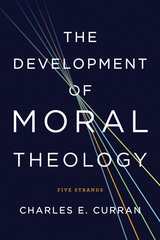
front cover of The Development of Moral Theology
The Development of Moral Theology
Five Strands
Charles E. Curran
Georgetown University Press, 2016

Charles Curran in his newest book The Development of Moral Theology: Five Strands, brings a unique historical and critical analysis to the five strands that differentiate Catholic moral theology from other approaches to Christian ethics—sin and the manuals of moral theology, the teaching of Thomas Aquinas and later Thomists, natural law, the role of authoritative church teaching in moral areas, and Vatican II. Significant changes have occurred over the course of these historical developments. In addition, pluralism and diversity exist even today, as illustrated, for example, in the theory of natural law proposed by Cardinal Ratzinger.

In light of these realities, Curran proposes his understanding of how the strands should influence moral theology today. A concluding chapter highlights the need for a truly theological approach and calls for a significant change in the way that the papal teaching office functions today and its understanding of natural law.

In a work useful to anyone who studies Catholic moral theology, The Development of Moral Theology underscores, in the light of the historical development of these strands, the importance of a truly theological and critical approach to moral theology that has significant ramifications for the life of the Catholic church.


[more]


Send via email Share on Facebook Share on Twitter