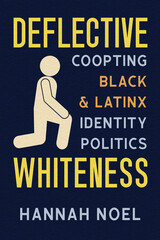
front cover of Deflective Whiteness
Deflective Whiteness
Co-Opting Black and Latinx Identity Politics
Hannah Noel
The Ohio State University Press, 2022
In Deflective Whiteness, Hannah Noel repositions Whiteness studies in relation to current discussions around racialized animus and White victimhood, demonstrating how White supremacy adapts its discursive strategies by cannibalizing the language and rhetoric of Black and Latinx social justice movements. Analyzing a wide-ranging collection of cultural objects—memes, oration, music, advertisements, and news coverage—Noel shows how White deflection sustains and reproduces structures of inequality and injustice.

White deflection offers a script for how social justice rhetoric and the emotions of victimization are appropriated to conjure a hegemonic White identity. Using derivative language, deflection claims Whiteness as the aggrieved social status. Through case studies of cultural moments and archives including Twitter, country music, the Black Lives Matter movement, and more, Deflective Whiteness exposes the various forms of tacit White supremacy that operate under the alibi of injury and that ultimately serve to deepen racial inequities. By understanding how, where, and why White deflection is used, Noel argues, scholars and social justice advocates can trace, tag, and deconstruct covert White supremacy at its rhetorical foundations.
[more]

front cover of Disorienting Politics
Disorienting Politics
Chimerican Media and Transpacific Entanglements
Fan Yang
University of Michigan Press, 2024
Disorienting Politics mines 21st-century media artifacts—including films like The Martian and TV/streaming media shows such as Firefly and House of Cards—to make visible the economic, cultural, political, and ecological entanglements of China and the United States. Describing these transpacific entanglements as “Chimerica”—coined by economic historians to reference the symbiosis of China and America—Yang examines how Chimerican media, originating in the US but traversing national boundaries in their production, circulation, and consumption, co-create the figure of rising China and extend a political imagination beyond the conventional ground of the nation.

Examining how Chimerican media are shaped by and perpetuate uneven power relations, Disorienting Politics argues that the pervasive tendency among wide-ranging cultural producers to depict the Chinese state as a racialized Other in American media life diminishes the possibility of engaging transpacific entanglements as a basis for envisioning new political horizons. Such othering of China not only results in overt racism against people of Asian descent, Yang argues, but also impacts the wellbeing of people of color more generally. This interdisciplinary book demonstrates the ways in which race is embedded in geopolitics even when the subject of discussion is not the people, but the (Chinese) state. Bridging media and cultural studies, Asian and Asian American studies, geography, and globalization studies, Disorienting Politics calls for a relational politics that acknowledges the multifarious interconnectivity between people, places, media, and environment.
[more]


front cover of Doom Patterns
Doom Patterns
Latinx Speculations and the Aesthetics of Violence
Maia Gil'Adí
Duke University Press, 2025
In Doom Patterns, Maia Gil’Adí takes up speculative fiction as a site for theorizing Latinx identity across national and ethnic borders and shows the vital role of historical trauma in its formation. Her analysis moves beyond reparative modes of reading to consider how literary representations of violence, destruction, and pain also elicit pleasurable affective and aesthetic experiences. Gil’Adí theorizes the paradox of pleasurable violence through the notion of doom patterns—narrative devices that include thematic repetition, nonlinear narration, character fragmentation, and unresolved plots. Doom patterns return the reader to instances of historical violence and destruction, revealing them as excessive and otherworldly processes that require the tropes of speculative fiction. Examining novels by established Latinx authors such as Junot Díaz and Cristina García as well as multiethnic writers such as Colson Whitehead and Sesshu Foster, Gil’Adí challenges definitions of what constitutes Latinx literature and notions of the speculative by dismantling generic boundaries and entrenched definitions of race, ethnicity, and nationhood. In so doing, she allows for a more capacious consideration of the speculative, realism, history, and the role of violence in literature.
[more]


Send via email Share on Facebook Share on Twitter