
front cover of Before Amoris Laetitia
Before Amoris Laetitia
The Sources of the Controversy
Jaroslaw Kupczak
Catholic University of America Press, 2021
The publication of Pope Francis’ post-synodal apostolic exhortation, Amoris Laetitia started the most important theological debate in the Catholic Church since the end of the Second Vatican Council. The cardinals, bishops, theologians, priests, lay Catholics found themselves on the opposite sides of this crucial and complicated discussion. This book attempts to shed some light on this debate by tracing its genealogy. Since Amoris Laetitia is a post-synodal document, the large part of the book is devoted to the theological analysis of the two Synods of Bishops convoked by Pope Francis in the first years of his pontificate: the extraordinary in October 2014 and the ordinary that took place a year later. The main topics for the two synods were determined, however, in the speech given by Cardinal Walter Kasper during the cardinals consistory in February 2014 whose main aim was to prepare the possibility of admitting divorced persons who live in second unions to Holy Communion. The arguments of Cardinal Kasper are presented in the first chapter of the book and confronted with the most significant statements of the Magisterium of the Church on the issue of admittance to the Holy Communion. This book is a study at the intersection of Church history, the history of theology, and systematic theology: dogmatic and moral. Kupczak is interested in the chronology of the events connected to the two synods on the family but in the context of theological problems discussed therein: the theological significance of contemporary cultural changes; the relation of the Church to the world; the understanding of the indissolubility of the sacramental marriage and the Eucharist; the methods of ethically assessing human acts, particularly the concept of so-called intrinsically evil acts (intrinsece malum); and the relation of conscience to the general moral norm. The non-partisan ambition of this book is to serve as a “road map”— a help in navigation for the reader in the complicated discussions leading to publication of Amoris Laetitia. The uniqueness of this book consists in combining the historical analysis of the events leading to the publication of Amoris Laetitia with research of the theological discussion that ensued. Since Amoris Laetitia is a post-synodal exhortation, this book rests on the assumption that crucial for its understanding is a thorough analysis of its genealogy. Only in the light of this historical and theological perspective the debates surrounding Amoris Laetitia may be understood.
[more]

logo for Georgetown University Press
Being as Symbol
On the Origins and Development of Karl Rahner's Metaphysics
Stephen M. Fields, SJ
Georgetown University Press, 2000

One of the most important theologians of the modern era, Karl Rahner is best known for his efforts to make Christianity credible in light of the intellectual questions of modern culture. Stephen M. Fields, SJ, now explains how Rahner developed his metaphysics as a creative synthesis of Thomism and the modern philosophical tradition. Focusing on Rahner's core concept of the Realsymbol, which posits all beings as symbolic, Fields establishes the place of the Realsymbol in philosophical theories of the symbol. He particularly concentrates on those key aspects of Rahner's metaphysics-his theories of finite realities and language—that have received insufficient attention.

By examining a wide range of Rahner's works in the context of twelve medieval, modern, and contemporary thinkers, Fields locates the origins of this seminal thinker's metaphysics to an extent never before attempted. He notes the correlations that exist between the Realsymbol and such work as Aquinas's theory of the sacraments, Goethe's and Hegel's dialectics, Moehler's view of religious language, and Heidegger's aesthetics.

Through this analysis, Fields reveals the structural core of Rahner's metaphysics and shows how art, language, knowledge, religious truth, and reality in general are all symbolic. Being as Symbol opens new perspectives on this important thinker and positions him in the broader spectrum of philosophical thought.
[more]

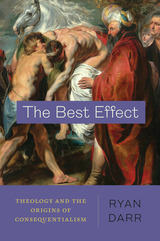
front cover of The Best Effect
The Best Effect
Theology and the Origins of Consequentialism
Ryan Darr
University of Chicago Press, 2023
A theological history of consequentialism and a fresh agenda for teleological ethics.
 

Consequentialism—the notion that we can judge an action by its effects alone—has been among the most influential approaches to ethics and public policy in the Anglophone world for more than two centuries. In The Best Effect, Ryan Darr argues that consequentialist ethics is not as secular or as rational as it is often assumed to be. Instead, Darr describes the emergence of consequentialism in the seventeenth century as a theological and cosmological vision and traces its intellectual development and eventual secularization across several centuries. The Best Effect reveals how contemporary consequentialism continues to bear traces of its history and proposes in its place a more expansive vision for teleological ethics.
[more]

logo for Georgetown University Press
Beyond Biology
Rethinking Parenthood in the Catholic Tradition
Jacob M. Kohlhaas
Georgetown University Press, 2023

A breakthrough in the theology of parenthood, integrating Catholic social thought and social scientific studies of child well-being in order to offer a more diverse and inclusive interpretation

The Catholic Church has a long and diverse history of tolerating various child-rearing arrangements. The dominant Catholic framework for conceptualizing parenthood, however, is highly influenced by concerns over sexual ethics and gender norms. While sexual and reproductive ethics are important, the present consensus that theological consideration of parenthood necessarily hinges on these matters diverts attention from actual parenting practices in their social and cultural contexts. In reality, kinship and caregiving are often negotiated in complex ways.

In Beyond Biology, Jacob M. Kohlhaas uses a historical and interdisciplinary theological method that engages both analytically and appreciatively with tradition to sketch a broader Catholic anthropology of parenthood. Kohlhaas’s identification of interpretive options within the Catholic tradition creates room for meaningful, intellectually convincing, and theologically rich responses to challenges facing Catholic parents and families today.

By marshaling the diversity of the Christian tradition and exploring contemporary research in the social sciences and humanities, Kohlhaas frames a theological conversation on parenthood as parenthood—considering the needs and well-being of children as well as the potentials and capabilities of adult caregivers. In his discussion, Kohlhaas considers adoption and nonbiological parenthood, fathers as primary caregivers and nurturers, caregiving by siblings and grandparents, and communal parenting and coparenting beyond the spousal pair. In Kohlhaas’s view, conceptions of parenthood should be guided by the meaning of Christian kinship rooted in baptism as well as concern for the actual caregiving capacities of adults and the needs of children.

[more]

logo for Catholic University of America Press
Bioethics
A Catholic Primer
Thomas Cavanaugh
Catholic University of America Press, 2026
Bioethics: A Catholic Primer is a succinct, precise, and accurate treatment of the Catholic moral tradition in medicine. Professors teaching an undergraduate bioethics course will use it as a primary text or as an ancillary text in a general ethics course that has a medical ethics section. Professors in both situations will find it an attractive alternative or addition to current offerings. This applies especially to those teaching at a Catholic-affiliated college or university. Professors teaching in pre-health­care professional, pre-medical, and in nursing programs (both undergraduate and graduate) will adopt this text both as a primary text and as an ancillary text, depending on their needs. Because of its slender, compact, yet rewarding content, professors will find it appealing to assign. Moreover, students will not find its size daunting. Its accuracy, precision, and small size will make it appealing to a more general audience. Moreover, by its brevity, it will gain an audience interested in Catholic med­ical ethics, yet often overwhelmed by the very size of the volumes available. People interested in an overarching, accurate, yet brief treatment of the Catholic moral tradition in medicine will read this slim volume (for exam­ple, members on ethics committees at Catholic hospitals). Others (faculty, students, patients, pastors, physicians, and nurses) will read it themselves and confidently share it with their friends and loved ones, knowing that they will find in it a rewarding, slender, accessible treatment of a rich moral tradition.
[more]

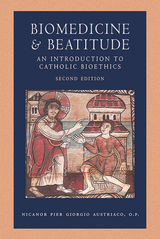
front cover of Biomedicen and Beatitude
Biomedicen and Beatitude
An Introduction to Catholic Bioethics, Second Edition
Nicanor Pier Giorgio Austriaco
Catholic University of America Press, 2021
This timely and up to date new edition of Biomedicine and Beatitude features an entirely new chapter on the ethics of bodily modification. It is also updated throughout to reflect the pontificate of Pope Francis, recent concerns including ethical issues raised by the COVID-19 pandemic, and feedback from the many instructors who used the first edition in the classroom.
[more]

front cover of Blood in the Fields
Blood in the Fields
Óscar Romero, Catholic Social Teaching, and Land Reform
Matthew Philipp Whelan
Catholic University of America Press, 2020
On March 24, 1980, a sniper shot and killed Archbishop Óscar Romero as he celebrated mass. Today, nearly four decades after his death, the world continues to wrestle with the meaning of his witness. Blood in the Fields: Óscar Romero, Catholic Social Teaching, and Land Reform treats Romero’s role in one of the central conflicts that seized El Salvador during his time as archbishop and that plunged the country into civil war immediately after his death: the conflict over the concentration of agricultural land and the exclusion of the majority from access to land to farm. Drawing extensively on historical and archival sources, Blood in the Fields examines how and why Romero advocated for justice in the distribution of land, and the cost he faced in doing so. In contrast to his critics, who understood Romero’s calls for land reform as a communist-inspired assault on private property, Blood in the Fields shows how Romero relied upon what Catholic Social Teaching calls the common destination of created goods, drawing out its implications for what property is and what possessing it entails. For Romero, the pursuit of land reform became part of a more comprehensive politics of common use, prioritizing access of all peoples to God’s gift of creation. In this way, Blood in the Fields reveals how close consideration of this conflict over land opened up into a much more expansive moral and theological landscape, in which the struggle for justice in the distribution of land also became a struggle over what it meant to be human, to live in society with others, and even to be a follower of Christ. Understanding this conflict and its theological stakes helps clarify the meaning of Romero’s witness and the way God’s work to restore creation in Christ is cruciform.
[more]

logo for Georgetown University Press
Bridging the Sacred and the Secular
Selected Writings of John Courtney Murray
J. Leon Hooper, SJ, Editor
Georgetown University Press, 1994

John Courtney Murray, SJ (1904-1967), is most renowned for his ethical writings, which distinguish between the secular and the sacred, and for his defense of civil religious freedom based on natural law philosophy. His later theological writings, however, in which he sought to reintegrate the temporal and the spiritual, civil society and the church, philosophy and theology, have been largely ignored. In this new collection of essays—previously scattered among various periodicals over the course of thirty years—J. Leon Hooper, S.J., presents a selection of Murray's theological writings that not only outlines and highlights the integrity of Murray's moves towards a public theological discourse but also contributes to the ongoing post-conciliar task of integrating the secular and the sacred, thereby invigorating American public conversation today.

In his editorial introductions, Hooper furthers Murray scholarship by identifying two distinct links between Murray's well known non-theological writings and the explicitly theological work that also spans his public life. Common to both areas are Murray's deepening appreciation of the historicity of all human knowing and the cognitional operations that the human person brings to both sacred and profane living.

By making available Murray's explicitly theological and Christian humanism writings, this collection further enriches American ethical, theological and philosophical debate.

[more]

logo for Georgetown University Press
Business Ethics and Catholic Social Thought
Daniel K. Finn, Editor
Georgetown University Press, 2023

A comprehensive overview of the contribution of Catholic social thought to business ethics

Can a religion founded on loving one’s neighbor give moral approval to profit-seeking business firms in a global economy? What should characterize the relationship between faith and economic life? What can businesses, employees, and executives do to contribute to the common good and to make their practices and society more ethical?

Business Ethics and Catholic Social Thought provides a new and wide-ranging account of these two ostensibly divergent fields. Focusing on the agency of the business person and the interests of firms, this volume outlines fundamental issues confronting moral leaders and corporations committed to responsible business practices.

The book leads with interviews of three Catholic CEOs and the intellectual history of business ethics in Christianity before examining fundamental moral concerns regarding business: its purpose, autonomy, practical wisdom, and the technocratic paradigm. Contributing authors also consider management science, the motivations of business leaders, the role of luck in personal success, the traditional moral justifications for business, and more. These contributions bring new depth to the application of Catholic social thought to business ethics during a time when economic crisis demands a reevaluation of business and its contribution to society.
[more]

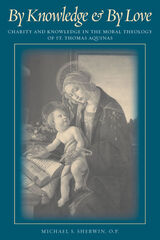
front cover of By knowledge & by love
By knowledge & by love
charity and knowledge in the moral theology of St. Thomas Aquinas
Michael S. Sherwin
Catholic University of America Press, 2005
By Knowledge and By Love represents a major contribution to Thomistic moral theology and philosophy by providing a thoughtful examination of Aquinas' psychology of action and his theology of charity.
[more]


Send via email Share on Facebook Share on Twitter