
 A SCHOLARLY BOOK REPOSITORY
5 start with A start with A

American Studies was first published in 1948. Minnesota Archive Editions uses digital technology to make long-unavailable books once again accessible, and are published unaltered from the original University of Minnesota Press editions.
Although the immediate subject of this book is American Studies, its ultimate concern is with the broad pattern of higher education in the United States. The program of American Studies uses the materials of the American scene to advance a contemporary movement in education, and to modify a tendency of mankind to live predominantly in one of the three tenses: past, present, or future. The movement in education is an attempt to supplement, but not replace, extreme academic specialization with a synthesis of knowledge.
Mr. McDowell, who has made firsthand observation of procedures in more than thirty colleges and universities in all parts of the United States, discusses curriculums and courses in American civilization throughout the country and the American Studies program at the University of Minnesota, which is the most extensive and inclusive existing today. In summing up, he analyzes the relationship of American Studies to regional culture, national loyalty, and world society.
The book is addressed to all who are concerned with American civilization or American education, but most particularly to those concerned with both. The discussion, though dealing chiefly with the liberal arts college and the graduate school, also has relevance for the general public and for high school teachers and administrators in higher education, for college teachers of the social sciences and humanities, and for graduate students and mature undergraduates about to choose a major field or already engaged in a study of American culture.


A forthright look at the future of the discipline in the wake of immense social changes.
What becomes of "national knowledge" in our age of globalization? If dramatic changes in technology, commerce, and social relations are undermining familiar connections between culture and place, what happens to legacies of learning that put the nation at the center of the study of history, culture, language, politics, and geography? In short, what remains of American Studies? At a critical moment, this book offers a richly textured historical perspective on where our notions of national knowledge-and our sense of American Studies-have come from and where they may lead in a future of new ideas about culture and community.
The America that seems to be disappearing before our very eyes is, George Lipsitz argues, actually the cumulative creation of yesterday’s struggles over identity, culture, and power. With examples from statistics and history, poster designs and music lyrics, Lipsitz shows how American Studies has been shaped by the social movements of the 1930s, 1960s, and 1980s. His analysis reveals the sedimented history of social movement contestation contained in contemporary popular music, visual art, and cinema.Finally, Lipsitz identifies the ways in which the globalization of commerce and culture are producing radically new understandings of politics, performance, consumption, knowledge, and nostalgia; the changing realities present not so much a danger as a clear challenge to a still-evolving American Studies-a challenge that this book helps us to confront wisely, flexibly, and effectively. Critical American Studies SeriesAnnouncing a new seriesCritical American Studies George Lipsitz, series editorThis series examines recent trends in American Studies that address fundamental questions about history, culture, social structure, race, gender, sexuality, and citizenship. It examines the forces-including mass migration, global economy, the seeming weaknesses of the nation-state, and ongoing ethnic antagonisms-that compel the field to reexamine the role of culture in producing individual and collective identities.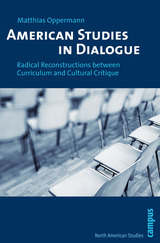
American studies has changed drastically over the past few decades, as a new wave of scholars—armed with groundbreaking ideas and more extensive methods of research—flocked to the relatively young field. This focus on scholarship, though necessary to the advancement of the discipline, has left pedagogy largely ignored. In American Studies in Dialogue, Matthias Oppermann consciously resists the traditional academic split between scholarship and classroom practice. His study calls for a radical reconstruction of American studies grounded in an understanding of cultural analysis and critique as genuinely dialogic processes of research and pedagogy. Drawing on case studies ranging from courses in early American civilization to recent multimedia projects, American Studies in Dialogue will be required reading for American studies scholars and teachers.
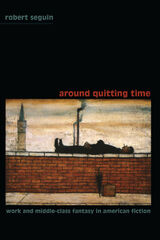
Tracing connections between the reconstruction of the labor process and the aesthetic dilemmas of modernism, between the emergence of the modern state and the structure of narrative, Seguin analyzes the work of Nathanael West, Ernest Hemingway, Willa Cather, John Barth, and others. These fictional narratives serve to demonstrate for Seguin the pattern of social sites and cultural phenomenon that have emerged where work and leisure, production and consumption, and activity and passivity coincide. He reveals how, by creating pathways between these seemingly opposed domains, the middle-class imaginary at once captures and suspends the dynamics of social class and opens out onto a political and cultural terrain where class is both omnipresent and invisible.
Around Quitting Time will interest critics and historians of modern U.S. culture, literary scholars, and those who explore the interaction between economic and cultural forms.
READERS
Browse our collection.
PUBLISHERS
See BiblioVault's publisher services.
STUDENT SERVICES
Files for college accessibility offices.
RECENTLY PUBLISHED






UChicago Accessibility Resources
home | accessibility | search | about | contact us
BiblioVault ® 2001 - 2026
The University of Chicago Press