
 A SCHOLARLY BOOK REPOSITORY
Results by Title
2 books about Sustainable Communities
2 books about Sustainable Communities
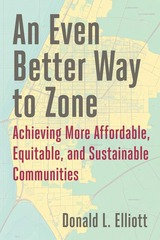
An Even Better Way to Zone
Achieving More Affordable, Equitable, and Sustainable Communities
Don Elliott
Island Press, 2025
Zoning is the tool that everyone loves to hate. It may also be the most important and least understood process affecting how US communities shape the lives of their residents. While almost every community comprehensive plan calls for more affordable, equitable, and sustainable development, zoning is often blamed for preventing that from happening. As US communities face an unprecedented housing affordability crisis, a long history of excluding the poor and disadvantaged from key opportunities, and a continuing climate disaster, zoning needs to change – a lot.
In An Even Better Way to Zone, planning expert Donald L. Elliott explains how outdated assumptions about development and unnecessary barriers in our current zoning regulations have contributed to development patterns that are not sustainable, affordable, or equitable to historically disadvantaged populations. It identifies what types of changes to zoning rules, procedures, and maps could improve outcomes in each of those areas. Importantly, it also helps the reader think through what to do when zoning changes that would improve outcomes for one of those challenges would undermine success in the others.
An Even Better Way to Zone also reorients the zoning discussion towards redevelopment and reuse rather than implicitly focusing on raw land development, because already developed areas represent the vast majority of the built environment where meaningful changes will need to be made. Instead of giving lip service to the importance of infill and reuse, zoning needs to actively remove the barriers that prevent innovative, equitable, and sustainable redevelopment.
With engaging, easy-to-understand prose, Elliott briefly explains the challenges of today’s zoning and then breaks down how this key legal tool can be used to reinvent our communities as places where housing is more affordable, everyone is treated fairly, and we do far less damage to the environment. From fixing zoning rules and incentives to fixing the procedures used to draft, implement, and change zoning, Elliott provides practical, sage advice on adapting zoning to address today’s most critical issues.
In An Even Better Way to Zone, planning expert Donald L. Elliott explains how outdated assumptions about development and unnecessary barriers in our current zoning regulations have contributed to development patterns that are not sustainable, affordable, or equitable to historically disadvantaged populations. It identifies what types of changes to zoning rules, procedures, and maps could improve outcomes in each of those areas. Importantly, it also helps the reader think through what to do when zoning changes that would improve outcomes for one of those challenges would undermine success in the others.
An Even Better Way to Zone also reorients the zoning discussion towards redevelopment and reuse rather than implicitly focusing on raw land development, because already developed areas represent the vast majority of the built environment where meaningful changes will need to be made. Instead of giving lip service to the importance of infill and reuse, zoning needs to actively remove the barriers that prevent innovative, equitable, and sustainable redevelopment.
With engaging, easy-to-understand prose, Elliott briefly explains the challenges of today’s zoning and then breaks down how this key legal tool can be used to reinvent our communities as places where housing is more affordable, everyone is treated fairly, and we do far less damage to the environment. From fixing zoning rules and incentives to fixing the procedures used to draft, implement, and change zoning, Elliott provides practical, sage advice on adapting zoning to address today’s most critical issues.
[more]
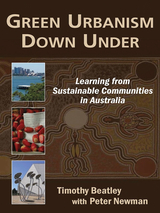
Green Urbanism Down Under
Learning from Sustainable Communities in Australia
Timothy Beatley with Peter Newman
Island Press, 2008
In this immensely practical book, Timothy Beatley sets out to answer a simple question: what can Americans learn from Australians about “greening” city life? Green Urbanism Down Under reports on the current state of “sustainability practice” in Australia and the many lessons that U.S. residents can learn from
the best Australian programs and initiatives.
Australia is similar to the United States in many ways, especially in its “energy footprint.” For example, Australia’s per capita greenhouse gas emissions are second only to those of the United States. A similar percentage of its residents live in cities (85 percent in Australia vs. 80 percent in the United States). And it suffers from parallel problems of air and water pollution, a national dependence on automobiles, and high fossil fuel consumption. Still, after traveling throughout Australia, Beatley finds that there are myriad creative responses to these problems—and that they offer instructive examples for the United States.
Green Urbanism Down Under is a very readable collection of solutions.
Although many of these innovative solutions are little-known outside Australia, they all present practical possibilities for U.S. cities. Beatley describes “green transport” projects, “city farms,” renewable energy plans, green living programs, and much more. He considers a host of public policy initiatives and scrutinizes regional and state planning efforts for answers. In closing, he shares his impressions about how Australian results might be applied to U.S. problems.
This is a unique book: hopeful, constructive, and filled with ideas that have been proven to work. It is a “must read” for anyone who cares about the future of American cities.
the best Australian programs and initiatives.
Australia is similar to the United States in many ways, especially in its “energy footprint.” For example, Australia’s per capita greenhouse gas emissions are second only to those of the United States. A similar percentage of its residents live in cities (85 percent in Australia vs. 80 percent in the United States). And it suffers from parallel problems of air and water pollution, a national dependence on automobiles, and high fossil fuel consumption. Still, after traveling throughout Australia, Beatley finds that there are myriad creative responses to these problems—and that they offer instructive examples for the United States.
Green Urbanism Down Under is a very readable collection of solutions.
Although many of these innovative solutions are little-known outside Australia, they all present practical possibilities for U.S. cities. Beatley describes “green transport” projects, “city farms,” renewable energy plans, green living programs, and much more. He considers a host of public policy initiatives and scrutinizes regional and state planning efforts for answers. In closing, he shares his impressions about how Australian results might be applied to U.S. problems.
This is a unique book: hopeful, constructive, and filled with ideas that have been proven to work. It is a “must read” for anyone who cares about the future of American cities.
[more]
READERS
Browse our collection.
PUBLISHERS
See BiblioVault's publisher services.
STUDENT SERVICES
Files for college accessibility offices.
RECENTLY PUBLISHED




UChicago Accessibility Resources
home | accessibility | search | about | contact us
BiblioVault ® 2001 - 2025
The University of Chicago Press