
 A SCHOLARLY BOOK REPOSITORY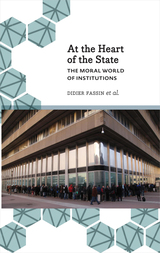
The state is often regarded as an abstract and neutral bureaucratic entity. Against this common sense idea, At the Heart of the State argues that it is also a concrete and situated reality, embodied in the work of its agents and inscribed in the issues of its time.
The result of a five-year investigation conducted by ten scholars, this book describes and analyses the police, the court system, the prison apparatus, the social services, and mental health facilities in France. Combining genealogy and ethnography, its authors show that these state institutions do not simply implement laws, rules and procedures: they mobilise values and affects, judgements and emotions. In other words, they reflect the morality of the state.
Of immense interest to both social scientists and political theorists, this work will make an important contribution to the ever expanding literature on the contemporary state.
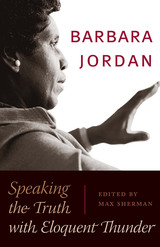
Revered by Americans across the political spectrum, Barbara Jordan was "the most outspoken moral voice of the American political system," in the words of former President Bill Clinton, who awarded her the Presidential Medal of Freedom in 1994. Throughout her career as a Texas senator, U.S. congresswoman, and distinguished professor at the Lyndon B. Johnson School of Public Affairs, Barbara Jordan lived by a simple creed: "Ethical behavior means being honest, telling the truth, and doing what you said you were going to do." Her strong stand for ethics in government, civil liberties, and democratic values still provides a standard around which the nation can unite in the twenty-first century.
This volume brings together several major political speeches that articulate Barbara Jordan's most deeply held values. They include:
- "Erosion of Civil Liberties," a commencement address delivered at Howard University on May 12, 1974, in which Jordan warned that "tyranny in America is possible"
- "The Constitutional Basis for Impeachment," Jordan's ringing defense of the U.S. Constitution before the House Judiciary Committee investigating the Watergate break-in
- Keynote addresses to the Democratic National Conventions of 1976 and 1992, in which Jordan set forth her vision of the Democratic Party as an advocate for the common good and a catalyst of change
- Testimony in the U.S. Congress on the confirmation of Supreme Court nominee Robert Bork and on immigration reform
- Meditations on faith and politics from two National Prayer Breakfasts
- Acceptance speech for the 1995 Sylvanus Thayer Award presented by the Association of Graduates of the United States Military Academy, in which Jordan challenged the military to uphold the values of "duty, honor, country"
Accompanying the speeches are context-setting introductions by volume editor Max Sherman. The book concludes with the eloquent eulogy that Bill Moyers delivered at Barbara Jordan's memorial service in 1996, in which he summed up Jordan's remarkable life and career by saying, "Just when we despaired of finding a hero, she showed up, to give the sign of democracy.... This is no small thing. This, my friends, this is grace. And for it we are thankful."
Americans are increasingly ruled by an unwritten constitution consisting of executive orders, signing statements, and other forms of quasi-law that lack the predictability and consistency essential for the legal system to function properly. As a result, the U.S. Constitution no longer means what it says to the people it is supposed to govern, and the government no longer acts according to the rule of law. These developments can be traced back to a change in “constitutional morality,” Bruce Frohnen and George Carey argue in this challenging book.
The principle of separation of powers among co-equal branches of government formed the cornerstone of America’s original constitutional morality. But toward the end of the nineteenth century, Progressives began to attack this bedrock principle, believing that it impeded government from “doing the people’s business.” The regime of mixed powers, delegation, and expansive legal interpretation they instituted rejected the ideals of limited government that had given birth to the Constitution. Instead, Progressives promoted a governmental model rooted in French revolutionary claims. They replaced a Constitution designed to mediate among society’s different geographic and socioeconomic groups with a body of quasi-laws commanding the democratic reformation of society.
Pursuit of this Progressive vision has become ingrained in American legal and political culture—at the cost, according to Frohnen and Carey, of the constitutional safeguards that preserve the rule of law.

Public trust in corporations plummeted in the wake of the 2008 financial crisis, when “Lehman Brothers” and “General Motors” became dirty words for many Americans. In Corporate Dreams, James Hoopes argues that Americans still place too much faith in corporations and, especially, in the idea of “values-based leadership” favored by most CEOs. The danger of corporations, he suggests, lies not just in their economic power, but also in how their confused and undemocratic values are infecting Americans’ visions of good governance.
Corporate Dreams proposes that Americans need to radically rethink their relationships with big business and the government. Rather than buying into the corporate notion of “values-based leadership,” we should view corporate leaders with the same healthy suspicion that our democratic political tradition teaches us to view our political leaders. Unfortunately, the trend is moving the other way. Corporate notions of leadership are invading our democratic political culture when it should be the reverse.
To diagnose the cause and find a cure for our toxic attachment to corporate models of leadership, Hoopes goes back to the root of the problem, offering a comprehensive history of corporate culture inAmerica, from the Great Depression to today’s Great Recession. Combining a historian’s careful eye with an insider’s perspective on the business world, this provocative volume tracks changes in government economic policy, changes in public attitudes toward big business, and changes in how corporate executives view themselves.
Whether examining the rise of Leadership Development programs or recounting JFK’s Pyrrhic victory over U.S. Steel, Hoopes tells a compelling story of how America lost its way, ceding authority to the policies and values of corporate culture. But he also shows us how it’s not too late to return to our democratic ideals—and that it’s not too late to restore the American dream.
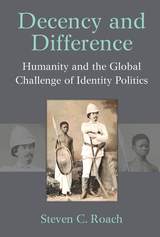
Decency remains one of the most prevalent yet least understood terms in today’s political discourse. In evoking respect, kindness, courage, integrity, reason, and tolerance, it has long expressed an unquestioned duty and belief in promoting and protecting the dignity of all persons. Today this unquestioned belief is in crisis. Tribalism and identity politics have both hindered and threatened its moral stability and efficacy. Still, many continue to undertheorize its political character by isolating it from the effects of identity politics. Decency and Difference argues that decency is a primary source of the political tension that has long shaped the struggles for power, identity, and justice in the global arena. It distinguishes among basic, conservative, and liberal strands of decency to critically examine the many conflicting and competing applications of decency in global politics. Together these different strands reflect a long and uneven evolution from the British and American empires to a global network of justice. This powerful book exposes the gaps of decency and the disparate ways it is practiced, thus addressing the global challenge of configuring a diverse political ethic of decency.
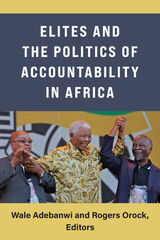
Elites and the Politics of Accountability in Africa examines the ways that accountability offers an effective interpretive lens to the social, cultural, and institutional struggles of both the elites and ordinary citizens in Africa. Each chapter investigates questions of power, its public deliberation, and its negotiation in Africa by studying elites through the framework of accountability. The book enters conversations about political subjectivity and agency, especially from ongoing struggles around identities and belonging, as well as representation and legitimacy. Who speaks to whom? And on whose behalf do they speak? The contributors to this volume offer careful analyses of how such concerns are embedded in wider forms of cultural, social, and institutional discussions about transparency, collective responsibility, community, and public decision-making processes. These concerns affect prospects for democratic oversight, as well as questions of alienation, exclusivity, privilege and democratic deficit. The book situates our understanding of the emergence, meaning, and conceptual relevance of elite accountability, to study political practices in Africa. It then juxtaposes this contextualization of accountability in relation to the practices of African elites. Elites and the Politics of Accountability in Africa offers fresh, dynamic, and multifarious accounts of elites and their practices of accountability and locally plausible self-legitimation, as well as illuminating accounts of contemporary African elites in relation to their socially and historicallysituated outcomes of contingency, composition, negotiation, and compromise.
Remer’s study is distinct from other works on political morality in that it turns to Cicero, not Aristotle, as the progenitor of an ethical rhetorical perspective. Contrary to many, if not most, studies of Cicero since the mid-nineteenth century, which have either attacked him as morally indifferent or have only taken his persuasive ends seriously (setting his moral concerns to the side), Ethics and the Orator demonstrates how Cicero presents his ideal orator as exemplary not only in his ability to persuade, but in his capacity as an ethical person. Remer makes a compelling case that Ciceronian values—balancing the moral and the useful, prudential reasoning, and decorum—are not particular only to the philosopher himself, but are distinctive of a broader Ciceronian rhetorical tradition that runs through the history of Western political thought post-Cicero, including the writings of Quintilian, John of Salisbury, Justus Lipsius, Edmund Burke, the authors of The Federalist, and John Stuart Mill.
Combining ethnographic fieldwork in the city of Kupang with an acute historical sensibility, Sylvia Tidey shows how good governance initiatives paradoxically perpetuate civil service corruption while also facilitating the emergence of new forms of it. Importing critical insights from the anthropology of ethics to the burgeoning anthropology of corruption, Tidey exposes enduring developmentalist fallacies that treat corruption as endemic to non-Western subjects. In practice, it is often indistinguishable from the ethics of care and exchange, as Indonesian civil servants make worthwhile lives for themselves and their families. This book will be a vital text for anthropologists and other social scientists, particularly scholars of global studies, development studies, and Southeast Asia.

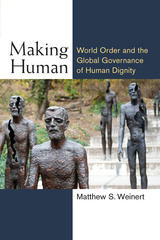
The editors argue that ideas about humanity find concrete expression in the governing work that operationalizes those ideas to produce order, prosperity, and security. As a site of governance, humanity appears as both an object of care and a source of anxiety. Assertions that humanity is being threatened, whether by environmental catastrophe or political upheaval, provide a justification for the elaboration of new governing techniques. At the same time, humanity itself is identified as a threat (to nature, to nation, to global peace) which governance must contain. These apparently contradictory understandings of the relation of threat to the category of humanity coexist and remain in tension, helping to maintain the dynamic co-production of governance and humanity.
Contributors. Arun Agrawal, Joao Biehl , Didier Fassin, Allen Feldman, Ilana Feldman, Rebecca Hardin, S. Lochann Jain, Liisa Malkki, Adriana Petryna, Miriam Ticktin, Richard Ashby Wilson, Charles Zerner
Human beings have lived by very different conceptions of the good life. In this book, Stuart Hampshire argues that no individual and no modern society can avoid conflicts between incompatible moral interests. Philosophers have tried in the past to find some underlying moral idea of justice which could resolve these conflicts and would be valid for any society. Hampshire claims that there can be no such thing. States can be held together, and war between them avoided, only by respect for the political process itself, and it is in these terms that justice must be defined.
The book closely examines the critical relationship between morality and justice, paying particular attention to Hume's moral subjectivism (which Hampshire disputes) and proposing a reply to Machiavelli's claim that the realities of politics inevitably oblige leaders to choose between unavoidable evils.
Most academic and moral philosophy, Hampshire argues, has been a fairy tale, representing ideals of private innocence rather than the realities of public experience. Conflicts between incompatible moral interests are as unavoidable in social and international arenas as they are in the lives of individuals. Philosophers, politicians, and theologians have all looked for an underlying moral consensus that will be valid for any just society. But the diversity of the human species and important differences in how various cultures define the good life militate against the formation of any such consensus. Ultimately, conflicts can be mediated only by respect for procedural justice.
Hampshire believes that themes of moral philosophy come from the writer's own experience, and he has given a brief but compelling account of his own life to help the reader understand the sources of his philosophy. Combining intellectual rigor with imaginative power, in Innocence and Experience Stuart Hampshire vividly illuminates the tensions between justice and other sources of value in society and in the life of the individual.

In Just Results, Ralph E. Ellis provides an authoritative solution to one of the major problems in the field of public policy. Until now, analysts and planners have had no practical or accurate means of incorporating qualitative social concerns into the traditional quantitative formulas used in policymaking. By introducing a justice factor—a quantitative measure for social values—Ellis opens the door for more balanced policy decisions.
Using concrete, real-world examples, Ellis shows how policy analysts can better account for the use value—or practical measurable utility—of universally agreed-upon social benefits such as life, health, safety, and environmental preservation when making cost-benefit analyses. In this way, policymakers, and by extension, society as a whole, can avoid making unjust tradeoffs between important social values and comparatively frivolous economic benefits.
Drawing on philosophical works on justice from Kant through John Rawls, this book is informed by a theoretical defense of distributive justice that emphasizes diminishing marginal utility, thus favoring the poor. Just Results is a stimulating and highly applicable book that will be of great interest to philosophers, political scientists, policy analysts and planners.

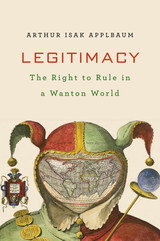
At an unsettled time for liberal democracy, with global eruptions of authoritarian and arbitrary rule, here is one of the first full-fledged philosophical accounts of what makes governments legitimate.
What makes a government legitimate? The dominant view is that public officials have the right to rule us, even if they are unfair or unfit, as long as they gain power through procedures traceable to the consent of the governed. In this rigorous and timely study, Arthur Isak Applbaum argues that adherence to procedure is not enough: even a properly chosen government does not rule legitimately if it fails to protect basic rights, to treat its citizens as political equals, or to act coherently.
How are we to reconcile every person’s entitlement to freedom with the necessity of coercive law? Applbaum’s answer is that a government legitimately governs its citizens only if the government is a free group agent constituted by free citizens. To be a such a group agent, a government must uphold three principles. The liberty principle, requiring that the basic rights of citizens be secured, is necessary to protect against inhumanity, a tyranny in practice. The equality principle, requiring that citizens have equal say in selecting who governs, is necessary to protect against despotism, a tyranny in title. The agency principle, requiring that a government’s actions reflect its decisions and its decisions reflect its reasons, is necessary to protect against wantonism, a tyranny of unreason.
Today, Applbaum writes, the greatest threat to the established democracies is neither inhumanity nor despotism but wantonism, the domination of citizens by incoherent, inconstant, and incontinent rulers. A government that cannot govern itself cannot legitimately govern others.
To recover that language, Fraistat turns to three prominent philosophers—Plato, Jean-Jacques Rousseau, and William Godwin—who illuminate the varied ways caring language and caring values have structured core debates in the history of Western political thought about the proper role of government, as well as the rights and responsibilities of citizens. The Liberalism of Care presents a distinctive vision for our liberal politics where political communities and citizens can utilize the ethic and practices of care to face practical challenges.
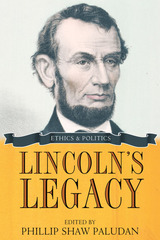
The four new essays in Lincoln's Legacy describe major ethical problems that the sixteenth president navigated what can be learned from how he did so. The distinguished and award-winning Lincoln scholars William Miller, Mark E. Neely Jr., Phillip Shaw Paludan, and Mark Summers describe Lincoln’s attitudes and actions during encounters with questions of politics, law, constitutionalism, patronage, and democracy. The remarkably focused essays include an assessment of Lincoln's virtues in the presidency, the first study on Lincoln and patronage in more than a decade, a challenge to the cliché of Lincoln the democrat, and a study of habeas corpus, Lincoln, and state courts. On the eve of the bicentennial celebration of Lincoln’s birth, Lincoln’s Legacy highlights his enduring importance in contemporary conversations about law, politics, and democracy.

Allan Gilbert is unquestionably the most accurate and reliable translator of Machiavelli into English; the publication of this edition is an altogether happy occasion. Students of the history of political thought owe a particular debt of gratitude to Allan Gilbert.”—Dante Germino, The Journal of Politics
“A most remarkable achievement.”—Felix Gilbert, Renaissance Quarterly
Allan Gilbert is unquestionably the most accurate and reliable translator of Machiavelli into English; the publication of this edition is an altogether happy occasion. Students of the history of political thought owe a particular debt of gratitude to Allan Gilbert.”—Dante Germino, The Journal of Politics
“A most remarkable achievement.”—Felix Gilbert, Renaissance Quarterly
Allan Gilbert is unquestionably the most accurate and reliable translator of Machiavelli into English; the publication of this edition is an altogether happy occasion. Students of the history of political thought owe a particular debt of gratitude to Allan Gilbert.”—Dante Germino, The Journal of Politics
“A most remarkable achievement.”—Felix Gilbert, Renaissance Quarterly
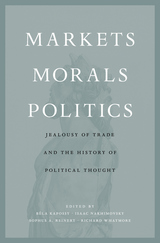
When István Hont died in 2013, the world lost a giant of intellectual history. A leader of the Cambridge School of Political Thought, Hont argued passionately for a global-historical approach to political ideas. To better understand the development of liberalism, he looked not only to the works of great thinkers but also to their reception and use amid revolution and interstate competition. His innovative program of study culminated in the landmark 2005 book Jealousy of Trade, which explores the birth of economic nationalism and other social effects of expanding eighteenth-century markets. Markets, Morals, Politics brings together a celebrated cast of Hont’s contemporaries to assess his influence, ideas, and methods.
Richard Tuck, John Pocock, John Dunn, Raymond Geuss, Gareth Stedman Jones, Michael Sonenscher, John Robertson, Keith Tribe, Pasquale Pasquino, and Peter N. Miller contribute original essays on themes Hont treated with penetrating insight: the politics of commerce, debt, and luxury; the morality of markets; and economic limits on state power. The authors delve into questions about the relationship between states and markets, politics and economics, through examinations of key Enlightenment and pre-Enlightenment figures in context—Hobbes, Rousseau, Spinoza, and many others. The contributors also add depth to Hont’s lifelong, if sometimes veiled, engagement with Marx.
The result is a work of interpretation that does justice to Hont’s influence while developing its own provocative and illuminating arguments. Markets, Morals, Politics will be a valuable companion to readers of Hont and anyone concerned with political economy and the history of ideas.
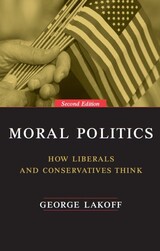
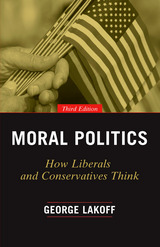
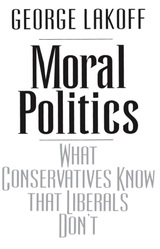
Lakoff reveals radically different but remarkably consistent conceptions of morality on both the left and right. Moral worldviews, like most deep ways of understanding the world, are unconscious—part of our “hard-wired” brain circuitry. When confronted with facts that don’t fit our moral worldview, our brains work automatically and unconsciously to ignore or reject these facts, and it takes extraordinary openness and awareness of this phenomenon to pay critical attention to the vast number of facts we are presented with each day. For this new edition, Lakoff has added a new preface and afterword, extending his observations to major ideological conflicts since the book's original publication, from the Affordable Care Act to the wars in Iraq and Afghanistan, the recent financial crisis, and the effects of global warming. One might have hoped such massive changes would bring people together, but the reverse has actually happened; the divide between liberals and conservatives has become stronger and more virulent.
To have any hope of bringing mutual respect to the current social and political divide, we need to clearly understand the problem and make it part of our contemporary public discourse. Moral Politics offers a much-needed wake-up call to both the left and the right.
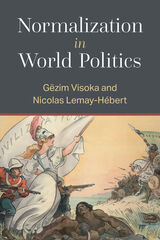
This book traces main discourses and practices associated with normalcy in world politics. Visoka and Lemay-Hébert mostly focus on how dominant states and international organizations try to manage global affairs through imposing normalcy over fragile states, restoring normalcy over disaster-affected states, and accepting normalcy over suppressive states. They show how discourses and practices come together in constituting normalization interventions and how in turn they play in shaping the dynamics of continuity and change in world politics.

The seven deadly sins of Christianity represent the abysses of character, whereas Judith Shklar’s “ordinary vices”—cruelty, hypocrisy, snobbery, betrayal, and misanthropy—are merely treacherous shoals, flawing our characters with mean-spiritedness and inhumanity.
Shklar draws from a brilliant array of writers—Molière and Dickens on hypocrisy, Jane Austen on snobbery, Shakespeare and Montesquieu on misanthropy, Hawthorne and Nietzsche on cruelty, Conrad and Faulkner on betrayal—to reveal the nature and effects of the vices. She examines their destructive effects, the ambiguities of the moral problems they pose to the liberal ethos, and their implications for government and citizens: liberalism is a difficult and challenging doctrine that demands a tolerance of contradiction, complexity, and the risks of freedom.
What is the best possible society? How would its rulers govern and its citizens behave? Such questions are sometimes dismissed as distractions from genuine political problems, but in an era when political idealism seems a relic of the past, says Jonny Thakkar, they are more urgent than ever. A daring experiment in using ancient philosophy to breathe life into our political present, Plato as Critical Theorist takes seriously one of Plato’s central claims: that philosophers should rule. What many accounts miss is the intimate connection between Plato’s politics and his metaphysics, Thakkar argues. Philosophy is the activity of articulating how parts and wholes best fit together, while ruling is the activity that shapes the parts of society into a coherent whole conducive to the good life. Plato’s ideal society is thus one in which ideal theory itself plays a leading role.
Today’s liberal democracies require not philosopher-kings legislating from above but philosopher-citizens willing to work toward a vision of the best society in their daily lives. Against the claim that such idealism is inherently illiberal, Thakkar shows that it is fully compatible with the liberal theories of both Popper and Rawls while nevertheless pushing beyond them in providing a new vantage point for the Marxian critique of capitalism.
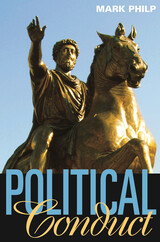
This book explores how the processes and practices of politics shape political values, such as liberty, justice, equality, and democracy. Mining the history of political episodes and political thinkers, including Caesar and Machiavelli, Mark Philp argues that it is through political activity that "values are articulated and embraced, and they become powerful motivating forces."
Political Conduct is thus an attempt to inform and enrich political theory--to show that its principles would be more relevant to actual politics if they were immersed in history and practice. Philp argues for a separation between moral and political philosophy and proposes that a less abstract and ideal approach to political philosophy than that provided by Rawls, Dworkin, Nagel, and Cohen would be more useful in illuminating the conduct of politicians and the limitations on what they can achieve.
Are public officials morally justified in threatening violence, engaging in deception, or forcing citizens to act for their own good? Can individual officials be held morally accountable for the wrongs that governments commit? Dennis Thompson addresses these questions by developing a conception of political ethics that respects the demands of both morality and politics. He criticizes conventional conceptions for failing to appreciate the difference democracy makes, and for ascribing responsibility only to isolated leaders or to impersonal organizations. His book seeks to recapture the sense that men and women, acting for us and together with us in a democratic process, make the moral choices that govern our public life.
Thompson surveys ethical conflicts of public officials over a range of political issues, including nuclear deterrence, foreign intervention, undercover investigation, bureaucratic negligence, campaign finance, the privacy of officials, health care, welfare paternalism, drug and safety regulation, and social experimentation. He views these conflicts from the perspectives of many different kinds of public officials—elected and appointed executives at several levels of government, administrators, judges, legislators, governmental advisers, and even doctors, lawyers, social workers, and journalists whose professional roles often thrust them into public life.
In clarifying the ethical problems faced by officials, Thompson combines theoretical analysis with practical prescription, and begins to define a field of inquiry for which many have said there is a need but to which few have yet contributed. Philosophers, political scientists, policy analysts, sociologists, lawyers, and other professionals interested in ethics in government will gain insight from this book.
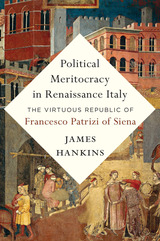
The first full-length study of Francesco Patrizi—the most important political philosopher of the Italian Renaissance before Machiavelli—who sought to reconcile conflicting claims of liberty and equality in the service of good governance.
At the heart of the Italian Renaissance was a longing to recapture the wisdom and virtue of Greece and Rome. But how could this be done? A new school of social reformers concluded that the best way to revitalize corrupt institutions was to promote an ambitious new form of political meritocracy aimed at nurturing virtuous citizens and political leaders.
The greatest thinker in this tradition of virtue politics was Francesco Patrizi of Siena, a humanist philosopher whose writings were once as famous as Machiavelli’s. Patrizi wrote two major works: On Founding Republics, addressing the enduring question of how to reconcile republican liberty with the principle of merit; and On Kingship and the Education of Kings, which lays out a detailed program of education designed to instill the qualities necessary for political leadership—above all, practical wisdom and sound character.
The first full-length study of Patrizi’s life and thought in any language, Political Meritocracy in Renaissance Italy argues that Patrizi is a thinker with profound lessons for our time. A pioneering advocate of universal literacy who believed urban planning could help shape civic values, he concluded that limiting the political power of the wealthy, protecting the poor from debt slavery, and reducing the political independence of the clergy were essential to a functioning society. These ideas were radical in his day. Far more than an exemplar of his time, Patrizi deserves to rank alongside the great political thinkers of the Renaissance: Machiavelli, Thomas More, and Jean Bodin.
Goodin—a political scientist who is also an associate editor of Ethics—shows that empirical and ethical theory can and should guide policy. To be useful, however, these philosophical discussions of public affairs must draw upon actual policy experiences rather than contrived cases. Further, they must reflect the broader social consequences of policies rather than just the dilemmas of personal conscience.
Effectively integrating the literatures of social science, policy science, and philosophy, Goodin provides a theoretically sophisticated yet empirically well-grounded analysis of public policies, the principles underlying them, the institutions shaping them, and the excuses offered for their failures. This analysis is enhanced by the author's discussion of such specific cases as the disposal of nuclear wastes and the priority accorded national defense—cases that illustrate Goodin's theoretical and methodological framework for approaching policy issues.

In our time, we require a religion, ethics, and politics adequate to confront the global crises we face. In our scientific era of “progress,” we might expect to look with confidence to the “scientific” disciplines of political science, sociology, and economics to solve the problems of our civilization. We might also look to the older disciplines of religion and ethics to determine our values and to tell us what we ought to do. But the sad truth is that the dominant paradigms, methods, and conclusions of the social sciences and humanities are inadequate to this task. We need a new “politics of compassion and transformation.”

This revised edition of Mansfield's acclaimed translation features an updated bibliography, a substantial glossary, an analytic introduction, a chronology of Machiavelli's life, and a map of Italy in Machiavelli's time.
"Of the other available [translations], that of Harvey C. Mansfield makes the necessary compromises between exactness and readability, as well as providing an excellent introduction and notes."—Clifford Orwin, The Wall Street Journal
"Mansfield's work . . . is worth acquiring as the best combination of accuracy and readability."—Choice
"There is good reason to assert that Machiavelli has met his match in Mansfield. . . . [He] is ready to read Machiavelli as he demands to be read—plainly and boldly, but also cautiously."—John Gueguen, The Sixteenth Century Journal
John Dewey delivered two sets of related lectures at the University of Chicago in the fall quarter 1895 and the spring quarter 1896. Designed for graduate students, the lectures show the birth of Dewey’s instrumentalist theory of inquiry in its application to ethical and political thinking.
From 1891 through 1903, Dewey attempted to develop a revolutionary experimentalist approach to ethical inquiry, designed to replace the more traditional ways of moral theorizing that relied on the fixed moral knowledge given in advance of the situations in which they were applied. In the lectures on the logic of ethics, he sets forth and defends the view that the "is" in a moral judgment such as "This is good" is a coordinating factor in an inquiry. Although the subject matter of the lectures is highly technical, its significance is paramount. It provides the key to and opens the door for a theory that preserves the difference between strictly scientific inquiry and moral inquiry even while it provides a "scientific treatment" of the latter.

The essays in Public Affairs reflect on a number of sex scandals while emphasizing the Clinton/Lewinsky affair, certainly the most avidly followed and momentous sex scandal in American political history. Leading scholars situate contemporary public affairs in the context not only of earlier sex scandals in American politics (such as Thomas Jefferson’s and Sally Hemings’s affair), but also of more purely political scandals (including Teapot Dome and Watergate) and sex scandals centered around public figures other than politicians (such as the actor Hugh Grant and the minister Jimmy Swaggart). Some essays consider the Clinton affair in light of feminist and anti-racist politics, while others discuss the dynamics of scandals as major media events. By charting a critical path through the muck of scandal rather than around it, Public Affairs illuminates why sex scandals have become such a prominent feature of American public life.
Contributors. Paul Apostolidis, Jodi Dean, Joshua Gamson, Theodore J. Lowi, Joshua D. Rothman, George Shulman, Anna Marie Smith, Jeremy Varon, Juliet A. Williams

Seeking a morality based on actual experience, Held offers a method of inquiry with which to deal with the specific moral problems encountered in daily life. She argues that the division between public and private morality is misleading and shows convincingly that moral judgment should be contextual. She maps out different approaches and positions for various types of issues, including membership in a state, legal decisions, political activities, economic transactions, interpersonal relations, diplomacy, journalism, and determining our obligation to future generations. Issues such as these provide the true test of moral theory, since its success is seen in the willingness of conscientious persons to commit themselves to it by acting on it in their daily lives.
Although the linking of "ethics" and "politics" may seem more like the ingredients for a comedian's monologue, it is a sober issue and one that affects every American—especially when it comes to state politics, where the cynical might say ethics can never survive. To find examples of the latest corruption du jour, all one has to do is turn to the newspaper, or switch on the local newscast (think Illinois and New Jersey).
Scandals have been ubiquitous since the beginning of the Republic, but it wasn't until 1954 that ethical self-regulation began to move legislatively beyond bribery statutes to address deeper issues—those which, in New York Governor Thomas Dewey's words, skulked in the "shadowlands of conduct." Rosenson begins her exploration with that moment when New York became the first state to enact a general ethics law, setting standards and guidelines for behavior. Unforgiving and illuminating, she examines the many laws that have been enacted since and the reasons that many of these law came into being.
It is crucial to the functioning of a democratic government to understand how and why ethics laws vary across legislatures, and it is surprising to discover that many states have become far more stringent than the U.S. Congress in laws and regulations. Using both qualitative historical sources and rigorous statistical analysis, Rosenson examines when and why, from 1954 to the present, legislators have enacted ethics laws that seem to threaten their own well-being. Among the economic, political, and institutional factors considered that have helped or hindered the passage of these laws, the most consistent was pure scandal, abetted by the media. To have good government, one must be able to trust it, and this book can help all citizens understand and find their way out of the shadowlands into the light.
A political philosopher dissects the duties and dilemmas of the unelected spokesperson, from Martin Luther King, Jr., to Greta Thunberg.
Political representation is typically assumed to be the purview of formal institutions and elected officials. But many of the people who represent us are not senators or city councilors—think of Martin Luther King, Jr., or Malala Yousafzai or even a neighbor who speaks up at a school board meeting. Informal political representatives are in fact ubiquitous, often powerful, and some bear enormous responsibility. In Speaking for Others, political philosopher Wendy Salkin develops the first systematic conceptual and moral analysis of informal political representation.
Salkin argues that informal representation can be a political lifeline, particularly for oppressed and marginalized groups that are denied representation in formal political institutions. Yet informal political representatives exert outsized influence over the ways these groups’ interests are understood by the public, without the represented having much recourse to hold them accountable. And many informal political representatives are selected not by the groups they represent but by outsiders, sticking these groups with representatives they would not choose but cannot shake. The role of informal political representatives is therefore fraught with moral questions. What exactly are their duties and to whom are they owed? Should they be members of the groups they represent? When is informal representation permissible and when is it best avoided?
Informal political representation is taking place all around us. In fact, you yourself may be an informal political representative without knowing it. Speaking for Others explores the tensions central to this pervasive yet underexamined practice, bringing light to both its perils and its promise.
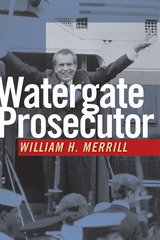
DC. Both of these crimes were eventually traced back to the "plumbers unit," which was directed by John Ehrlichman, President Nixon's top domestic aide. As he convincingly recounts, Merrill sought the job as Assistant Special Prosecutor for one reason: to bring these criminals to justice. In addition, as this revelatory account makes clear, he pursued that goal tenaciously.

During the oppressive reign of Louis XIV, Gabrielle Suchon (1632–1703) was the most forceful female voice in France, advocating women’s freedom and self-determination, access to knowledge, and assertion of authority. This volume collects Suchon’s writing from two works—Treatise on Ethics and Politics (1693) and On the Celibate Life Freely Chosen; or, Life without Commitments (1700)—and demonstrates her to be an original philosophical and moral thinker and writer.
Suchon argues that both women and men have inherently similar intellectual, corporeal, and spiritual capacities, which entitle them equally to essentially human prerogatives, and she displays her breadth of knowledge as she harnesses evidence from biblical, classical, patristic, and contemporary secular sources to bolster her claim. Forgotten over the centuries, these writings have been gaining increasing attention from feminist historians, students of philosophy, and scholars of seventeenth-century French literature and culture. This translation, from Domna C. Stanton and Rebecca M. Wilkin, marks the first time these works will appear in English.
READERS
Browse our collection.
PUBLISHERS
See BiblioVault's publisher services.
STUDENT SERVICES
Files for college accessibility offices.
RECENTLY PUBLISHED






UChicago Accessibility Resources
home | accessibility | search | about | contact us
BiblioVault ® 2001 - 2024
The University of Chicago Press