front cover of Alternatives to Democracy in Twentieth-Century Europe
Alternatives to Democracy in Twentieth-Century Europe
Collectivist Visions of Modernity
Sabrina P. Ramet
Central European University Press, 2019
Alternatives to Democracy in Twentieth-Century Europe examines the historical examples of Soviet Communism, Italian Fascism, German Nazism, and Spanish Anarchism, suggesting that, in spite of their differences, they had some key features in common, in particular their shared hostility to individualism, representative government, laissez faire capitalism, and the decadence they associated with modern culture. But rather than seeking to return to earlier ways of working these movements and regimes sought to design a new future – an alternative future – that would restore the nation to spiritual and political health. The Fascists, for their part, specifically promoted palingenesis, which is to say the spiritual rebirth of the nation. 
The book closes with a long epilogue, in which Ramet defends liberal democracy, highlighting its strengths and advantages. In this chapter, the author identifies five key choke points, which would-be authoritarians typically seek to control, subvert, or instrumentalize: electoral rules, the judiciary, the media, hate speech, and surveillance, and looks at the cases of Viktor Orbán’s Hungary, Jarosław Kaczyński’s Poland, and Donald Trump’s United States.
[more]

front cover of Anti-fascism in European History
Anti-fascism in European History
From the 1920s to Today
Jože Pirjevec
Central European University Press, 2023

The increasing radicalization of political life in most countries in Europe lends special relevance to studies of the antifascist legacies on the continent. This insightful collection of essays is an in-depth review of antifascism in Slovenia, setting it in the context of related movements elsewhere in Europe. The period treated by the 19 essays comprises the interwar period, World War Two, and the post-war decades. The comparative and transnational perspectives advanced by the volume change our understanding of antifascism.

The essays deal with the right-wing but also left-wing instrumentalization of antifascism, with a particular focus on the communist and post-communist periods. The authors point out that antifascism comes in various strains, whether inspired by liberalism, social democracy, communism, monarchism, anarchism, or even Christian conservatism. The contributors bring to light several overlooked antifascist actors, campaigns, and organisations, mostly in Slovenia and the Adriatic area.
[more]

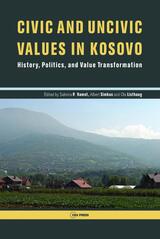
front cover of Civic and Uncivic Values in Kosovo
Civic and Uncivic Values in Kosovo
History, Politics, and Value Transformation
Albert Simkus
Central European University Press, 2015
This volume is driven by the conviction that the key to the establishment of stable liberal democracy anywhere in the world and, in this case, in Kosovo lies in the completion of three interrelated tasks: first, the creation of effective political institutions, based on the principle of the separation of powers (including the independence of the judiciary); second, the promotion of the rule of law; and, third, the promotion of civic values, including tolerance or ethnic/religious/sexual minorities, trust, and respect for the harm principle. In fact, there are problems across all three measures, including with judicial independence, with the rule of law, and with civic values. On the last of these, research findings show that the citizens of Kosovo rank extremely low on trust of other citizens, low on engagement in social organizations, and tolerance of gays, lesbians, and atheists, but high on trust in the political institutions of their country and in pride of their newly independent state.
[more]

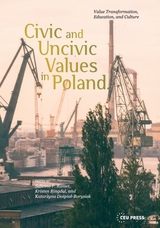
front cover of Civic and Uncivic Values in Poland
Civic and Uncivic Values in Poland
Value Transformation, Education, and Culture
Kristen Ringdal
Central European University Press, 2019
Poland, like many societies across the world, is becoming more polarized in diverse areas of life, as contending forces seek to advance incompatible agendas. The polarization over values in Polish politics was evident already before communism collapsed but became more obvious in the following years and reached a crescendo after the October 2015 parliamentary elections, which brought a right-wing party into power. This volume focuses on the years since 1989, looking at the clash between civic values (the rule of law, individual rights, tolerance, respect for the harm principle, equality, and neutrality of the state in matters of religion) and uncivic values (the rule of a dictator or dictatorial party, contempt for individual rights, bigotry, disrespect for the harm principle, unequal treatment of people whether through discrimination or through exploitation, and state favoritism of one religion over others). The authors address voting behavior, political parties, anti-Semitism, homophobia, the role of the Catholic Church, and reflections in history textbooks, fi lm, and even rock music. This volume makes clear that for the foreseeable future the conflict in Poland between traditional, conservative values and liberal, civic values is likely to continue, provoking tensions and protests.
[more]

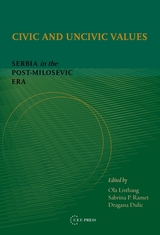
front cover of Civic and Uncivic Values
Civic and Uncivic Values
Serbia in the Post-Miloševic Era
Dragana Dulic
Central European University Press, 2011
Discusses Serbia’s struggle for democratic values after the fall of the Miloševic regime provoked by the NATO war, and after the trauma caused by the secession of Kosovo. Are the value systems of the post-Miloševic era true stumbling blocks of a delayed transition of this country? Seventeen contributors from Norway, Serbia, Italy, Germany, Poland and some other European countries covered a broad range of topics in order to provide answers to this question. The subjects of their investigations were national myths and symbols, history textbooks, media, film, religion, inter-ethnic dialogue, transitional justice, political party agendas and other related themes. The authors of the essays represent different scholarly disciplines whose theoretical conceptions and frameworks are employed in order to analyze two alternative value systems in Serbia: liberal, cosmopolitan and civic on the one hand, and traditional, provincial, nationalist on the other.
[more]


Send via email Share on Facebook Share on Twitter