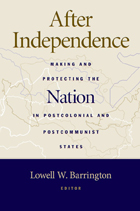
front cover of After Independence
After Independence
Making and Protecting the Nation in Postcolonial and Postcommunist States
Lowell W. Barrington, Ed.
University of Michigan Press, 2006
The majority of the existing work on nationalism has centered on its role in the creation of new states. After Independence breaks new ground by examining the changes to nationalism after independence in seven new states. This innovative volume challenges scholars and specialists to rethink conventional views of ethnic and civic nationalism and the division between primordial and constructivist understandings of national identity.

"Where do nationalists go once they get what they want? We know rather little about how nationalist movements transform themselves into the governments of new states, or how they can become opponents of new regimes that, in their view, have not taken the self-determination drive far enough. This stellar collection contributes not only to comparative theorizing on nationalist movements, but also deepens our understanding of the contentious politics of nationalism's ultimate product--new countries."
--Charles King, Chair of the Faculty and Ion Ratiu Associate Professor, Georgetown University School of Foreign Service

"This well-integrated volume analyzes two important variants of nationalism-postcolonial and postcommunist-in a sober, lucid way and will benefit students and scholars alike."
--Zvi Gitelman, University of Michigan


Lowell W. Barrington is Associate Professor of Political Science, Marquette University.

[more]

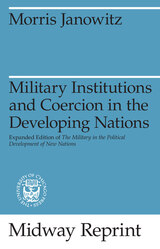
front cover of Military Institutions and Coercion in the Developing Nations
Military Institutions and Coercion in the Developing Nations
The Military in the Political Development of New Nations
Morris Janowitz
University of Chicago Press, 1988
This book includes Janowitz's seminal work, The Military in the Political Development of New Nations, with additional new analysis of Latin American nations and of the increasing significance of paramilitary and police forces in authoritarian regimes in developing nations.
[more]

logo for Harvard University Press
New States in the Modern World
Martin L. Kilson
Harvard University Press, 1975

New States in the Modern World is probably the first book to consider new states in relationship to their effect on world political order. This volume of original essays focuses on the origins and current status of the new African states and one Arab-African state, Egypt.

Despite their many distinguishing features, the new nations all have in common the colonial experience, which has formulated their major political attributes. The eminent authors of these studies describe the structural problems of new states, particularly the role of ideology, the patterns of internal conflict, and the character of political cleavages. Of special concern are the ways in which international organization induced the formation of new states and, conversely, the impact the new nations have had on the international system. The resulting conflicts require redefinition of the international order, a new kind of regulation. This book takes a major step on the road to such redefinition.

[more]


Send via email Share on Facebook Share on Twitter