
 A SCHOLARLY BOOK REPOSITORY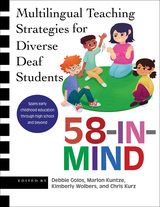
Each chapter is written by a team of researchers and P–12 teachers with at least one Deaf coauthor. With seventy-five percent of the authors being Deaf, this is the first teaching methods book to harness the expertise of Deaf professionals at this level, highlighting their vital role in Deaf education and in shaping inclusive and effective learning environments. This book meets the need for a resource that recognizes the diversity of Deaf students by creating space in the classroom to honor their home/heritage languages, cultures, races, genders, abilities, hearing levels, and other multiple and intersecting identities. Written in a conversational tone, the book includes core recommendations for instruction of the targeted subject area, examples of key strategies, lessons and real stories from those working in the field, suggestions for practice, and recommended resources.
“58-IN-MIND” in the title refers to the version of the ASL sign "stick" that is made on the forehead, which is equivalent to the English idiom “to stick in one's mind.” As in, when students learn in a culturally responsive manner, the learning is likely to stick. The title also alludes indirectly to the collective aspirations of the chapter authors that the practices discussed in the book will also stick in the readers’ minds, and thus have a transformative impact on the way Deaf students are taught.
The chapters in this volume demonstrate that teaching effective communication skills to all students in ways that recognize the needs of multiple language users requires a shift in perspective that approaches multilingualism as an opportunity that is enhanced by the internationalization of higher education because it makes transparent the problems of current structures and disciplinary approaches in accessing those opportunities. A goal of this collection is to address the economic, structural, disciplinary, and pedagogical challenges of making this type of shift in bold and compassionate ways.
Chapters are organized into these four parts--Program-Level Challenges and Opportunities, Opportunities for Enhancing Teacher Training, Multilingualism and the Revision of First-Year Writing, and Integrating Writing Center Insights—and reflect the perspectives of a variety of university language settings. The contributions feature collaborative models and illustrate the need to rethink structures, pedagogies, assessment/evaluation processes, and teacher training for graduate and undergraduate students who will teach writing and other forms of communication.
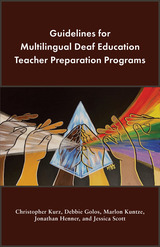
The key goals and anticipated outcomes of this volume are:
- to increase the number of multilingual Deaf education teacher preparation programs;
- to increase the number of fluent language and cultural models for Deaf children in varying educational environments;
- to increase the number of high quality teachers with competencies in multilingual strategies;
- to increase collaboration between teacher training programs; and
- to increase research and professional development focused in multilingual pedagogies.

This longitudinal qualitative study follows Morgan and Leo through their undergraduate careers, collecting rich ethnographic data across private, academic, and digital spaces. The resulting theoretical framework conceptualizes multilingual writing as simultaneously strategic, agentive, creative, diffused, contingent, and messy—a phenomenon shaped by dynamic interplay between ephemeral encounters and established practices. Employing chronotopic figuring as a methodological tool, Wang illuminates aspects of multilingual writing often elided in research: fleeting encounters that energize composition, reciprocal relationships that distribute writing labor, unexpected detours that redirect the writing process, and the layering of writing and identity practices across multiple historical trajectories. This approach moves beyond examining writing in isolated moments to trace how meaning emerges across languages, modes, and spacetimes.
Multilingual Writing in Entanglement offers crucial insights into how international students strategically and improvisationally reconfigure their semiotic and rhetorical repertoires to write multilingual lives into meaning. This work is influential for scholars and educators in composition, literacy studies, multilingual education, ESL, and linguistics.
This collection extends the disciplinary conversations about translingualism by foregrounding the role race and racism play in the construction and maintenance of language differences. In doing so, the contributors examine the co-naturalization of race and language in order to theorize a race-conscious translingual praxis. The book begins by offering generative critiques of translingualism, centering on the ways in which the approach’s democratic orientation to language avoids issues of race, language, and power and appeals to colorblind racist tropes of equal opportunity. Following these critiques, contributors demonstrate the important intersections of race and translingualism by drawing upon voices typically marginalized by monolingual language ideologies and pedagogies. Finally, Racing Translingualism concludes by attending to the pedagogical implications of a race-conscious translingual praxis in writing and literacy education.
Making the case for race-conscious, rather than colorblind, theories and pedagogies, Racing Translingualism offers a unique take on how translingualism is theorized and practiced and moves the field forward through its direct consideration of the links between language, race, and racism.
Contributors: Lindsey Albracht, Steven Alvarez, Bethany Davila, Tom Do, Jaclyn Hilberg, Bruce Horner, Aja Martinez, Esther Milu, Stephanie Mosher, Yasmine Romero, Karen Rowan, Rachael Shapiro, Shawanda Stewart, Brian Stone, Victor Villanueva, Missy Watson
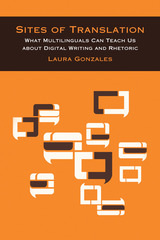
Winner of the 2016 Sweetland Digital Rhetoric Collaborative Book Prize
Sites of Translation illustrates the intricate rhetorical work that multilingual communicators engage in as they translate information for their communities. Blending ethnographic and empirical methods from multiple disciplines, Laura Gonzales provides methodological examples of how linguistic diversity can be studied in practice, both in and outside the classroom, and provides insights into the rhetorical labor that is often unacknowledged and made invisible in multilingual communication. Sites of Translation is relevant to researchers and teachers of writing as well as technology designers interested in creating systems, pedagogies, and platforms that will be more accessible and useful to multilingual audiences. Gonzales presents multilingual communication as intellectual labor that should be further valued in both academic and professional spaces, and supported by multilingual technologies and pedagogies that center the expertise of linguistically diverse communicators.
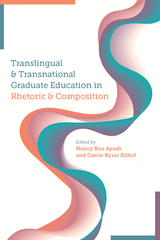
Contributors to the collection articulate the need for translingual and transnational sensibilities in rhetoric and composition graduate programs in light of the material conditions of graduate students’ lives and labor. They further present pathways for rethinking the design of graduate-level coursework, foreign language learning policies and labor, mentoring practices, writing teacher and writing center tutor training, and other professionalization initiatives. Offering a range of conceptually and empirically driven pieces, the collection brings together the voices and lived experiences of graduate students, faculty advisors, and administrators involved in the constant, necessary reworking of rhetoric and composition graduate education in a variety of institutional locales.
Translingual and Transnational Graduate Education in Rhetoric and Composition provides inspiration for graduate programs working to enact well-grounded curricular and pedagogical changes to counter the long-standing effects of the dominant racist and monolingualist ideologies in higher education generally, and rhetoric and composition studies specifically.
Contributors: Lucía Durá, Patricia Flores, Joe Franklin, Moisés Garcia-Renteria, Bruce Horner, Aimee Jones, Corina Lerma, Kate Mangelsdorf, Brice Nordquist, Madelyn Pawlowski, Christine Tardy, Amy Wan, Alex Way, Anselma Widha Prihandita, Joe Wilson, Xiaoye You, Emily Yuko Cousins, Michelle Zaleski
READERS
Browse our collection.
PUBLISHERS
See BiblioVault's publisher services.
STUDENT SERVICES
Files for college accessibility offices.
RECENTLY PUBLISHED


UChicago Accessibility Resources
home | accessibility | search | about | contact us
BiblioVault ® 2001 - 2025
The University of Chicago Press