
 A SCHOLARLY BOOK REPOSITORY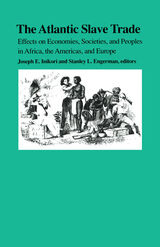
Among the questions these essays address are: the social cost to Africa of this forced migration; the role of slavery in the economic development of Europe and the United States; the short-term and long-term effects of the slave trade on black mortality, health, and life in the New World; and the racial and cultural consequences of the abolition of slavery. Some of these essays originally appeared in recent issues of Social Science History; the editors have added new material, along with an introduction placing each essay in the context of current debates.
Based on extensive archival research and detailed historical examination, this collection constitutes an important contribution to the study of an issue of enduring significance. It is sure to become a standard reference on the Atlantic slave trade for years to come.
Contributors. Ralph A. Austen, Ronald Bailey, William Darity, Jr., Seymour Drescher, Stanley L. Engerman, David Barry Gaspar, Clarence Grim, Brian Higgins, Jan S. Hogendorn, Joseph E. Inikori, Kenneth Kiple, Martin A. Klein, Paul E. Lovejoy, Patrick Manning, Joseph C. Miller, Johannes Postma, Woodruff Smith, Thomas Wilson
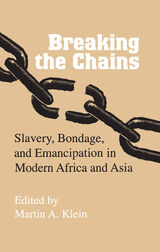
“Martin Klein has brought together recent work on the abolition of slavery, from Ottoman Turkey to Thailand and from South India to West Africa. This anthology builds on the recent scholarship on both slavery in Asia and Africa and the end of slavery as a world-wide historical phenomenon. Whereas other anthologies have tended to focus on either Africa or Asia, this project brings together in one volume case studies and methodological approaches concerning both regions. Breaking the Chains will be an important part of the relatively sparse literature on emancipation in comparative and global context.”—Richard Roberts, Stanford University
Because the American history of slavery and emancipation tends to be foremost in Western minds, few realize that traditional forms of servitude still exist in a variety of places around the world: children are sold on the streets of Bangkok, bondage persists in India despite official efforts to abolish it, and until 1980 slavery was legal in Mauritania.
Breaking the Chains deals with emancipation in African and Asian societies which were either colonized or came under the domination of European powers in the nineteenth century. In these societies, emancipation involved the imposition on non-European societies of an explicitly European discourse on slavery, and, in most cases, a free labor ideology. Most of the slave masters described in these essays were not European and found European ideas on emancipation difficult to accept.
Against this backdrop, the essayists (many of whom contribute their own non-Western perspective) focus on the transition from slavery (or other forms of bondage) to emancipation. They show that in each case the process involved pressure from European abolition movements, the extension of capitalist relations of production, the concerns and perceptions of the colonial state, and the efforts of non-Western elites to modernize their cultures.
Martin A. Klein argues that the Asian and African experience has much in common with the American experience, particularly in efforts to control labor and family life. The struggle to control the labor of former slaves has often been intense and, he suggests, has had a continuing impact on the social order in former slave societies.

An exploration of the resilient lives and legacies of enslaved Africans in Africa
Unlike narratives focused on enslaved people in the Americas, Europe, or the Middle East, this edited collection highlights the lives of African slaves and their descendants who remained in Africa. The contributors chronicle lives spanning the continent, from Sierra Leone, Burkina Faso, Nigeria, Chad, and Cameroon to Egypt, Ethiopia, Tanzania, and South Africa.
The collection explores various forms of slavery and diverse personal trajectories, with many stories beginning in childhood enslavement and evolving into adulthood with limited chances for education or personal advancement. Notably, the accounts include figures who managed to achieve prominent roles, such as a slave who became a general and administrator, a female slave who rose to be a village chief, and a woman who became a successful obstetrician in Muslim Africa.
The narratives underscore the resilience and agency of the enslaved individuals, many of whom created meaningful lives despite the constraints and stigma of both slavery and post-slavery. Some, like a medical missionary in Tanganyika and a slave convert who helped grow the Catholic Church in Burkina Faso, contributed significantly to their communities and religious institutions.
Accessing these stories required rigorous research due to limited documentation, social silence surrounding slavery, and stigma associated with slave ancestry. The contributors’ extensive research brings together fragmented knowledge and oral histories to provide an invaluable perspective and insight into the complex identities, struggles, and achievements of African slaves and their descendants.
Contributors:
Richard Anderson
Dadda Astabarka
Abdourahman Halirou
Martin A. Klein
George Michael La Rue
Adam Mahamat
Ricardo Marquez Garcia
Stephen J. Rockel
Ute Röschenthaler
Mohammed Bashir Salau
Moris Samen
Sandra Rowoldt Shell
Joseph Jules Sinang
READERS
Browse our collection.
PUBLISHERS
See BiblioVault's publisher services.
STUDENT SERVICES
Files for college accessibility offices.
RECENTLY PUBLISHED





UChicago Accessibility Resources
home | accessibility | search | about | contact us
BiblioVault ® 2001 - 2025
The University of Chicago Press