
front cover of Gender and Nation in the Spanish Modernist Novel
Gender and Nation in the Spanish Modernist Novel
Roberta Johnson
Vanderbilt University Press, 2003
Offering a fresh, revisionist analysis of Spanish fiction from 1900 to 1940, this study examines the work of both men and women writers and how they practiced differing forms of modernism. As Roberta Johnson notes, Spanish male novelists emphasized technical and verbal innovation in representing the contents of an individual consciousness and thus were more modernist in the usual understanding of the term. Female writers, on the other hand, were less aesthetically innovative but engaged in a social modernism that focused on domestic issues, gender roles, and relations between the sexes. Compared to the more conventional--even reactionary--ways their male counterparts treated such matters, Spanish women's fiction in the first half of the twentieth century was often revolutionary.

The book begins by tracing the history of public discourse on gender from the 1890s through the 1930s, a discourse that included the rise of feminism. Each chapter then analyzes works by female and male novelists that address key issues related to gender and nationalism: the concept of intrahistoria, or an essential Spanish soul; modernist uses of figures from the Spanish literary tradition, notably Don Quixote and Don Juan; biological theories of gender prevalent in the 1920s and 1930s; and the growth of an organized feminist movement that coincided with the burgeoning Republican movement.

This is the first book dealing with this period of Spanish literature to consider women novelists, such as Maria Martinez Sierra, Carmen de Burgos, and Concha Espina, alongside canonical male novelists, including Miguel de Unamuno, Ramon del Valle-Inclan, and Pio Baroja. With its contrasting conceptions of modernism, Johnson's work provides a compelling new model for bridging the gender divide in the study of Spanish fiction.
[more]

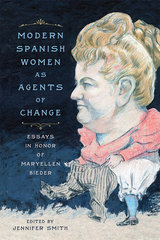
front cover of Modern Spanish Women as Agents of Change
Modern Spanish Women as Agents of Change
Essays in Honor of Maryellen Bieder
Smith, Jennifer
Bucknell University Press, 2019
This volume brings together cutting-edge research on modern Spanish women as writers, activists, and embodiments of cultural change, and simultaneously honors Maryellen Bieder’s invaluable scholarly contribution to the field. The essays are innovative in their consideration of lesser-known women writers, focus on women as political activists, and use of post-colonialism, queer theory, and spatial theory to examine the period from the Enlightenment until World War II. The contributors study women as agents and representations of social change in a variety of genres, including short stories, novels, plays, personal letters, and journalistic pieces. Canonical authors such as Emilia Pardo Bazán, Leopoldo Alas “Clarín,” and Carmen de Burgos are considered alongside lesser known writers and activists such as María Rosa Gálvez, Sofía Tartilán, and Caterina Albert i Paradís. The critical analyses are situated within their specific socio-historical context, and shed new light on nineteenth- and early twentieth-century Spanish literature, history, and culture.

Published by Bucknell University Press. Distributed worldwide by Rutgers University Press. 
[more]


Send via email Share on Facebook Share on Twitter