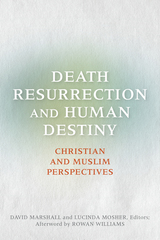
front cover of Death, Resurrection, and Human Destiny
Death, Resurrection, and Human Destiny
Christian and Muslim Perspectives
David Marshall and Lucinda Mosher, Editors. Afterword by Rowan Williams
Georgetown University Press, 2016

Death, Resurrection, and Human Destiny: Christian and Muslim Perspectives is a record of the 2012 Building Bridges seminar for leading Christian and Muslim scholars, convened by Rowan Williams, then Archbishop of Canterbury. The essays in this volume explore what the Bible and Qurān—and the Christian and Islamic theological traditions—have to say about death, resurrection, and human destiny. Special attention is given to the writings of al-Ghazali and Dante. Other essays explore the notion of the good death. Funeral practices of each tradition are explained. Relevant texts are included with commentary, as are personal reflections on death by several of the seminar participants. An account of the informal conversations at the seminar conveys a vivid sense of the lively, penetrating, but respectful dialogue which took place. Three short pieces by Rowan Williams provide his opening comments at the seminar and his reflections on its proceedings. The volume also contains an analysis of the Building Bridges Seminar after a decade of his leadership.

[more]

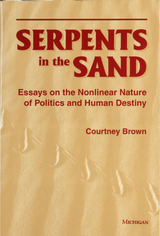
front cover of Serpents in the Sand
Serpents in the Sand
Essays in the Nonlinear Nature of Politics and Human Destiny
Courtney Brown
University of Michigan Press, 1995
For decades, social scientists have worked with models that have sought to quantify and explain human behavior. The common foundation for nearly all of these mathematical applications is the assumption of linear progression, equilibrium, and stability. Serpents in the Sand not only argues that political life is fundamentally nonlinear but thoroughly analyzes specific instances of extreme nonlinearity in politics. By so doing, Courtney Brown offers a guide to the reader on how to apply nonlinearity, including chaos theory, to real-world situations. The author develops his argument by in-depth analysis of four examples covering a broad spectrum of political life. He considers, first, the relationship between individual rationality and the influence of a voter's political milieu. He then turns to look at the dynamics behind the Johnson vs. Goldwater landslide presidential election of 1964. The fall of the Weimar Republic and the rise of Nazi Germany provide a third case study, followed, by an analysis of the relationship between democratic electoral politics and the ecological environment. Highly original in its finding, Serpents in the Sand resembles no other work on politics. It is the first study of nonlinearity in political behavior to base its argument on specific examples rather than on analogies to physical and ecological systems. Substantively, the book draws provocative conclusions from the test cases, examining for instance the potential for disaster in the oscillatory relationship between the way U.S. presidents are elected and the management of the country's environment. In the end, Serpents in the Sand extends its argument to the philosophy of human existence, showing that human behavior is as nonlinear as all other processes in the universe. Courtney Brown is Associate Professor of Political Science, Emory University.
[more]

front cover of World Technology and Human Destiny
World Technology and Human Destiny
Edited by Raymond Aron
University of Michigan Press, 1963
What lies ahead — Ashes or Eden? As a result of the greatest revolution the world has ever known empires are dissolving, religions changing, and stone-age nations are being driven into the Nuclear Society. In this technological revolution every country is a part of a vast machine culture whose scientific symbols, language, and hierarchies appear from pole to pole. Will man's political and spiritual life keep pace with the accelerating scientific progress that is reshaping the contours of human existence? This question is the most important one confronting the world today. World Technology and Human Destiny is the product of a meeting of brilliant and compassionate minds, who gathered together to find the answer to this and related questions. Here Aron, Oppenheimer, Kennan, Rostow, Polanyi, and many others analyze this Nuclear Era and explore the fate of man.
[more]


Send via email Share on Facebook Share on Twitter