
 A SCHOLARLY BOOK REPOSITORY
385 start with A start with A
Abandoning the Black Hero is the first book to examine the postwar African American white-life novel—novels with white protagonists written by African Americans. These fascinating works have been understudied despite having been written by such defining figures in the tradition as Richard Wright, Zora Neale Hurston, James Baldwin, Ann Petry, and Chester Himes, as well as lesser known but formerly best-selling authors Willard Motley and Frank Yerby.
John C. Charles argues that these fictions have been overlooked because they deviate from two critical suppositions: that black literature is always about black life and that when it represents whiteness, it must attack white supremacy. The authors are, however, quite sympathetic in the treatment of their white protagonists, which Charles contends should be read not as a failure of racial pride but instead as a strategy for claiming creative freedom, expansive moral authority, and critical agency.
In an era when “Negro writers” were expected to protest, their sympathetic treatment of white suffering grants these authors a degree of racial privacy previously unavailable to them. White writers, after all, have the privilege of racial privacy because they are never pressured to write only about white life. Charles reveals that the freedom to abandon the “Negro problem” encouraged these authors to explore a range of new genres and themes, generating a strikingly diverse body of novels that significantly revise our understanding of mid-twentieth-century black writing.
A hard-hitting look at the regulation of sexual difference and its role in circumscribing African American culture
The sociology of race relations in America typically describes an intersection of poverty, race, and economic discrimination. But what is missing from the picture—sexual difference—can be as instructive as what is present. In this ambitious work, Roderick A. Ferguson reveals how the discourses of sexuality are used to articulate theories of racial difference in the field of sociology. He shows how canonical sociology—Gunnar Myrdal, Ernest Burgess, Robert Park, Daniel Patrick Moynihan, and William Julius Wilson—has measured African Americans’s unsuitability for a liberal capitalist order in terms of their adherence to the norms of a heterosexual and patriarchal nuclear family model. In short, to the extent that African Americans’s culture and behavior deviated from those norms, they would not achieve economic and racial equality.
Aberrations in Black tells the story of canonical sociology’s regulation of sexual difference as part of its general regulation of African American culture. Ferguson places this story within other stories—the narrative of capital’s emergence and development, the histories of Marxism and revolutionary nationalism, and the novels that depict the gendered and sexual idiosyncrasies of African American culture—works by Richard Wright, Ralph Ellison, James Baldwin, Audre Lorde, and Toni Morrison. In turn, this book tries to present another story—one in which people who presumably manifest the dysfunctions of capitalism are reconsidered as indictments of the norms of state, capital, and social science. Ferguson includes the first-ever discussion of a new archival discovery—a never-published chapter of Invisible Man that deals with a gay character in a way that complicates and illuminates Ellison’s project.
Unique in the way it situates critiques of race, gender, and sexuality within analyses of cultural, economic, and epistemological formations, Ferguson’s work introduces a new mode of discourse—which Ferguson calls queer of color analysis—that helps to lay bare the mutual distortions of racial, economic, and sexual portrayals within sociology.
Rickels studies mourning and melancholia within and around psychoanalysis, analyzing the writings of such thinkers as Freud, Nietzsche, Lessing, Heinse, Artaud, Keller, Stifter, Kafka, and Kraus. Rickels maintains that we must shift the way we read literature, philosophy, and psychoanalysis to go beyond traditional Oedipal structures.
Aberrations of Mourning argues that the idea of the crypt has had a surprisingly potent influence on psychoanalysis, and Rickels shows how society’s disturbed relationship with death and dying, our inability to let go of loved ones, has resulted in technology to form more and more crypts for the dead by preserving them—both physically and psychologically—in new ways.

In the opening of the book, Wilt discusses real case histories of several women. After studying the ambiguities of their decisions, she turns to their counterpoints depicted in contemporary fiction. Working from a feminist perspective, Wilt traces the theme of maternal choice in works by Margaret Atwood, Margaret Drabble, Joan Didion, Mary Gordon, Alice Walker, Toni Morrison, Gloria Naylor, Marge Piercy, Thomas Keneally, Graham Swift, Ernest Hemingway, William Faulkner, John Barth, John Irving, and others.
Behind the political, medical, and moral debates on abortion, Wilt argues, is a profound psychocultural shock at the recognition that maternity is passing from the domain of instinct to that of conscious choice. Although never wholly instinctual, maternity's potential capture by consciousness raises complex questions. The novels Wilt discusses portray worlds in which principles are endangered by sexual inequality, male power and hidden male fear of abandonment, impotence, female submission, and covert rage, and, in the case of black maternity, the hideous aftermath of slavery.
Wilt provides a resonant new context for debates—whether political or personal—on the issue of abortion and maternal choice. Ultimately she enables us to rethink how we shape our own identities and lives.
Abortion in the American Imagination returns to the moment when American writers first dared to broach the controversial subject of abortion. What was once a topic avoided by polite society, only discussed in vague euphemisms behind closed doors, suddenly became open to vigorous public debate as it was represented everywhere from sensationalistic melodramas to treatises on social reform. Literary scholar and cultural historian Karen Weingarten shows how these discussions were remarkably fluid and far-ranging, touching upon issues of eugenics, economics, race, and gender roles.
Weingarten traces the discourses on abortion across a wide array of media, putting fiction by canonical writers like William Faulkner, Edith Wharton, and Langston Hughes into conversation with the era’s films, newspaper articles, and activist rhetoric. By doing so, she exposes not only the ways that public perceptions of abortion changed over the course of the twentieth century, but also the ways in which these abortion debates shaped our very sense of what it means to be an American.
Contributors are Gregory G. Butler, Jen-Yen Chen, Alexander J. Fisher, Mary Dalton Greer, Robert Hill, Ton Koopman, Daniel R. Melamed, Michael Ochs, Mark Risinger, William H. Scheide, Hans-Joachim Schulze, Douglass Seaton, George B. Stauffer, Andrew Talle, and Kathryn Welter.
In addition to the editors and David S. Reynolds, contributors include Jeffrey Bilbro, Dawn Coleman, Jonathan A. Cook, Tracy Fessenden, Zachary Hutchins, Richard Kopley, Mason I. Lowance Jr., John Matteson, Christopher N. Phillips, Vivian Pollak, Michael Robertson, Gail K. Smith, Claudia Stokes, and Timothy Sweet.
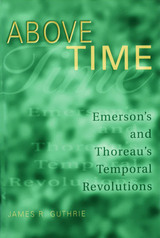
In Above Time, James R. Guthrie explores the origins of the two preeminent transcendentalists' revolutionary approaches to time, as well as to the related concepts of history, memory, and change. Most critical discussions of this period neglect the important truth that the entire American transcendentalist project involved a transcendence of temporality as well as of materiality. Correspondingly, both writers call in their major works for temporal reform, to be achieved primarily by rejecting the past and future in order to live in an amplified present moment.
Emerson and Thoreau were compelled to see time in a new light by concurrent developments in the sciences and the professions. Geologists were just then hotly debating the age of the earth, while zoologists were beginning to unravel the mysteries of speciation, and archaeologists were deciphering the Egyptian hieroglyphs. These discoveries worked collectively to enlarge the scope of time, thereby helping pave the way for the appearance of Darwin's Origin of Species in 1859.
Well aware of these wider cultural developments, Emerson and Thoreau both tried (although with varying degrees of success) to integrate contemporary scientific thought with their preexisting late-romantic idealism. As transcendentalists, they already believed in the existence of "correspondences"—affinities between man and nature, formalized as symbols. These symbols could then be decoded to discover the animating presence in the world of eternal laws as pervasive as the laws of science. Yet unlike scientists, Emerson and Thoreau hoped to go beyond merely understanding nature to achieving a kind of passionate identity with it, and they believed that such a union might be achieved only if time was first recognized as being a purely human construct with little or no validity in the rest of the natural world. Consequently, both authors employ a series of philosophical, rhetorical, and psychological strategies designed to jolt their readers out of time, often by attacking received cultural notions about temporality.
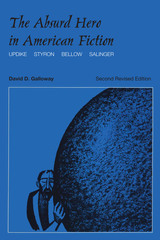
When The Absurd Hero in American Fiction was first released in 1966, Granville Hicks praised it in a lead article for the Saturday Review as a sensitive and definitive study of a new trend in postwar American literature. In the years that followed, David Galloway’s analysis of the writings of John Updike, William Styron, Saul Bellow, and J. D. Salinger became a standard critical work, an indispensable tool for readers concerned with contemporary American literature. The New York Times described the book as “a seminal study of the modern literary imagination."
David Galloway, himself an established novelist, later extensively revised The Absurd Hero to include authoritative discussions of more than a dozen novels which had appeared since the first revised edition was released in 1970. Among them are John Updike’s Couples, Rabbit Redux, and The Coup; William Styron’s The Confessions of Nat Turner and Sophie’s Choice; and Saul Bellow’s Mr. Sammler’s Planet and Humboldt’s Gift. Through detailed analyses of these works, Galloway demonstrates the continuing relevance of his own provocative concept of the absurd hero and provides important insights into the literary achievements of four of America’s most influential postwar novelists.

A volume in the American Literatures Initiative
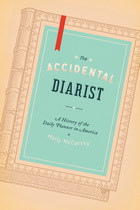

Described as “all under Heaven,” the Chinese empire might have extended infinitely, covering all worlds and cultures. That ideology might have been convenient for the state, but what did late imperial people really think about the scope and limits of the human community?
Writers of late imperial fiction and drama were, the author argues, deeply engaged with questions about the nature of the Chinese empire and of the human community. Fiction and drama repeatedly pose questions concerning relations both among people and between people and their possessions: What ties individuals together, whether permanently or temporarily? When can ownership be transferred, and when does an object define its owner? What transforms individual families or couples into a society?
Tina Lu traces how these political questions were addressed in fiction through extreme situations: husbands and wives torn apart in periods of political upheaval, families so disrupted that incestuous encounters become inevitable, times so desperate that people have to sell themselves to be eaten.
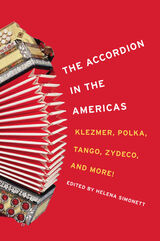
This rich collection considers the accordion and its myriad forms, from the concertina, button accordion, and piano accordion familiar in European and North American music to the exotic-sounding South American bandoneon and the sanfoninha. Capturing the instrument's spread and adaptation to many different cultures in North and South America, contributors illuminate how the accordion factored into power struggles over aesthetic values between elites and working-class people who often were members of immigrant and/or marginalized ethnic communities. Specific histories and cultural contexts discussed include the accordion in Brazil, Argentine tango, accordion traditions in Colombia and the Dominican Republic, cross-border accordion culture between Mexico and Texas, Cajun and Creole identity, working-class culture near Lake Superior, the virtuoso Italian-American and Klezmer accordions, Native American dance music, and American avant-garde.
Contributors are María Susana Azzi, Egberto Bermúdez, Mark DeWitt, Joshua Horowitz, Sydney Hutchinson, Marion Jacobson, James P. Leary, Megwen Loveless, Richard March, Cathy Ragland, Helena Simonett, Jared Snyder, Janet L. Sturman, and Christine F. Zinni.

Based on original archival research in Buenos Aires, Havana, Paris, and the United States, the book develops a literary media theory that understands sound as a transmedial phenomenon and radio as a transnational medium. Analyzing the construction of new social and political relations in the wake of the United States’ 1930s Good Neighbor Policy, Acoustic Properties challenges standard narratives of hemispheric influence through new readings of Richard Wright’s cinematic work in Argentina, Severo Sarduy’s radio plays in France, and novels by John Dos Passos, Manuel Puig, Raymond Chandler, and Carson McCullers. Alongside these writers, the book also explores Che Guevara and Fidel Castro’s Radio Rebelde, FDR’s fireside chats, Félix Caignet’s invention of the radionovela in Cuba, Evita Perón’s populist melodramas in Argentina, Orson Welles’s experimental New Deal radio, Cuban and U.S. “radio wars,” and the 1960s African American activist Robert F. Williams’s proto–black power Radio Free Dixie.
From the doldrums of the Great Depression to the tumult of the Cuban Revolution, Acoustic Properties illuminates how novelists in the radio age converted writing into a practice of listening, transforming realism as they struggled to channel and shape popular power.

In this ear-opening journey into the sound-worlds of Shakespeare's contemporaries, Bruce R. Smith explores both the physical aspects of human speech (ears, lungs, tongue) and the surrounding environment (buildings, landscape, climate), as well as social and political structures. Drawing on a staggeringly wide range of evidence, he crafts a historical phenomenology of sound, from reconstructions of the "soundscapes" of city, country, and court to detailed accounts of the acoustic properties of the Globe and Blackfriars theaters and how scripts designed for the two spaces exploited sound very differently.
Critical for anyone who wants to understand the world of early modern England, Smith's pathbreaking "ecology" of voice and listening also has much to offer musicologists and acoustic ecologists.
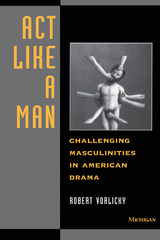
In the first comprehensive study of plays written for male characters only, Robert Vorlicky offers a new theory that links cultural codes governing gender and the conventions determining dramatic form. Act Like a Manlooks at a range of plays, including those by O'Neill, Albee, Mamet, Baraka, and Rabe as well as new works by Philip Kan Gotanda, Alonzo Lamont, and Robin Swados, to examine how dialogue within these works reflects the social codes of male behavior and inhibits individualization among men.
Plays in which women are absent are often characterized by the location of a male "other"—a female presence who distances himself from the dominant, impersonal masculine ethos and thereby becomes a facilitator of personal communication. The potential authority of this figure is so powerful that its presence becomes the primary determinant of the quality of men's interaction and of the range of male subjectivities possible. This formulation becomes the basis of an alternative theory of American dramatic construction, one that challenges traditional dramaturgical notions of realism.
The book will appeal to scholars and students interested in drama, gender, race, sexuality, and American culture, as well as playwrights, teachers of playwrights, and artistic directors. It includes an extensive bibliography of more than four hundred male-cast plays and monodramas, the first such compilation and one that points to further research into a previously unexplored area.
There is, Sartwell contends, a fundamental elusiveness to that identity. Whiteness defines itself as normative, as a neutral form of the human condition, marking all other forms of identity as "racial" or "ethnic" deviations. Invisible to itself, white identity seeks to define its essence over and against those other identities, in effect defining itself through opposition and oppression. By maintaining fictions of black licentiousness, violence, and corruption, white identity is able to cast itself as humane, benevolent, and pure; the stereotype fabricates not only the oppressed but the oppressor as well. Sartwell argues that African-American autobiography perceives white identity from a particular and unique vantage point; one that is knowledgeable and intimate, yet fundamentally removed from the white world and thus unencumbered by its obfuscating claims to normativity.
Throughout this provocative work, Sartwell steadfastly recognizes the many ways in which he too is implicated in the formulation and perpetuation of racial attitudes and discourse. In Act Like You Know, he challenges both himself and others to take a long, hard look in the mirror of African-American autobiography, and to find there, in the light of those narratives, the visible features of white identity.
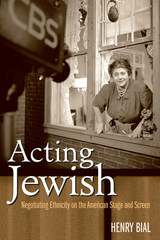
Acting Jewish documents this history, looking at the work of Jewish writers, directors, and actors in the American entertainment industry with particular attention to the ways in which these artists offer behavioral models for Jewish-American audiences. The book spans the period from 1947 to the present and takes a close look at some of America's favorite plays (Death of a Salesman, Fiddler on the Roof, Angels in America), films (Gentleman's Agreement, AnnieHall), and television shows (The Goldbergs, Seinfeld), identifying a double-coding by which performers enact, and spectators read, Jewishness in contemporary performance-and, by extension, enact and read other minority identities. The book thus explores and illuminates the ever-changing relationship between Jews and mainstream American culture.
"Fascinating and original . . . Bial's command of sources is impressive, and his concept of 'double-coding' is convincing . . . the book should have no trouble finding a large audience."
-Barbara Grossman, author of Funny Woman: The Life and Times of Fanny Brice
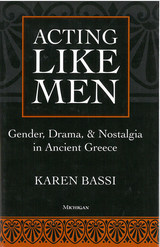
In her discussion of theaterlike practices and experiences, Bassi proposes new conceptual categories for understanding Greek drama as a cultural institution, viewing theatrical performance as part of what Foucault has called a discursive formation. Bassi also provides an important new analysis of gender in Greek culture at large and in Athenian civic ideology in particular, where spectatorship at the civic theater was a distinguishing feature of citizenship, and where citizenship was denied women.
Acting Like Men includes detailed discussions of message-sending as a form of scripted speech in the Iliad, of disguise and the theatrical body of Odysseus in the Odyssey, of tyranny as a theaterlike phenomenon in the narratives of Herodotus, and of Dionysus as the tyrannical and effeminate god of the theater in Euripides' Bacchae and Aristophanes' Frogs. Bassi concludes that the validity of an idealized masculine identity in Greek and Athenian culture is highly contested in the theater, where--in principle--citizens become passive spectators. Thereafter the author considers Athenian theater and Athenian democracy as mutually reinforcing mimetic regimes.
Acting Like Men will interest those interested in the history of the theater, performance theory, gender and cultural studies, and feminist approaches to ancient texts.
Karen Bassi is Associate Professor of Classics, University of California, Santa Cruz.
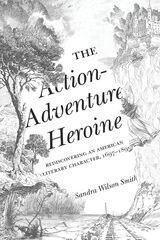
Unlike the “tomboy” or the American frontierswoman, this more encompassing figure has been understudied until now. The action-adventure heroine has special relevance today, as scholars are forcefully challenging the once-dominant separate-spheres paradigm and offering alternative interpretations of gender conventions in nineteenth-century America. The hard-body action heroine in our contemporary popular culture is often assumed to be largely a product of the twentieth-century television and film industries (and therefore influenced by the women’s movement); however, physically strong, agile, sometimes violent female figures have appeared in American popular culture and literature for a very long time.
Smith analyzes captivity narratives, war narratives, stories of manifest destiny, dime novels, and tales of seduction to reveal the long literary history of female protagonists who step into traditionally masculine heroic roles to win the day. Smith’s study includes such authors as Herman Mann, Mercy Otis Warren, Catharine Maria Sedgwick, E.D.E.N. Southworth, Edward L. Wheeler, and many more who are due for critical reassessment. In examining the female hero—with her strength, physicality, and violence—in eighteenth-and nineteenth-century American narratives, The Action-Adventure Heroine represents an important contribution to the field of American studies.
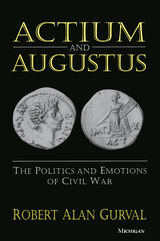
Actium and Augustus marks a turning point as well. Robert Alan Gurval's unusual approach is to examine contemporary views of the battle and its immediate political and social consequences. He starts with a consideration of the official celebration and public commemoration of the Actian victory and then moves on to other questions. What were the "Actian" monuments that Octavian erected on the battle site and later in Rome? What role did the Actian victory play in the political formation of the Principate and its public ideology? What was the response of contemporary poetry? Throughout, this volume concentrates on contemporary views of Actium and its results.
Written to include the general reader, Actium and Augustus presents a thoughtful examination of a complex period. All Greek and Latin quotations are translated, and extensive illustrations present graphic evidence about the issues Romans faced.
Robert Alan Gurval is Associate Professor of Classics, University of California, Los Angeles, and has been a recipient of the Rome Prize awarded by the American Academy in Rome.
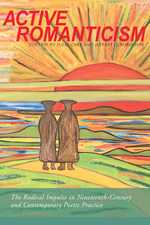
Literary history generally locates the primary movement toward poetic innovation in twentieth-century modernism, an impulse carried out against a supposedly enervated “late-Romantic” poetry of the nineteenth century. The original essays in Active Romanticism challenge this interpretation by tracing the fundamental continuities between Romanticism’s poetic and political radicalism and the experimental movements in poetry from the late nineteenth century to the present day.
According to editors July Carr and Jeffrey C. Robinson, “active romanticism” is a poetic response, direct or indirect, to pressing social issues and an attempt to redress forms of ideological repression; at its core, “active romanticism” champions democratic pluralism and confronts ideologies that suppress the evidence of pluralism. “Poetry fetter’d, fetters the human race,” declared poet William Blake at the beginning of the nineteenth century. No other statement from the era of the French Revolution marks with such terseness the challenge for poetry to participate in the liberation of human society from forms of inequality and invisibility. No other statement insists so vividly that a poetic event pushing for social progress demands the unfettering of traditional, customary poetic form and language.
Bringing together work by well-known writers and critics, ranging from scholarly studies to poets’ testimonials, Active Romanticism shows Romantic poetry not to be the sclerotic corpse against which the avant-garde reacted but rather the wellspring from which it flowed.
Offering a fundamental rethinking of the history of modern poetry, Carr and Robinson have grouped together in this collection a variety of essays that confirm the existence of Romanticism as an ongoing mode of poetic production that is innovative and dynamic, a continuation of the nineteenth-century Romantic tradition, and a form that reacts and renews itself at any given moment of perceived social crisis.
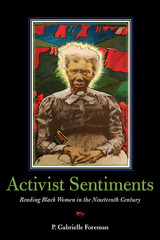
Activist Sentiments takes as its subject women who in fewer than fifty years moved from near literary invisibility to prolific productivity. Grounded in primary research and paying close attention to the historical archive, this book offers against-the-grain readings of the literary and activist work of Harriet Jacobs, Harriet Wilson, Frances E. W. Harper, Victoria Earle Matthews and Amelia E. Johnson.
Part literary criticism and part cultural history, Activist Sentiments examines nineteenth-century social, political, and representational literacies and reading practices. P. Gabrielle Foreman reveals how Black women's complex and confrontational commentary–often expressed directly in their journalistic prose and organizational involvement--emerges in their sentimental, and simultaneously political, literary production.
When Nero took the stage, the audience played along--or else. The drama thus enacted, whether in the theater proper or in the political arena, unfolds in all its rich complexity in Actors in the Audience. This is a book about language, theatricality, and empire--about how the Roman emperor dramatized his rule and how his subordinates in turn staged their response. The focus is on Nero: his performances onstage spurred his contemporaries to reflect on the nature of power and representation, and to make the stage a paradigm for larger questions about the theatricality of power. Through these portrayals by ancient writers, Shadi Bartsch explores what happens to language and representation when all discourse is distorted by the pull of an autocratic authority.
Some Roman senators, forced to become actors and dissimulators under the scrutinizing eye of the ruler, portrayed themselves and their class as the victims of regimes that are, for us, redolent of Stalinism. Other writers claimed that doublespeak--saying one thing and meaning two--was the way one could, and did, undo the constraining effects of imperial oppression. Tacitus, Suetonius, and Juvenal all figure in Bartsch's shrewd analysis of historical and literary responses to the brute facts of empire; even the Panegyricus of Pliny the Younger now appears as a reaction against the widespread awareness of dissimulation. Informed by theories of dramaturgy, sociology, new historicism, and cultural criticism, this close reading of literary and historical texts gives us a new perspective on the politics of the Roman empire--and on the languages and representation of power.

Acts of Dramaturgy is a critical frame for Michael Pinchbeck’s The Shakespeare Trilogy, a recent touring project comprising three performances—The Beginning, The Middle, and The End—that explored the role of the dramaturg. This book sets the playtexts in dialogue with reflexive essays and provocations on contemporary dramaturgy from a range of contributors.
Weaving together different modes of writing, the volume reflects on the politics of dramaturgy, authorship, adaptation, performance, and the use of Shakespeare as a stimulus for making contemporary theater. The resulting work is as much a reflection on the entanglements of processes, lineages, and relations that have shaped the work and its reception as it is an exploration of ways of reflecting and being with practice now. A valuable new contribution to the study of contemporary dramaturgy, the book will be of interest to makers and scholars of theater and performance and anyone interested in practice research and creative critical writing.
Acts of Mind grew out of interviews conducted by the author for Poetry Miscellany. The aim of which was to help develop a method for talking about the work of contemporary poets.
The poets whose views appear in this volume represent a fair cross-section of the more important tendencies and impulses to be found in contemporary poetry and poetics.
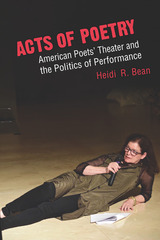
American poets’ theater emerged in the postwar period alongside the rich, performance-oriented poetry and theater scenes that proliferated on the makeshift stages of urban coffee houses, shared apartments, and underground theaters, yet its significance has been largely overlooked by critics. Acts of Poetry shines a spotlight on poets’ theater’s key groups, practitioners, influencers, and inheritors, such as the Poets’ Theatre, the Living Theatre, Gertrude Stein, Bunny Lang, Frank O’Hara, Amiri Baraka, Carla Harryman, and Suzan-Lori Parks. Heidi R. Bean demonstrates the importance of poets’ theater in the development of twentieth-century theater and performance poetry, and especially evolving notions of the audience’s role in performance, and in narratives of the relationship between performance and everyday life. Drawing on an extensive archive of scripts, production materials, personal correspondence, theater records, interviews, manifestoes, editorials, and reviews, the book captures critical assessments and behind-the-scenes discussions that enrich our understanding of the intertwined histories of American theater and American poetry in the twentieth century.
Provides a new foundation for discussions about theater, film, and translations between the two mediums.
Adapting Performance Between Stage and Screen provides an introduction to adaptations between theater and film, establishing a framework for considering these as distinct from literary adaptation. The book places emphasis on performance and event, opening new avenues of exploration to include non-literary issues such as the treatment of space and place, mis en scène, acting styles, and star personas. The recent growth of digital theater is examined to foreground the “events” of theater and cinema—largely ignored in adaptation studies—with phenomena such as National Theatre Live analyzed for the different ways that “liveness” is adapted.
Drawing from case studies that explore distinct periods in British film and theater history, the volume looks at issues surrounding theatrical naturalism and cinematic realism and illustrates the principle that adaptations can't be divorced from the historical and cultural moment in which they are produced. Adapting Performance Between Stage and Screen explores how cultural values can be articulated in the act of translating between media, providing a new framework for the discussion of theater and film as dramatic works.
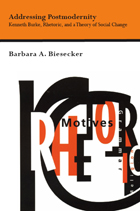
In Addressing Postmodernity, Barbara Biesecker examines the relationship between rhetoric and social change and the ways human beings transform social relations through the purposeful use of symbols. In discerning the conditions of possibility for social transformation and the role of human beings and rhetoric in it, Biesecker turns to the seminal work of Kenneth Burke.
Through a close reading of Burke's major works, A Grammar of Motives, A Rhetoric of Motives, and The Rhetoric of Religion: Studies in Logology, the author addresses the critical topic of the
fragmentation of the contemporary lifeworld revealing postmodernity will have a major impact on Burkeian scholarship and on the rhetorical critique of social relations in general.
Directly confronting the challenges posed by postmodernity to social theorists and critics alike and juxtaposing the work of Burke and Jurgen Habermas, Biesecker argues that a radicalized rereading of Burke's theory of the negative opens the way toward a resolutely rhetorical theory of social change and human agency.

Novy considers 45 memoirs, mostly from the twenty-first century, by birthmothers, adoptees, and adoptive parents, about same-race and transracial adoption. These adoptees, she recounts, wanted to learn about their ancestry and appreciated adoptive parents who helped. Birthmother Amy Seek shows why open adoption is not simple, and many other memoirs tell stories that continue past reunion.
Adoption Memoirs will enlighten readers who lack experience with adoption and help those looking for a shared experience to also understand adoption from a different standpoint.
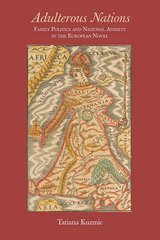
In Adulterous Nations, Tatiana Kuzmic enlarges our perspective on the nineteenth-century novel of adultery, showing how it often served as a metaphor for relationships between the imperialistic and the colonized. In the context of the long-standing practice of gendering nations as female, the novels under discussion here—George Eliot’s Middlemarch, Theodor Fontane’s Effi Briest, and Leo Tolstoy’s Anna Karenina, along with August Šenoa’s The Goldsmith’s Gold and Henryk Sienkiewicz’s Quo Vadis—can be understood as depicting international crises on the scale of the nuclear family. In each example, an outsider figure is responsible for the disruption experienced by the family. Kuzmic deftly argues that the hopes, anxieties, and interests of European nations during this period can be discerned in the destabilizing force of adultery. Reading the work of Šenoa and Sienkiewicz, from Croatia and Poland, respectively, Kuzmic illuminates the relationship between the literature of dominant nations and that of the semicolonized territories that posed a threat to them. Ultimately, Kuzmic’s study enhances our understanding of not only these five novels but nineteenth-century European literature more generally.
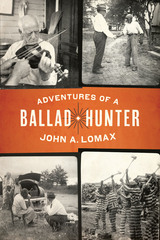
Growing up beside the Chisholm Trail, captivated by the songs of passing cowboys and his bosom friend, an African American farmhand, John A. Lomax developed a passion for American folk songs that ultimately made him one of the foremost authorities on this fundamental aspect of Americana. Across many decades and throughout the country, Lomax and his informants created over five thousand recordings of America’s musical heritage, including ballads, blues, children’s songs, fiddle tunes, field hollers, lullabies, play-party songs, religious dramas, spirituals, and work songs. He acted as honorary curator of the Archive of American Folk Song at the Library of Congress, directed the Slave Narrative Project of the WPA, and cofounded the Texas Folklore Society. Lomax’s books include Cowboy Songs and Other Frontier Ballads, American Ballads and Folk Songs, Negro Folk Songs as Sung by Leadbelly, and Our Singing Country, the last three coauthored with his son Alan Lomax.
Adventures of a Ballad Hunter is a memoir of Lomax’s eventful life. It recalls his early years and the fruitful decades he spent on the road collecting folk songs, on his own and later with son Alan and second wife Ruby Terrill Lomax. Vibrant, amusing, often haunting stories of the people he met and recorded are the gems of this book, which also gives lyrics for dozens of songs. Adventures of a Ballad Hunter illuminates vital traditions in American popular culture and the labor that has gone into their preservation.
Published by University of Delaware Press. Distributed worldwide by Rutgers University Press.
On a December morning in 1925, a newspaper journalist reported receiving 25 different handbills in an hour's walk in downtown Tokyo, advertising everything from Western-style clothing and furniture to sweet shops, charity organizations, phonograph recordings, plays, and films. The activities of advertisers, and the new entertainment culture and patterns of consumption that they promoted, helped to define a new urban aesthetic emerging in the 1920s.
This book examines some of the responses of Japanese authors to the transformation of Tokyo in the early decades of the twentieth century. In particular, it explores the themes and formal strategies of the modernist literature that flourished in the 1920s, focusing on the work of Hagiwara Kyojiro (1899-1938) and Hayashi Fumiko (1903-1951). William Gardner shows how modernist works offer new constructions of individual subjectivity amid the social and technological changes that provided the ground for the appearance of "mass media." Hagiwara's conception of the poem and poet as an electric-radio "advertising tower" provides an emblem for the aesthetic tensions and multiple discourses of technology, media, urbanism, commerce, and propaganda that were circulating through the urban environment at the time; while Hayashi's work, with its references to popular songs, plays, and movies, suggests an understanding of "everyday life" as the interface between individual subjectivity and a highly mediated environment.
In Aesthetics and Revolution, Dawes demonstrates that there is an objective grounding for cultural studies found in the aesthetic means of production. By analyzing the relations and forces of production in this realm we inevitably cross over into the economic means of production as well as the struggle for political representation. Ultimately, aesthetics is at the intersection of class and gender interests and their struggle for hegemony.
In Aesthetics and Revolution, Dawes has chosen a group of writers of different theoretical sympathies, class, gender, and social positions to reveal the conflictual interests of the social classes and genders as a whole. Through close readings of their work, Dawes examines the thematic nodes that are expressed in positions as diverse as Ernesto Cardenal’s liberation theology, Pablo Antonio Cuadra’s populism, the campesino’s oral tradition, and Gioconda Belli’s erotic verses in relation to the changes taking place in revolutionary Nicaragua.
In chapters on Proletkult, RAPP, LEF, and Pereval, Dobrenko reexamines the theories generated by these major Marxist literary groupings of the early Soviet Union. He shows how each approached the problems of literature's response to the presumed social mandate of the young communist society, and how Socialist Realism emerged as a conglomerate of these earlier, revolutionary theories. With extensive and detailed reference to supporting testimony and documents, Dobrenko clearly demonstrates how Socialist Realism was created from within the revolutionary culture, and how this culture and its disciples fully participated in this creative process. His work represents a major breakthrough in our current understanding of the complex sources that contributed to early Soviet culture.
Violence in the modernist mode, an ostensible intrusion of raw bodily harm into the artwork, aspires to transcend its own textuality, and yet, as An Aesthetics of Injury establishes, the wound paradoxically remains the essence of inscription. Fleishman thus shows how the wound, once the modernist emblem par excellence of an immediate aesthetic experience, comes to be implicated in a postmodern understanding of reality reduced to ceaseless mediation. In so doing, he demonstrates how what we think of as the most real object, the human body, becomes indistinguishable from its “nonreal” function as text. At stake in this tautological textual model is the heritage of narrative thought: both the narratological workings of these texts (how they tell stories) and the underlying epistemology exposed (whether these narrativists still believe in narrative at all).
With fresh and revealing readings of canonical authors and filmmakers seldom treated alongside one another, An Aesthetics of Injury is important reading for scholars working on literary or cinematic modernism and the postmodern, philosophy, narratology, body culture studies, queer and gender studies, trauma studies, and cultural theory.
In The Aesthetics of Service in Early Modern England, Elizabeth Rivlin explores the ways in which servant-master relationships reshaped literature. The early modern servant is enjoined to obey his or her master out of dutiful love, but the servant's duty actually amounts to standing in for the master, a move that opens the possibility of becoming master. Rivlin shows that service is fundamentally a representational practice, in which the servant who acts for a master merges with the servant who acts as a master.
Rivlin argues that in the early modern period, servants found new positions as subjects and authors found new forms of literature. Representations of servants and masters became a site of contact between pressing material concerns and evolving aesthetic ones. Offering readings of dramas by Shakespeare, Jonson, and Thomas Dekker and prose fictions by Thomas Deloney and Thomas Nashe, Rivlin suggests that these authors discovered their own exciting and unstable projects in the servants they created.
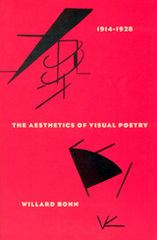
"An important contribution. Highly sophisticated, the study tends to raise its reader's impression of visual poetry in the twentieth century from trivial pastime to serious preoccupation."—Eric Sellin, Journal of Modern Literature
"With his definitive analyses full of quotable observations and sharp critical insights, Bohn has provided a model, pioneering study, one from which current and future studies of visual poetry will most certainly benefit."—Gerald J. Janacek, Romance Quarterly
"Bohn substantiates his thesis with thoughtful and often ingenious explications of texts both well known and hard to find. . . . Aesthetics of Visual Poetry is a thoroughly researched, beautifully written and fascinating introduction to an infinitely intriguing genre."—Mechthild Cranston, French Review
What happens when the cerebral--that is, theories of literature and of affect--encounters the corporeal, the human body? In this study by Jane Thrailkill, what emerges from the convergence is an important vision of late-nineteenth-century American realist literature and the role of emotion and physiology in literary criticism.
Affecting Fictions offers a new understanding of American literary realism that draws on neuroscience and cognitive psychology. Thrailkill positions herself against the emotionless interpretations of the New Critics. Taking as her point of departure realist works of medicine, psychology, and literature, she argues that nineteenth-century readers and critics would have taken it for granted that texts engaged both mind and body. Feeling, she writes, is part of interpretation.
Examining literary works by Henry James, Kate Chopin, Charlotte Perkins Gilman, and Oliver Wendell Holmes, Thrailkill explores the connections among the aesthetic, emotion, consciousness, and the body in readings that illuminate lesser-known works such as "Elsie Venner" and that resuscitate classics such as "The Yellow Wallpaper."
Focusing on pity, fear, nervousness, pleasure, and wonder, Thrailkill makes an important contribution to the growing body of critical work on affect and aesthetics, presenting a case for the indispensability of emotions to the study of fiction.
The surprising claim of this book is that dwelling on loss is not necessarily depressing. Instead, Jonathan Flatley argues, embracing melancholy can be a road back to contact with others and can lead people to productively remap their relationship to the world around them. Flatley demonstrates that a seemingly disparate set of modernist writers and thinkers showed how aesthetic activity can give us the means to comprehend and change our relation to loss.
The texts at the center of Flatley’s analysis—Henry James’s Turn of the Screw, W. E. B. Du Bois’s The Souls of Black Folk, and Andrei Platonov’s Chevengur—share with Freud an interest in understanding the depressing effects of difficult losses and with Walter Benjamin the hope that loss itself could become a means of connection and the basis for social transformation. For Du Bois, Platonov, and James, the focus on melancholy illuminates both the historical origins of subjective emotional life and a heretofore unarticulated community of melancholics. The affective maps they produce make possible the conversion of a depressive melancholia into a way to be interested in the world.
The Affinity of the Eye scrutinizes authors such as José Watanabe, Fernando Iwasaki, Augusto Higa, Doris Moromisato, and Carlos Yushimito, discussing their literature and their connections to the past, present, and future. Whether these authors push against or accept what it means to be Japanese Peruvians, they enrich the images and feelings of that experience. Through a close reading of literary and cultural productions, López-Calvo’s analysis challenges and reframes the parameters of being Nikkei in Peru.
Covering both Japanese issues in Peru and Peruvian issues in Japan, the book is more than a compendium of stories, characters, and titles. It proves the fluid, enriching, and ongoing relationship that exists between Peru and Japan.
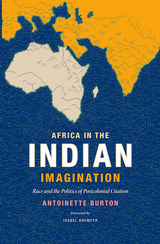
In Bedford-Stuyvesant, Brooklyn, pianist Randy Weston and bassist Ahmed Abdul-Malik celebrated with song the revolutions spreading across Africa. In Ghana and South Africa, drummer Guy Warren and vocalist Sathima Bea Benjamin fused local musical forms with the dizzying innovations of modern jazz. These four were among hundreds of musicians in the 1950s and ’60s who forged connections between jazz and Africa that definitively reshaped both their music and the world.
Each artist identified in particular ways with Africa’s struggle for liberation and made music dedicated to, or inspired by, demands for independence and self-determination. That music was the wild, boundary-breaking exultation of modern jazz. The result was an abundance of conversation, collaboration, and tension between African and African American musicians during the era of decolonization. This collective biography demonstrates how modern Africa reshaped jazz, how modern jazz helped form a new African identity, and how musical convergences and crossings altered politics and culture on both continents.
In a crucial moment when freedom electrified the African diaspora, these black artists sought one another out to create new modes of expression. Documenting individuals and places, from Lagos to Chicago, from New York to Cape Town, Robin Kelley gives us a meditation on modernity: we see innovation not as an imposition from the West but rather as indigenous, multilingual, and messy, the result of innumerable exchanges across a breadth of cultures.
Ogunyemi uses the novels to trace a Nigerian women's literary tradition that reflects an ideology centered on children and community. Of prime importance is the paradoxical Mammywata figure, the independent, childless mother, who serves as a basis for the new woman in these novels. Ogunyemi tracks this figure through many permutations, from matriarch to exile to woman writer, her multiple personalities reflecting competing loyalties—to self and other, children and nation. Such fragmented personalities characterize the postcolonial condition in their writing. Mapping geographies of pain and endurance, the work opens a space for addressing the palava between different groups of people. Valuable as the first sustained critical study of a substantial but little known body of literature, this book also counters the shortcomings of prevailing "masculinist" theories of black literature in a powerful narrative of the Nigerian world.
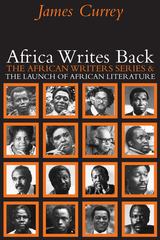
June 17, 2008, is the fiftieth anniversary of the publication of Chinua Achebe’s Things Fall Apart by Heinemann. This publication provided the impetus for the foundation of the African Writers Series in 1962 with Chinua Achebe as the editorial adviser.
Africa Writes Back: The African Writers Series and the Launch of African Literature captures the energy of literary publishing in a new and undefined field. Portraits of the leading characters and the many consultants and readers providing reports and advice to new and established writers make Africa Writes Back a stand-out book. James Currey’s voice and insights are an added bonus.
CONTENTS
Publishing and selling the African Writers Series
The African Writers Series Portfolio & George Hallett’s covers
Main dates for the African Writers Series
INTRODUCTION: The establishment of African Literature
Publishing Chinua Achebe
1. WRITERS FROM WEST AFRICA
Nigeria: The country where so much started
Negritude from Senegal to Cameroun
Magic & realism from Ghana, The Gambia & Sierra Leone
2. WRITERS FROM EASTERN AFRICA
Towards the oral & the popular in Kenya, Uganda & Tanzania
Publishing Ngugi
3. WRITERS FROM THE HORN & NORTH-EASTERN AFRICA
Emperors in Ethiopia
Publishing Nuruddin Farah
Arab authors in Egypt & Sudan
4. WRITERS FROM SOUTH AFRICA
Resistance in South Africa
Publishing Alex la Guma
Publishing Dennis Brutus
Publishing Bessie Head
Publishing Masizi Kunene
5. WRITERS FROM SOUTHERN AFRICAN
Guns & Guerrillas in Mozambique &Angola
Zambia Shall be Free
Death & detention in Malawi
The struggle to become Zimbabwe
Publishing Dambudzo Marechera
CONCLUSION: Is there still a role for the African Writers Series?
While African American political thought is inextricable from the historical movement of American political thought, this volume stresses the individuality of Black thinkers, the transnational and diasporic consciousness, and how individual speakers and writers draw on various traditions simultaneously to broaden our conception of African American political ideas. This landmark volume gives us the opportunity to tap into the myriad and nuanced political theories central to Black life. In doing so, African American Political Thought: A Collected History transforms how we understand the past and future of political thinking in the West.
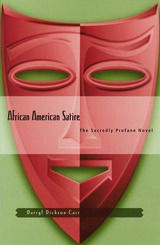
Satire's real purpose as a literary genre is to criticize through humor, irony, caricature, and parody, and ultimately to defy the status quo. In African American Satire, Darryl Dickson-Carr provides the first book-length study of African American satire and the vital role it has played. In the process he investigates African American literature, American literature, and the history of satire.
Dickson-Carr argues that major works by such authors as Rudolph Fisher, Ishmael Reed, Ralph Ellison, Langston Hughes, and George S. Schuyler should be read primarily as satires in order to avoid misinterpretation and to gain a greater understanding of their specific meanings and the eras in which they were written. He also examines the satirical rhetoric and ideological bases of complex works such as John Oliver Killens's The Cotillion and Cecil Brown's The Life and Loves of Mr. Jiveass Nigger—books that are currently out of print and that have received only scant critical attention since they were first published.
Beginning with the tradition of folk humor that originated in West Africa and was forcibly transplanted to the Americas through chattel slavery, Dickson-Carr focuses in each chapter on a particular period of the twentieth century in which the African American satirical novel flourished. He analyzes the historical contexts surrounding African American literature and culture within discrete crucial movements, starting with the Harlem Renaissance of the 1920s and ending in the present. He also demonstrates how the political, cultural, and literary ethos of each particular moment is manifested and contested in each text.
By examining these texts closely within their historical and ideological contexts, Dickson-Carr shows how African American satirical novels provide the reader of African American literature with a critique of popular ideologies seldom found in nonsatirical works. Providing a better understanding of what satire is and why it is so important for fulfilling many of the goals of African American literature, African American Satire will be an important addition to African American studies.
In this book, Gary Totten examines the global travel narratives of a diverse set of African American writers, including Ida B. Wells, Booker T. Washington, Matthew Henson, Jessie Redmon Fauset, and Zora Neale Hurston. While these writers deal with issues of identity in relation to a reimagined sense of self—in a way that we might expect to find in travel narratives—they also push against the constraints and conventions of the genre, reconsidering discourses of tourism, ethnography, and exploration. This book not only offers new insights about African American writers and mobility, it also charts the ideological distinctions and divergent agendas within this group of writers. Totten demonstrates how these travelers and their writings challenged dominant ideologies about African American experience, expression, and identity in a period of escalating racial violence. By setting these texts in their historical context and within the genre of travel writing, Totten presents a nuanced understanding of both popular and recovered work of the period.
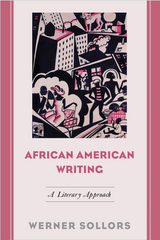
Werner Sollors’ African American Writing takes a fresh look at what used to be called “Negro literature.” The essays collected here, ranging in topic from Gustavus Vassa/Olaudah Equiano to LeRoi Jones/Amiri Baraka, and in time from the Enlightenment to the Obama presidency, take a literary approach to black writing and present writers as readers and as intellectuals who were or are open to the world.
From W.E.B. Du Bois commenting on Richard Wagner and Elvis Presley, to Zora Neale Hurston attacking Brown v. Board of Ed. in a segregationist newspaper, to Charles Chesnutt’s effigy darkened for the black heritage postage stamp, Sollors alternates between close readings and broader cultural contextualizations to delineate the various aesthetic modes and intellectual exchanges that shaped a series of striking literary works.
Readers will make often-surprising discoveries in the authors’ writing and in their encounters and dialogues with others. The essays, accompanied by Winold Reiss’s pastels, Carl Van Vechten’s photographs, and other portraits, attempt to honor this important literature’s achievement, heterogeneity, and creativity.
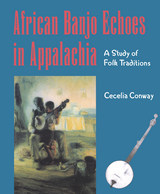
Drawing in part on interviews with elderly African-American banjo players from the Piedmont—among the last American representatives of an African banjo-playing tradition that spans several centuries—Conway reaches beyond the written records to reveal the similarity of pre-blues black banjo lyric patterns, improvisational playing styles, and the accompanying singing and dance movements to traditional West African music performances. The author then shows how Africans had, by the mid-eighteenth century, transformed the lyrical music of the gourd banjo as they dealt with the experience of slavery in America.
By the mid-nineteenth century, white southern musicians were learning the banjo playing styles of their African-American mentors and had soon created or popularized a five-string, wooden-rim banjo. Some of these white banjo players remained in the mountain hollows, but others dispersed banjo music to distant musicians and the American public through popular minstrel shows.
By the turn of the century, traditional black and white musicians still shared banjo playing, and Conway shows that this exchange gave rise to a distinct and complex new genre—the banjo song. Soon, however, black banjo players put down their banjos, set their songs with increasingly assertive commentary to the guitar, and left the banjo and its story to white musicians. But the banjo still echoed at the crossroads between the West African griots, the traveling country guitar bluesmen, the banjo players of the old-time southern string bands, and eventually the bluegrass bands.
The Author: Cecelia Conway is associate professor of English at Appalachian State University. She is a folklorist who teaches twentieth-century literature, including cultural perspectives, southern literature, and film.


African Literature in the Twentieth Century was first published in 1976. Minnesota Archive Editions uses digital technology to make long-unavailable books once again accessible, and are published unaltered from the original University of Minnesota Press editions.
This paperback makes available the major part of Professor Dathorne's The Black Mind.It concentrates on the writings of Africans in various African and European languages and provides insight, both broad and deep, into the Black intellect. Professor Dathorne examines the literature of Africans as spoken or written in their local languages and in French, Portuguese, and English. This extensive survey and interpretation gives the reader a remarkable pathway to an understanding of the Black imagination and its relevance to thought and creativity throughout the world.
The author himself lived in Africa for ten years, and his view is not that of an outsider, since it is as a Black man that he speaks about Black people. Throughout the book, a major theme is the demonstration that, despite slavery and colonialism, Africans remained very close to their own cultures. Professor Dathorne shows that African writers may be, like some Afro-American writers, "marginal men," but that they are Black men and it is as Black men that they feel the nostalgia of their past and the corrosive influences of their present.
O. R. Dathorne is a member of the Department of Black Studies and of the Department of English at Ohio State University. He has taught at universities in Nigeria and Sierra Leone and served as a UNESCO adviser in Sierra Leone. He also has taught at Ohio State University, Howard University, and the University of Wisconsin and lectured at Yale, Federal City College, Michigan State, and other universities in and out of the United States. He is the author of two novels and editor of a number of anthologies of Black literature, and has written widely in journals on his subject.
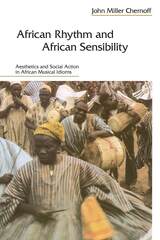
"John Miller Chernoff, who spent 10 years studying African drumming, has a flair for descriptive writing, and his first-person narratives should be easily understood by any reader, while ringing unmistakably true for the reader who has also been to West Africa."—Roderick Knight, Washington Post Book World
"Ethnomusicologists must be proud that their discipline has produced a book that will, beyond doubt, rank as a classic of African studies."—Peter Fryer, Research in Literatures
"A marvelous book. . . . Not many scholars will ever be able to achieve the kind of synthesis of 'doing' and 'writing about' their subject matter that Chernoff has achieved, but he has given us an excellent illustration of what is possible."—Chet Creider, Culture
"Chernoff develops a brilliant and penetrating musicological essay that is, at the same time, an intensely personal and even touching account of musical and cultural discovery that anyone with an interest in Africa can and should read. . . . No other writing comes close to approaching Chernoff's ability to convey a feeling of how African music 'works'"—James Koetting, Africana Journal
"Four stars. One of the few books I know of that talks of the political, social, and spiritual meanings of music. I was moved. It was so nice I read it twice."—David Byrne of "Talking Heads"
The companion cassette tape has 44 examples of the music discussed in the book. It consists of field recordings illustrating cross-rhythms, multiple meters, call and response forms, etc.
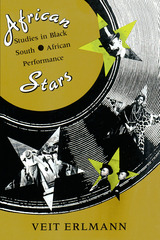
become ever more popular in the West, where they are now
widely celebrated as expressions of opposition to
discrimination and repression. Less well known is the
rich history of these arts, which were shaped by several
generations of black artists and performers whose
struggles, visions, and aspirations did not differ fundamentally
from those of their present-day counterparts.
In five detailed case studies Veit Erlmann digs deep to expose the roots of the most important of these performance traditions. He relates the early history of isicathamiya, the a cappella vocal style made famous by Ladysmith Black Mambazo.
In two chapters on Durban between the World Wars he charts the evolution of Zulu music and dance, studying in depth the transformation of ingoma, a dance form popular among migrant workers since the 1930s. He goes on to
record the colorful life and influential work of Reuben T. Caluza,
South Africa's first black ragtime composer. And Erlmann's reconstruction of the 1890s concert tours of an Afro-American vocal group, Orpheus M. McAdoo and the Virginia Jubilee Singers, documents the earliest link between the African and American performance traditions.
Numerous eyewitness reports, musicians' personal testimonies, and song texts enrich Erlmann's narratives and demonstrate that black performance evolved in response to the growing economic and racial segmentation of South African
society. Early ragtime, ingoma, and isicathamiya enabled the black urban population to comment on their precarious social position and to symbolically construct a secure space within a rapidly changing political world.
Today, South African workers, artists, and youth continue to build upon this performance tradition in their struggle for freedom and democracy. The early performers portrayed by Erlmann were guiding lights—African stars—by which the present and future course of South Africa is being determined.
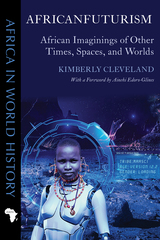
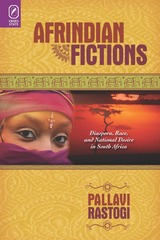

Reveals a century of political solidarity uniting Asians and African Americans
As early as 1914, in his pivotal essay “The World Problem of the Color Line,” W. E. B. Du Bois was charting a search for Afro-Asian solidarity and for an international anticolonialism. In Afro-Orientalism, Bill Mullen traces the tradition of revolutionary thought and writing developed by African American and Asian American artists and intellectuals in response to Du Bois’s challenge.
Afro-Orientalism unfolds here as a distinctive strand of cultural and political work that contests the longstanding, dominant discourse about race and nation first fully named in Edward Said’s Orientalism. Mullen tracks Afro-Asian engagement with U.S. imperialism—including writings by Richard Wright, Grace and James Boggs, Robert F. Williams, and Fred Ho—and companion struggles against racism and capitalism around the globe. To this end, he offers Afro-Orientalism as an antidote to essentialist, race-based, or narrow conceptions of ethnic studies and postcolonial studies, calling on scholars in these fields to re-imagine their critical enterprises as mutually constituting and politically interdependent.
"This diverse and inspired collection . . . testifies to the Afro-Am academy's extraordinary vitality."—Voice Literary Supplement
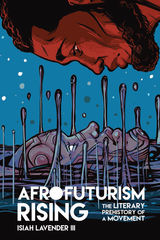
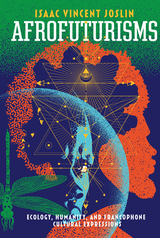
By engaging with authors as diverse as Phillis Wheatley, David Walker, Frederick Douglass, Harriet Ann Jacobs, Samuel R. Delany Jr., Pauline Hopkins, Zora Neale Hurston, and Richard Wright, Afrofuturism Rising extends existing scholarly conversations about who creates and what is created via science fiction. Through a trans-historical rereading of texts by these authors as science fiction, Lavender highlights the ways black experience in America has always been an experience of spatial and temporal dislocation akin to science fiction. Compelling and ambitious in scope, Afrofuturism Rising redefines both science fiction and literature as a whole.
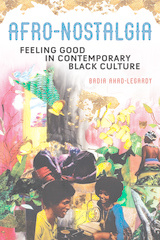
Badia Ahad-Legardy mines literature, visual culture, performance, and culinary arts to form an archive of black historical joy for use by the African-descended. Her analysis reveals how contemporary black artists find more than trauma and subjugation within the historical past. Drawing on contemporary African American culture and recent psychological studies, she reveals nostalgia’s capacity to produce positive emotions. Afro-nostalgia emerges as an expression of black romantic recollection that creates and inspires good feelings even within our darkest moments.
Original and provocative, Afro-Nostalgia offers black historical pleasure as a remedy to contend with the disillusionment of the present and the traumas of the past.
The book has been enriched by the author's in-depth conversations with the playwrights. The topics covered include contemporary politics and the theater, the National Theatre, the Royal Shakespeare Company, and such well-known fringe companies as Foco Novo, Joint Stock, Portable Theatre, and 7:84. Reinelt examines each playwright within an interpretive frame drawn from an application of Brecht's theories and practice to the historically specific situation of post-war British theater.
The book will appeal to those interested in the relationship between politics and art and contemporary European theater and its antecedents.
"After Brecht represents the best and most detailed engagement with the contemporary British theater scene to date." --Stanton B. Garner, Jr.
"This fine study . . . confronts issues that are important to all students and practitioners of the theater. Sensitive to the uniqueness of each of the playwrights in her study, Reinelt demonstrates that Brechtian theory can be modified in many ways by those who share the belief that 'politics and aesthetics are inseparably linked.'" --Choice
Janelle Reinelt is Chair of the Department of Dramatic Art and Dance, University of California-Davis.
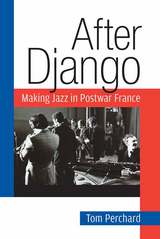
Arguing against a model of cultural identity based on race, Gorra begins with Scott's portrait, in The Raj Quartet, of the character Hari Kumar—a seeming oxymoron, an "English boy with a dark brown skin," whose very existence undercuts the belief in an absolute distinction between England and India. He then turns to the opposed figures of Naipaul and Rushdie, the two great novelists of the Indian diaspora. Whereas Naipaul's long and controversial career maps the "deep disorder" spread by both imperialism and its passing, Rushdie demonstrates that certain consequences of that disorder, such as migrancy and mimicry, have themselves become creative forces.
After Empire provides engaging and enlightening readings of postcolonial fiction, showing how imperialism helped shape British national identity—and how, after the end of empire, that identity must now be reconfigured.
Alfred Hitchcock is arguably the most famous director to have ever made a film. Almost single-handedly he turned the suspense thriller into one of the most popular film genres of all time, while his Psycho updated the horror film and inspired two generations of directors to imitate and adapt this most Hitchcockian of movies. Yet while much scholarly and popular attention has focused on the director's oeuvre, until now there has been no extensive study of how Alfred Hitchcock's films and methods have affected and transformed the history of the film medium.
In this book, thirteen original essays by leading film scholars reveal the richness and variety of Alfred Hitchcock's legacy as they trace his shaping influence on particular films, filmmakers, genres, and even on film criticism. Some essays concentrate on films that imitate Hitchcock in diverse ways, including the movies of Brian de Palma and thrillers such as True Lies, The Silence of the Lambs, and Dead Again. Other essays look at genres that have been influenced by Hitchcock's work, including the 1970s paranoid thriller, the Italian giallo film, and the post-Psycho horror film. The remaining essays investigate developments within film culture and academic film study, including the enthusiasm of French New Wave filmmakers for Hitchcock's work, his influence on the filmic representation of violence in the post-studio Hollywood era, and the ways in which his films have become central texts for film theorists.
The fear of falling, the awareness of lost innocence, lost illusions, lost hopes and intentions, of civilization in decline—these are the themes which link literature to theology, both concerned with the shape of human destiny. Otten discusses the continuing viability of the myth of the Fall in literature. He relates a wide variety of romantic and modern works to fundamental issues in modern Christianity.
Ireland is suffering from a crisis of authority. Catholic Church scandals, political corruption, and economic collapse have shaken the Irish people’s faith in their institutions and thrown the nation’s struggle for independence into question. While Declan Kiberd explores how political failures and economic globalization have eroded Irish sovereignty, he also sees a way out of this crisis. After Ireland surveys thirty works by modern writers that speak to worrisome trends in Irish life and yet also imagine a renewed, more plural and open nation.
After Dublin burned in 1916, Samuel Beckett feared “the birth of a nation might also seal its doom.” In Waiting for Godot and a range of powerful works by other writers, Kiberd traces the development of an early warning system in Irish literature that portended social, cultural, and political decline. Edna O’Brien, Frank O’Connor, Seamus Heaney, and Michael Hartnett lamented the loss of the Irish language, Gaelic tradition, and rural life. Nuala Ní Dhomhnaill and Eavan Boland grappled with institutional corruption and the end of traditional Catholicism. These themes, though bleak, led to audacious experimentation, exemplified in the plays of Brian Friel and Tom Murphy and the novels of John Banville. Their achievements embody the defiance and resourcefulness of Ireland’s founding spirit—and a strange kind of hope.
After Ireland places these writers and others at the center of Ireland’s ongoing fight for independence. In their diagnoses of Ireland’s troubles, Irish artists preserve and extend a humane culture, planting the seeds of a sound moral economy.
This is the first book in English to analyze the Chinese literary scene during the post-Mao thaw in government control. The seven contributors originally presented their research at a 1982 international conference at St. John’s University, New York, which was attended by scholars from America, Europe, and Asia, including participants from the People’s Republic of China and Taiwan.
The special focus on popular literature—science fiction, love stories, detective fiction—reflects China’s new urban mass culture. These popular genres, plus the new “obscure” poetry, and the short-lived literary magazine Today are examined from an international comparative perspective and from a variety of viewpoints—literary, social, historical, political.
Those social and political realities that help determine what books are on hand in China for people to read are discussed. The final chapter presents data on periodical sales, book sales, library borrowings, and readers’ stated preferences in large cities, with emphasis on Canton. Such investigations into what the Chinese public was writing and reading in the years 1978–1981 throw new light on Chinese social attitudes, ideals, morals, and taste.
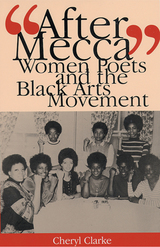
In "After Mecca," Cheryl Clarke explores the relationship between the Black Arts Movement and black women writers of the period. Poems by Gwendolyn Brooks, Ntozake Shange, Audre Lorde, Nikki Giovanni, Sonia Sanchez, Jayne Cortez, Alice Walker, and others chart the emergence of a new and distinct black poetry and its relationship to the black community's struggle for rights and liberation. Clarke also traces the contributions of these poets to the development of feminism and lesbian-feminism, and the legacy they left for others to build on.
She argues that whether black women poets of the time were writing from within the movement or writing against it, virtually all were responding to it. Using the trope of "Mecca," she explores the ways in which these writers were turning away from white, western society to create a new literacy of blackness.
All scholars subscribe to theories, and these are embedded in their criticism and scholarship. Whatever the excesses of (and differences between) deconstruction, feminism, the new historicism, and the other theories that Jay and Miller review, they share a commitment to heightening the teacher/critic's self-consciousness about the labor that he or she performs.
*
Calling Samuel Johnson the greatest literary critic since Aristotle, Richard B. Schwartz assumes the perspective of that quintessential eighteenth-century man of letters to examine the critical and theoretical literary developments that gained momentum in the 1970s and stimulated the culture wars of the 1980s and 1990s.
Schwartz speculates that Johnson—who revered hard facts, a wide cultural base, and common sense—would have exhibited scant patience with the heavily academic approaches currently favored in the study of literature. He considers it probable that the combatants in the early struggles of the culture wars are losing energy and that, in the wake of Alvin Kernan’s declaration of the death of literature, new battlegrounds are developing. Ironically admiring the orchestration and staging of battles old and new—"superb" he calls them—he characterizes the entire cultural war as a "battle between straw men, carefully constructed by the combatants to sustain a pattern of polarization that could be exploited to provide continuing professional advancement."
In seven diverse essays, Schwartz calls for both the broad cultural vision and the sanity of a Samuel Johnson from those who make pronouncements about literature. Running through and unifying these essays is the conviction that the cultural elite is clearly detached from life: "Academics, fleeing in horror from anything smacking of the bourgeois, offer us something far worse: bland sameness presented in elitist terms in the name of the poor." Another theme is that the either/or absolutism of many of the combatants is "absurd on its face [and] belies the complexities of art, culture, and humanity."
Like Johnson, Schwartz would terminate the divorce between literature and life, make allies of literature and criticism, and remove poetry from the province of the university and return it to the domain of readers. Texts would carry meaning, embody values, and have a serious impact on life.
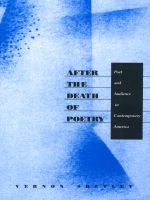
In exemplary case studies, Shetley identifies the very different ways in which three postwar poets—Elizabeth Bishop, James Merrill, and John Ashbery—try to restore some of the challenge and risk that characterized modernist poetry's relation to its first readers. Sure to be controversial, this cogent analysis offers poets and readers a clear sense of direction and purpose, and so, the hope of reaching each other again.
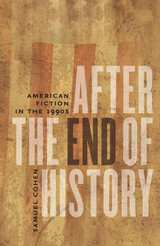
At the same time, Cohen enters into the theoretical discussion about postmodern historical understanding. Throwing his hat in the ring with force and style, he confronts not only Francis Fukuyama’s triumphalist response to the fall of the Soviet Union but also the other literary and political “end of history” claims put forth by such theorists as Fredric Jameson and Walter Benn Michaels. In a straightforward, affecting style, After the End of History offers us a new vision for the capabilities and confines of contemporary fiction.
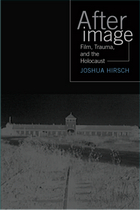
Joshua Hirsch explores the changes in documentary brought about by cinema verite, culminating in Shoah. He then turns to teh appearance of a fictional posttraumatic cinema, tracing its development through the vivid flashbacks in Resnais' Hiroshima, mon amour to the portrayal of pain and memory in Pawnbroker. He excavates a posttraumatic autobiography in three early films by the Hungarian Istvan Szabo. Finally, Hirsch examines the effects of postmodernism on posttraumatic cinema, looking at Schindler's List and a work about a different form of historical trauma, History and Memory, a videotape dealing with the internment of Japanese Americans during the Second World War.
Sweeping in its scope, Afterimage presents a new way of thinking about film and history, trauma and its representation.
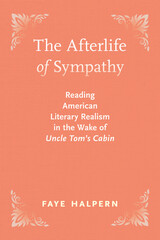
Literary realism rose to prominence in postbellum America with what the realists heralded as artful and accurate depictions of the world. Realism is thought to have replaced sentimentality—an earlier mode of writing the realists disparaged, which has often been seen as antithetical to realism. Literary scholar Faye Halpern challenges this apparent binary by uncovering how and why William Dean Howells, Mark Twain, Henry James, Constance Fenimore Woolson, and Charles Chesnutt incorporated sentimental elements into their most famous works.
With its distinctively narratological approach, The Afterlife of Sympathy offers a more rhetorical way to understand sentimentality and assess the ethical complexity of sympathy. Halpern demonstrates how sentimentality enables authors to form intimate relationships between their characters and readers to supplement the critical distance that realist writers otherwise celebrate and that has remained a key value in literary studies today. In reassessing American literary realism, Halpern seeks not only to understand why these writers adopted sentimental techniques but to provide insight into contemporary arguments in literary studies about critical distance and sympathetic identification.
Popular representations of the past are everywhere in Japan, from cell phone charms to manga, from television dramas to video games to young people dressed as their favorite historical figures hanging out in the hip Harajuku district. But how does this mass consumption of the past affect the way consumers think about history and what it means to be Japanese?
By analyzing representations of the famous sixteenth-century samurai leader Toyotomi Hideyoshi in historical fiction based on Taikōki, the original biography of him, this book explores how and why Hideyoshi has had a continued and ever-changing presence in popular culture in twentieth- and twenty-first-century Japan. The multiple fictionalized histories of Hideyoshi published as serial novels and novellas before, during, and after World War II demonstrate how imaginative re-presentations of Japan’s past have been used by various actors throughout the modern era.
Using close reading of several novels and short stories as well as the analysis of various other texts and paratextual materials, Susan Furukawa discovers a Hideyoshi who is always changing to meet the needs of the current era, and in the process expands our understanding of the powerful role that historical narratives play in Japan.
Popular representations of the past are everywhere in Japan, from cell phone charms to manga, from television dramas to video games to young people dressed as their favorite historical figures hanging out in the hip Harajuku district. But how does this mass consumption of the past affect the way consumers think about history and what it means to be Japanese?
By analyzing representations of the famous sixteenth-century samurai leader Toyotomi Hideyoshi in historical fiction based on Taikōki, the original biography of him, this book explores how and why Hideyoshi has had a continued and ever-changing presence in popular culture in twentieth- and twenty-first-century Japan. The multiple fictionalized histories of Hideyoshi published as serial novels and novellas before, during, and after World War II demonstrate how imaginative re-presentations of Japan’s past have been used by various actors throughout the modern era.
Using close reading of several novels and short stories as well as the analysis of various other texts and paratextual materials, Susan Furukawa discovers a Hideyoshi who is always changing to meet the needs of the current era, and in the process expands our understanding of the powerful role that historical narratives play in Japan.
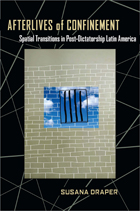
The afterlife of prisons became an important tool in the “forgetting” of past politics, while also serving as a reminder to citizens of the liberties they now enjoyed. In Draper’s analysis, these symbols led the populace to believe they had attained freedom, although they had only witnessed the veneer of democracy—in the ability to vote and consume.
In selected literary works by Roberto Bolaño, Eleuterio Fernández Huidoboro, and Diamela Eltit and films by Alejandro Agresti and Marco Bechis, Draper finds further evidence of the emptiness and melancholy of underachieved goals in the afterlife of dictatorships. The social changes that did not occur, the inability to effectively mourn the losses of a now-hidden past, the homogenizing effects of market economies, and a yearning for the promises of true freedom are thematic currents underlying much of these texts.
Draper’s study of the manipulation of culture and consumerism under the guise of democracy will have powerful implications not only for Latin Americanists but also for those studying neoliberal transformations globally.
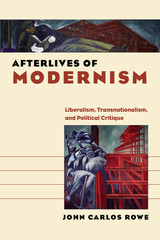
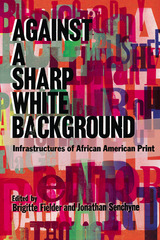
READERS
Browse our collection.
PUBLISHERS
See BiblioVault's publisher services.
STUDENT SERVICES
Files for college accessibility offices.
RECENTLY PUBLISHED


UChicago Accessibility Resources
home | accessibility | search | about | contact us
BiblioVault ® 2001 - 2024
The University of Chicago Press