
 A SCHOLARLY BOOK REPOSITORY
Results by Title
3 books about Family Planning
3 books about Family Planning
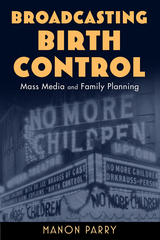
Broadcasting Birth Control
Mass Media and Family Planning
Parry, Manon
Rutgers University Press, 2013
Traditionally, the history of the birth control movement has been told through the accounts of the leaders, organizations, and legislation that shaped the campaign. Recently, historians have begun examining the cultural work of printed media, including newspapers, magazines, and even novels in fostering support for the cause. Broadcasting Birth Control builds on this new scholarship to explore the films and radio and television broadcasts developed by twentieth-century birth control advocates to promote family planning at home in the United States, and in the expanding international arena of population control.
Mass media, Manon Parry contends, was critical to the birth control movement’s attempts to build support and later to publicize the idea of fertility control and the availability of contraceptive services in the United States and around the world. Though these public efforts in advertising and education were undertaken initially by leading advocates, including Margaret Sanger, increasingly a growing class of public communications experts took on the role, mimicking the efforts of commercial advertisers to promote health and contraception in short plays, cartoons, films, and soap operas. In this way, they made a private subject—fertility control—appropriate for public discussion.
Parry examines these trends to shed light on the contested nature of the motivations of birth control advocates. Acknowledging that supporters of contraception were not always motivated by the best interests of individual women, Parry concludes that family planning advocates were nonetheless convinced of women’s desire for contraception and highly aware of the ethical issues involved in the use of the media to inform and persuade.
Mass media, Manon Parry contends, was critical to the birth control movement’s attempts to build support and later to publicize the idea of fertility control and the availability of contraceptive services in the United States and around the world. Though these public efforts in advertising and education were undertaken initially by leading advocates, including Margaret Sanger, increasingly a growing class of public communications experts took on the role, mimicking the efforts of commercial advertisers to promote health and contraception in short plays, cartoons, films, and soap operas. In this way, they made a private subject—fertility control—appropriate for public discussion.
Parry examines these trends to shed light on the contested nature of the motivations of birth control advocates. Acknowledging that supporters of contraception were not always motivated by the best interests of individual women, Parry concludes that family planning advocates were nonetheless convinced of women’s desire for contraception and highly aware of the ethical issues involved in the use of the media to inform and persuade.
[more]
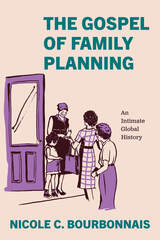
The Gospel of Family Planning
An Intimate Global History
Nicole C. Bourbonnais
University of Chicago Press, 2025
An engaging, insightful history of the family planning movement and its connection to broader social and political developments across the globe.
In the twentieth century, the idea that people should consciously plan (and limit) the size of their families became a global cause. Historical accounts of the global family planning movement have largely focused on the most prominent activists and those at the helm of international organizations, philanthropic foundations, and government programs. In The Gospel of Family Planning, however, historian Nicole C. Bourbonnais shifts our attention to frontline workers—doctors, social workers, nurses, fieldworkers, consultants, church groups, and volunteers—who, she compellingly shows, played a central (if complicated) role in preaching contraception around the world.
Through a mix of collective biography and microhistory, Bourbonnais visits clinics, doorsteps, and bedrooms, revealing the everyday, ground-level workings of grassroots family planning campaigns, state population control programs, and the movements for reproductive rights and justice that arose to contest them. Throughout the book, Bourbonnais invites readers to consider how the intertwined histories of missionary work, humanitarianism, feminism, decolonization, and international development shaped intimate interventions into people’s reproductive lives around the world.
In the twentieth century, the idea that people should consciously plan (and limit) the size of their families became a global cause. Historical accounts of the global family planning movement have largely focused on the most prominent activists and those at the helm of international organizations, philanthropic foundations, and government programs. In The Gospel of Family Planning, however, historian Nicole C. Bourbonnais shifts our attention to frontline workers—doctors, social workers, nurses, fieldworkers, consultants, church groups, and volunteers—who, she compellingly shows, played a central (if complicated) role in preaching contraception around the world.
Through a mix of collective biography and microhistory, Bourbonnais visits clinics, doorsteps, and bedrooms, revealing the everyday, ground-level workings of grassroots family planning campaigns, state population control programs, and the movements for reproductive rights and justice that arose to contest them. Throughout the book, Bourbonnais invites readers to consider how the intertwined histories of missionary work, humanitarianism, feminism, decolonization, and international development shaped intimate interventions into people’s reproductive lives around the world.
[more]

Unmaking Russia’s Abortion Culture
Family Planning and the Struggle for a Liberal Biopolitics
Michele Rivkin-Fish
Vanderbilt University Press, 2024
Honorable Mention, Davis Center Book Prize in Political and Social Studies, Association for Slavic, East European, and Eurasian Studies, 2025
As the predominant form of birth control in Soviet society, abortion reflected key paradoxes of state socialism: women held formal equality but lacked basic needs such as contraceptives. With market reforms, Russians enjoyed new access to Western contraceptives and new pressures to postpone childbearing until economically self-sufficient. But habits of family planning did not emerge automatically—they required extensive physician retraining, public education, and cultural transformation. In Unmaking Russia’s Abortion Culture, author Michele Rivkin-Fish examines the creative strategies of Russians who promoted family planning in place of routine abortion. Rather than emphasizing individual rights, they explained family planning’s benefits to the nation—its potential to strengthen families and prevent the secondary sterility that resulted when women underwent repeat, poor-quality abortions. Still, fierce debates about abortion and contraceptives erupted as declining fertility was framed as threatening Russia’s demographic sovereignty.
Although Russian family planners embraced a culturally meaningful liberalism that would rationalize public policy and reenchant relations, nationalist opponents cast family planning as suspicious for its association with the individualistic, “child-free” West. This book tells the story of how Russian family planners developed culturally salient frameworks to promote the acceptability of contraceptives and help end routine abortion. It also documents how nationalist campaigns for higher fertility denounced family planning and ultimately dismantled its institutions. By tracing these processes, Unmaking Russia’s Abortion Culture demonstrates the central importance of reproductive politics in the struggle for liberalizing social change that preceded Russia’s 2022 descent into war, repression, and global marginalization.
As the predominant form of birth control in Soviet society, abortion reflected key paradoxes of state socialism: women held formal equality but lacked basic needs such as contraceptives. With market reforms, Russians enjoyed new access to Western contraceptives and new pressures to postpone childbearing until economically self-sufficient. But habits of family planning did not emerge automatically—they required extensive physician retraining, public education, and cultural transformation. In Unmaking Russia’s Abortion Culture, author Michele Rivkin-Fish examines the creative strategies of Russians who promoted family planning in place of routine abortion. Rather than emphasizing individual rights, they explained family planning’s benefits to the nation—its potential to strengthen families and prevent the secondary sterility that resulted when women underwent repeat, poor-quality abortions. Still, fierce debates about abortion and contraceptives erupted as declining fertility was framed as threatening Russia’s demographic sovereignty.
Although Russian family planners embraced a culturally meaningful liberalism that would rationalize public policy and reenchant relations, nationalist opponents cast family planning as suspicious for its association with the individualistic, “child-free” West. This book tells the story of how Russian family planners developed culturally salient frameworks to promote the acceptability of contraceptives and help end routine abortion. It also documents how nationalist campaigns for higher fertility denounced family planning and ultimately dismantled its institutions. By tracing these processes, Unmaking Russia’s Abortion Culture demonstrates the central importance of reproductive politics in the struggle for liberalizing social change that preceded Russia’s 2022 descent into war, repression, and global marginalization.
[more]
READERS
Browse our collection.
PUBLISHERS
See BiblioVault's publisher services.
STUDENT SERVICES
Files for college accessibility offices.
RECENTLY PUBLISHED







UChicago Accessibility Resources
home | accessibility | search | about | contact us
BiblioVault ® 2001 - 2025
The University of Chicago Press