
 A SCHOLARLY BOOK REPOSITORY
Results by Title
2 books about Deadline
2 books about Deadline

Deadline
200 Years of Violence Against Journalists in the United States
Elizabeth Atwood
University of Missouri Press, 2025
In Deadline: 200 Years of Violence against Journalists in the United States, Elizabeth Atwood offers the first comprehensive look at the history of fatal attacks against journalists in the United States between 1829 and the present. Atwood describes the political, technological, and economic context of these assaults, and includes brief biographies of the victims and accounts of what happened both them and to their assailants after the attacks.
To help us understand these attacks, Atwood presents a framework for categorizing them, built on John Nerone’s studies on assaults on American media workers. Atwood categorizes attacks against journalists as attacks against individuals, ideas, and media institutions, and undertaken to suppress reporting on certain topics and in the context of wars and other international or conflicts. Crucially, Deadline utilizes this framework to offer possible solutions to the issue of violence against journalists.
Atwood was inspired to explore the pressing issue of violence against American journalists after the tragic death of one of her colleagues at the Baltimore Sun, Rob Hiaasen, in the Capital Gazette shooting in 2018. Throughout, she demonstrates that distrust of the media and violence against the press in the United States are hardly new developments. Her work examines how intimidation, violence, and censorship have, in fact, been used against the American press since both its and the nation’s founding.
To help us understand these attacks, Atwood presents a framework for categorizing them, built on John Nerone’s studies on assaults on American media workers. Atwood categorizes attacks against journalists as attacks against individuals, ideas, and media institutions, and undertaken to suppress reporting on certain topics and in the context of wars and other international or conflicts. Crucially, Deadline utilizes this framework to offer possible solutions to the issue of violence against journalists.
Atwood was inspired to explore the pressing issue of violence against American journalists after the tragic death of one of her colleagues at the Baltimore Sun, Rob Hiaasen, in the Capital Gazette shooting in 2018. Throughout, she demonstrates that distrust of the media and violence against the press in the United States are hardly new developments. Her work examines how intimidation, violence, and censorship have, in fact, been used against the American press since both its and the nation’s founding.
[more]
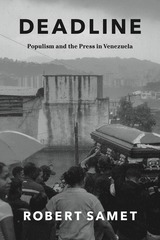
Deadline
Populism and the Press in Venezuela
Robert Samet
University of Chicago Press, 2019
Since 2006, Venezuela has had the highest homicide rate in South America and one of the highest levels of gun violence in the world. Former president Hugo Chávez, who died in 2013, downplayed the extent of violent crime and instead emphasized rehabilitation. His successor, President Nicolás Maduro, took the opposite approach, declaring an all-out war on crime (mano dura). What accounts for this drastic shift toward more punitive measures?
In Deadline, anthropologist Robert Samet answers this question by focusing on the relationship between populism, the press, and what he calls “the will to security.” Drawing on nearly a decade of ethnographic research alongside journalists on the Caracas crime beat, he shows how the media shaped the politics of security from the ground up. Paradoxically, Venezuela’s punitive turn was not the product of dictatorship, but rather an outgrowth of practices and institutions normally associated with democracy. Samet reckons with this apparent contradiction by exploring the circulation of extralegal denuncias (accusations) by crime journalists, editors, sources, and audiences. Denuncias are a form of public shaming or exposé that channels popular anger against the powers that be. By showing how denuncias mobilize dissent, Deadline weaves a much larger tale about the relationship between the press, popular outrage, and the politics of security in the twenty-first century.
In Deadline, anthropologist Robert Samet answers this question by focusing on the relationship between populism, the press, and what he calls “the will to security.” Drawing on nearly a decade of ethnographic research alongside journalists on the Caracas crime beat, he shows how the media shaped the politics of security from the ground up. Paradoxically, Venezuela’s punitive turn was not the product of dictatorship, but rather an outgrowth of practices and institutions normally associated with democracy. Samet reckons with this apparent contradiction by exploring the circulation of extralegal denuncias (accusations) by crime journalists, editors, sources, and audiences. Denuncias are a form of public shaming or exposé that channels popular anger against the powers that be. By showing how denuncias mobilize dissent, Deadline weaves a much larger tale about the relationship between the press, popular outrage, and the politics of security in the twenty-first century.
[more]
READERS
Browse our collection.
PUBLISHERS
See BiblioVault's publisher services.
STUDENT SERVICES
Files for college accessibility offices.
RECENTLY PUBLISHED






UChicago Accessibility Resources
home | accessibility | search | about | contact us
BiblioVault ® 2001 - 2025
The University of Chicago Press