
 A SCHOLARLY BOOK REPOSITORY
Drawing on the archival research of wills, public documents, and other texts from late-colonial and early-republican Mexico, Voekel describes the marked scaling-down of the pomp and display that had characterized baroque Catholic burials and the various devices through which citizens sought to safeguard their souls in the afterlife. In lieu of these baroque practices, the new enlightened Catholics, claims Voekel, expressed a spiritually and hygienically motivated preference for extremely simple burial ceremonies, for burial outside the confines of the church building, and for leaving their earthly goods to charity. Claiming that these changes mirrored a larger shift from an external, corporate Catholicism to a more interior piety, she demonstrates how this new form of Catholicism helped to initiate a cultural and epistemic shift that placed the individual at the center of knowledge.
Breaking with the traditional historiography to argue that Mexican liberalism had deeply religious roots, Alone Before God will be of interest to specialists in Latin American history, modernity, and religion.
The twentieth-century French church was still feeling the shock waves of the French Revolution, assaulted from without and torn from within regarding its role in politics. Challenging the views of prominent historians of the period, Arnal shows that between 1899 and 1939 Catholic leaders pursued a consistent strategy of political and social conservatism. Whereas many regarded the church's flirtations with social democracy and its occasional attempts to rally French Catholics behind constitutional politics as proof of its progressive character, Arnal sees a fundamentally reactionary continuity in church leadership. Pius XI did not condemn the Acton Française for its fascist ideology; he feared independence among Catholics more than the radical right.
Arnal's wide-ranging study brings a controversial new interpretation to the political and ecclesiastical history of the twentieth-century.


"O'Brien's bravura performance [is] seductive in its intellectual sweep and literary assurance."—Toby Barnard, Times Literary Supplement
"Has the magical insistence which Conor Cruise O'Brien can produce at his best. . . . Where he looks back to his own childhood the book shines. He writes of his mother and father with effortless grace and candor, with a marvelous, elegant mix of affection and detachment."—Observer
American evangelicalism often appears as a politically monolithic, textbook red-state fundamentalism that elected George W. Bush, opposes gay marriage, abortion, and evolution, and promotes apathy about global warming. Prominent public figures hold forth on these topics, speaking with great authority for millions of followers. Authors Stephens and Giberson, with roots in the evangelical tradition, argue that this popular impression understates the diversity within evangelicalism—an often insular world where serious disagreements are invisible to secular and religiously liberal media consumers. Yet, in the face of this diversity, why do so many people follow leaders with dubious credentials when they have other options? Why do tens of millions of Americans prefer to get their science from Ken Ham, founder of the creationist Answers in Genesis, who has no scientific expertise, rather than from his fellow evangelical Francis Collins, current Director of the National Institutes of Health?
Exploring intellectual authority within evangelicalism, the authors reveal how America’s populist ideals, anti-intellectualism, and religious free market, along with the concept of anointing—being chosen by God to speak for him like the biblical prophets—established a conservative evangelical leadership isolated from the world of secular arts and sciences.
Today, charismatic and media-savvy creationists, historians, psychologists, and biblical exegetes continue to receive more funding and airtime than their more qualified counterparts. Though a growing minority of evangelicals engage with contemporary scholarship, the community’s authority structure still encourages the “anointed” to assume positions of leadership.
As the high-ranking Bishop of Alexandria from 328 to 373, Athanasius came into conflict with no fewer than four Roman emperors—Constantine himself, his son Constantius, Julian the Apostate, and the “Arian” Valens. In this new reconstruction of Athanasius’s career, Timothy D. Barnes analyzes the nature and extent of the Bishop’s power, especially as it intersected with the policies of these emperors.
Repeatedly condemned and deposed by church councils, the Bishop persistently resurfaced as a player to contend with in ecclesiastic and imperial politics. Barnes’s work reveals that Athanasius’s writings, though a significant source for this period, are riddled with deliberate misinterpretations, which historians through the ages have uncritically accepted.
Untangling longstanding misconceptions, Barnes reveals the Bishop’s true role in the struggles within Christianity, and in the relations between the Roman emperor and the Church at a critical juncture.
In Beheading the Saint, Geneviève Zubrzycki studies that transformation through a close investigation of the annual Feast of St. John the Baptist of June 24. The celebrations of that national holiday, she shows, provided a venue for a public contesting of the dominant ethno-Catholic conception of French Canadian identity and, via the violent rejection of Catholic symbols, the articulation of a new, secular Québécois identity. From there, Zubrzycki extends her analysis to the present, looking at the role of Québécois identity in recent debates over immigration, the place of religious symbols in the public sphere, and the politics of cultural heritage—issues that also offer insight on similar debates elsewhere in the world.
Guenée chooses as his frame the momentous period from the height of Saint Louis's reign in the mid-thirteenth century to the beginning of the Italian wars two hundred years later. During this time of schism in the church, of war between nascent states, and of treachery among princes, Bernard Gui (1261-1331), Gilles Le Muisit (1272-1353), Pierre D'Ailly (1351-1420), and Thomas Basin (1412-1490) all rose from modest circumstances to the dignity of office. Guenée shows us how these prelates used their talent, ambition, patrons, zeal, and experience to juggle the competing demands of obedience to church and state; to overcome competition from an upcoming new generation; and to cope with plague, war, and violence. Free of jargon yet steeped in learning, Between Church and State reveals the career patterns and politics of an era while forging a new model for points of departure in historical scholarship.
This eloquently presented, exhaustive study concludes that legislation, however persistently enacted, was unequal to the task of remedying a lack of unity and other social and political ills. Notions of consensus are explored as a way of maintaining community cohesion and order in the absence of strong central authorities. Other issues the author confronts are Catholic tolerance and intolerance toward heterodox and non-Christian "others;" the transformation and transmission of ancient ideals and social structures from the Roman to the later medieval worlds; and the position of medieval Spain in relation to the mainstream of western European history.
This nuanced study is a must-read for anyone interested in medieval life, politics, religion, and the precarious nature of the medieval state.
Rachel Stocking is Professor of History, Southern Illinois University at Carbondale.
The reach of the Catholic Church is arguably greater than that of any other religion, extending across diverse political, ethnic, class, and cultural boundaries. But what is it about Catholicism that resonates so profoundly with followers who live under disparate conditions? What is it, for instance, that binds parishioners in America with those in Mexico? For Joseph M. Palacios, what unites Catholics is a sense of being Catholic—a social imagination that motivates them to promote justice and build a better world.
In The Catholic Social Imagination, Palacios gives readers a feeling for what it means to be Catholic and put one’s faith into action. Tracing the practices of a group of parishioners in Oakland, California, and another in Guadalajara, Mexico, Palacios reveals parallels—and contrasts—in the ways these ordinary Catholics receive and act on a church doctrine that emphasizes social justice. Whether they are building a supermarket for the low-income elderly or waging protests to promote school reform, these parishioners provide important insights into the construction of the Catholic social imagination. Throughout, Palacios also offers important new cultural and sociological interpretations of Catholic doctrine on issues such as poverty, civil and human rights, political participation, and the natural law.
Catholicism has, on the one hand, traditionally regarded earthly life as of secondary importance—as an instrument of spiritual transformation—and, on the other, has ascribed great value to the early institutions of the church, taking great interest in temporal matters that affects its institutional concerns. Against the backdrop of this duality, the church has changed over the centuries, adapting to local and national conditions. Catholicism and Politics in Communist Societies surveys these local and national adaptations in their historical contexts, linking the past experience of the church to its present circumstances. Organized around themes of tradition vs. modernity, hierarchy vs. lower clergy, and institutional structure vs. grass-roots organization, this comprehensive volume presents a detailed, country-by-country portrait of the political and social status of the church today in communist and socialist settings.
Contributors. Pedro Ramet, Arthur F. McGovern, Roman Solchanyk, Ivan Hvat, Robert F. Goeckel, C. Chrypinski, Milan J. Reban, Leslie Laszlo, Janice Broun, Eric O. Hanson, Stephen Denney, Thomas E. Quigley, Humberto Belli, Hansjakob Stehle, George H. Williams
It is about a world whose dimensions have been basically obscured not only in China but also in the global public square, and walk with this young journalist, step by step, to find, paradoxically, the hope in the depth of hopelessness, the strength in acknowledging weakness, the change in substance by, among other things, keeping the form unchanged for at least a while, the youth in growing up despite growing old, the invisible in the visible, the imperishable in the perishable, the reality in the shadow of numerous fake realities, and the freedom gained not mainly through human efforts but as mercy and grace from the one who created humans and other beings.
As well as digging out the overlooked Christian background in the rise of the sanctity of human life, creative culture, constitutionalism, work as a vocation, modern management, servant leadership, and catchphrases like “the global village” and “The medium is the message”, the author tells of insider observations about the rise of Christianity in China generally and about Shouwang Church in particular. Through sharing these findings, this book aims to show how the one who made the universe rules the world and how this creator sets his creatures free by himself.
China’s Quest for Liberty is a fascinating work of nuance and surprise.
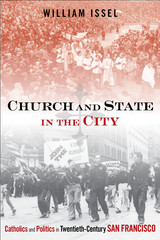
Church and State in the City provides the first comprehensive analysis of the city’s long debate about the public interest. Historian William Issel explores the complex ways that the San Francisco Catholic Church—and its lay men and women—developed relationships with the local businesses, unions, other community groups, and city government to shape debates about how to define and implement the common good. Issel’s deeply researched narrative also sheds new light on the city’s socialists, including Communist Party activists—the most important transnational challengers of both capitalism and Catholicism during the twentieth century.
Moreover, Church and State in the City is revisionist in challenging the notion that the history of urban politics and policy can best be understood as the unfolding of a progressive, secular modernization of urban political culture. Issel shows how tussles over the public interest in San Francisco were both distinctive to the city and shaped by its American character.
In the series Urban Life, Landscape, and Policy, edited by Zane L. Miller, David Stradling, and Larry Bennett
Years in advance of the collapse of communism in Eastern Europe, Poland underwent one of the most radical and painful social and political upheavals of our century. Through a wide body of writing and an unswerving political commitment that took him from prison to parliament, Adam Michnik was a central figure in these events—culminating in 1989 with his role in formulating the political deal that brought Solidarity to power. Michnik's writings, most of them smuggled out of prison, have been translated into many languages; but until now, only isolated essays have appeared in English.
In The Church and the Left, Michnik gives full expression to the ideas that have shaped the drama of Poland and of our time. The unlikely alliance of the Catholic Church and the dissident Left is one of the most fascinating and confusing features of the Polish revolutionary movement. No other book better explains the logic of this powerful coalition—or its future implications. In superb discussions of liberalism and nationalism, of secularism and clericalism, Michnik illuminates the unique makeup and direction of Poland's social revolution and, at the same time, offers unparalleled insight into the internal struggles still present in Eastern Europe.
Today, as religious revivals proliferate and secular progress, whether liberal or communist, comes under suspicion, the relationship of religion to politics has become a pressing issue far beyond the boundaries of Poland. As none has done before, Michnik's clear and thoughtful book gives us the means to understand this volatile mix as it has transformed Poland and as it figures in the future we see taking shape.
Through readings of the opinions of the US Supreme Court and other legal texts, Sullivan shows how “the church” as a religious collective is granted special privilege in US law. In-depth analyses of Hosanna-Tabor v. EEOC and Burwell v. Hobby Lobby reveal that the law tends to honor the religious rights of the group—whether in the form of a church, as in Hosanna-Tabor, or in corporate form, as in Hobby Lobby—over the rights of the individual, offering corporate religious entities an autonomy denied to their respective members. In discussing the various communities that construct the “church-shaped space” in American law, Sullivan also delves into disputes over church property, the legal exploitation of the black church in the criminal justice system, and the recent case of Masterpiece Cakeshop v. Colorado Civil Rights Commission. Brimming with insight, Church State Corporation provocatively challenges our most basic beliefs about the ties between religion and law in ostensibly secular democracies.
Americans have long acknowledged a deep connection between evangelical religion and democracy in the early days of the republic. This is a widely accepted narrative that is maintained as a matter of fact and tradition—and in spite of evangelicalism’s more authoritarian and reactionary aspects.
In Conceived in Doubt, Amanda Porterfield challenges this standard interpretation of evangelicalism’s relation to democracy and describes the intertwined relationship between religion and partisan politics that emerged in the formative era of the early republic. In the 1790s, religious doubt became common in the young republic as the culture shifted from mere skepticism toward darker expressions of suspicion and fear. But by the end of that decade, Porterfield shows, economic instability, disruption of traditional forms of community, rampant ambition, and greed for land worked to undermine heady optimism about American political and religious independence. Evangelicals managed and manipulated doubt, reaching out to disenfranchised citizens as well as to those seeking political influence, blaming religious skeptics for immorality and social distress, and demanding affirmation of biblical authority as the foundation of the new American national identity.
As the fledgling nation took shape, evangelicals organized aggressively, exploiting the fissures of partisan politics by offering a coherent hierarchy in which God was king and governance righteous. By laying out this narrative, Porterfield demolishes the idea that evangelical growth in the early republic was the cheerful product of enthusiasm for democracy, and she creates for us a very different narrative of influence and ideals in the young republic.
Although it is often charged with hostility toward religion, First Amendment doctrine in fact treats religion as a distinctive human good. It insists, however, that this good be understood abstractly, without the state taking sides on any theological question. Here, a leading scholar of constitutional law explains the logic of this uniquely American form of neutrality—more religion-centered than liberal theorists propose, and less overtly theistic than conservatives advocate.
The First Amendment’s guarantee of freedom of religion is under threat. Growing numbers of critics, including a near-majority of the Supreme Court, seem ready to cast aside the ideal of American religious neutrality. Andrew Koppelman defends that ideal and explains why protecting religion from political manipulation is imperative in an America of growing religious diversity.
Understanding American religious neutrality, Koppelman shows, can explain some familiar puzzles. How can Bible reading in public schools be impermissible while legislative sessions begin with prayers, Christmas is an official holiday, and the words “under God” appear in the Pledge of Allegiance? Are faith-based social services, public financing of religious schools, or the teaching of intelligent design constitutional? Combining legal, historical, and philosophical analysis, Koppelman shows how law coherently navigates these conundrums. He explains why laws must have a secular legislative purpose, why old, but not new, ceremonial acknowledgments of religion are permitted, and why it is fair to give religion special treatment.
traditions of church-state relations rooted in the colony’s peoples, their country of origin, and religion.
This definitive volume, comprising twenty-one original essays by eminent historians and political scientists, is a comprehensive state-by-state account of disestablishment in the original thirteen states, as well as a look at similar events in the soon-to-be-admitted states of Vermont, Tennessee, and Kentucky. Also considered are disestablishment in Ohio (the first state admitted from the Northwest Territory), Louisiana and Missouri (the first states admitted from the Louisiana Purchase), and Florida (wrestled from Spain under U.S. pressure). The volume makes a unique scholarly contribution by recounting in detail the process of disestablishment in each of the colonies, as well as religion’s constitutional and legal place in the new states of the federal republic.
The first of a closely linked trio of essays is by Paul Johnson, and offers a new interpretation of the Brazilian community gathered at Canudos and its massacre in 1896–97, carried out as a joint churchstate mission and spectacle. In the second essay, Pamela Klassen argues that the colonial churchstate relationship of Canada came into being through local and national practices that emerged as Indigenous nations responded to and resisted becoming “possessions” of colonial British America. Finally, Winnifred Sullivan’s essay begins with reflection on the increased effort within the United States to ban Bibles and scriptural references from death penalty courtrooms and jury rooms; she follows with a consideration of the political theological pressure thereby placed on the jury that decides between life and death. Through these three inquiries, Ekklesia takes up the familiar topos of “church and state” in order to render it strange.
“Solomon’s fascinating and sweeping history of the legal fight over mandatory school prayers is compelling, judicious, and elegantly written. Fabulous!”
—David Rudenstine, Dean, Benjamin N. Cardozo School of Law, Yeshiva University
“Stephen Solomon’s Ellery’s Protest provides a brilliant analysis of a major Supreme Court decision that redefined the relationship between church and state almost a half century ago. This study goes well beyond simply offering a gripping account of the course of litigation that brought before the Justices the contentious issue of prayer and Bible reading in public schools, though the thoroughness of that account would merit careful reading by itself. Especially impressive is the author’s deep probing of hitherto neglected sources, and invaluable primary material including extensive direct contact with the plaintiff, the ‘Ellery’ of the book’s title. Finally, and perhaps most impressive, is Solomon’s careful placement of the issue and the case in a far broader context that is as critical to national life and policy today as it was four and a half decades ago when the high Court first tackled these questions.”
—Robert O’Neil, Professor of Law, University of Virginia
Great legal decisions often result from the heroic actions of average citizens. Ellery’s Protest is the story of how one student’s objection to mandatory school prayer and Bible reading led to one of the most controversial court cases of the twentieth century—and a decision that still reverberates in the battle over the role of religion in public life.
Abington School District v. Schempp began its journey through the nation’s courts in 1956, when sixteen-year-old Ellery Schempp protested his public school’s compulsory prayer and Bible-reading period by reading silently from the Koran. Ejected from class for his actions, Schempp sued the school district. The Supreme Court’s decision in his favor was one of the most important rulings on religious freedom in our nation’s history. It prompted a conservative backlash that continues to this day, in the skirmishes over school prayer, the teaching of creationism and intelligent design, and the recitation of the Pledge of Allegiance with the phrase “under God.”
Author Stephen D. Solomon tells the fascinating personal and legal drama of the Schempp case: the family’s struggle against the ugly reactions of neighbors, and the impassioned courtroom clashes as brilliant lawyers on both sides argued about the meaning of religious freedom. But Schempp was not the only case challenging religious exercises in the schools at the time, and Ellery’s Protest describes the race to the Supreme Court among the attorneys for four such cases, including one involving the colorful atheist Madalyn Murray.
Solomon also explores the political, cultural, and religious roots of the controversy. Contrary to popular belief, liberal justices did not kick God out of the public schools. Bitter conflict over school Bible reading had long divided Protestants and Catholics in the United States. Eventually, it was the American people themselves who removed most religious exercises from public education as a more religiously diverse nation chose tolerance over sectarianism. Ellery’s Protest offers a vivid account of the case that embodied this change, and a reminder that conservative justices of the 1950s and 60s not only signed on to the Schempp decision, but strongly endorsed the separation of church and state.
Although some critics of Eric Voegelin’s later work have faulted his failure to deal with the historical Jesus and to address the implications of Christianity for social and political life, the recent publication of Voegelin’s History of Political Ideas has allowed a more complete assessment of his position regarding the Christian political order. This book addresses that criticism through an analysis of Voegelin’s early work.
In Eric Voegelin and the Problem of Christian Political Order, Jeffrey C. Herndon analyzes the development of Voegelin’s thought regarding the origins of Christianity in the person of Jesus, the development of the church in the works of Paul, and the relationship between an immanent institutional order symbolizing the divine presence and the struggle for social and political order. Focusing on the tension between a spiritual phenomenon based on Pauline faith and the institutionalization of that experience in the church, Herndon offers one of the first examinations of the relationship of the History of Political Ideas to Voegelin’s larger body of work.
In his wide-ranging study, Herndon explores Voegelin’s examination of the problem of Christian political order from the inception of Christianity through the Great Reformation. He also presents a clarification of Voegelin’s theory of civilizational foundation and of Voegelin’s philosophy of history with regard to Christianity and Western political order.
Herndon addresses not only the nagging problem in Voegelin scholarship regarding his relationship with the historical Jesus but also the “Pauline compromises with the world” that enabled Christianity to become the instrument by which the West was civilized. He also shows that Voegelin’s interpretation of the historical pressures released by the Great Reformation is important to an understanding of his later work regarding the negative effect of Christian symbols in the creation of ideological disorder.
Eric Voegelin and the Problem of Christian Political Order clarifies issues in Voegelin studies regarding the intersection between political theory and Christian concerns, addressing the relation of religious experience to the public sphere of political life in the West and helping to explain Voegelin’s contention that the death of the spirit is the price of progress. It offers scholars a perspective heretofore lacking in Voegelin scholarship and a clearer view of Voegelin’s understanding of the Christian dispensation and its influence on the course of Western development, history, and philosophy.
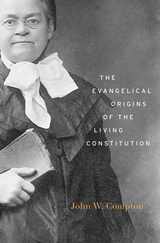
The New Deal is often said to represent a sea change in American constitutional history, overturning a century of precedent to permit an expanded federal government, increased regulation of the economy, and eroded property protections. John Compton offers a surprising revision of this familiar narrative, showing that nineteenth-century evangelical Protestants, not New Deal reformers, paved the way for the most important constitutional developments of the twentieth century.
Following the great religious revivals of the early 1800s, American evangelicals embarked on a crusade to eradicate immorality from national life by destroying the property that made it possible. Their cause represented a direct challenge to founding-era legal protections of sinful practices such as slavery, lottery gambling, and buying and selling liquor. Although evangelicals urged the judiciary to bend the rules of constitutional adjudication on behalf of moral reform, antebellum judges usually resisted their overtures. But after the Civil War, American jurists increasingly acquiesced in the destruction of property on moral grounds.
In the early twentieth century, Oliver Wendell Holmes and other critics of laissez-faire constitutionalism used the judiciary’s acceptance of evangelical moral values to demonstrate that conceptions of property rights and federalism were fluid, socially constructed, and subject to modification by democratic majorities. The result was a progressive constitutional regime—rooted in evangelical Protestantism—that would hold sway for the rest of the twentieth century.
In the capital of humanism, he initiated what was to be a lifelong examination of the Western civil tradition. In Florence he could study the interplay of ideas and action in what he was to call the "public world." The rise of this world out of the private, feudal and corporate structures of the medieval commune, its functioning and its eventual subversion by the authoritarian structures of the early modern state were, he thought, valuable information for modern political cultures. In the 1950s and 1960s, Becker produced approximately twenty papers dealing with a wide variety of themes and issues raised by the work of other scholars such as Davidson, Salvemini, Ottokar, Panella, Rodolico, Barbadoro, Baron, and others. He also introduced his own formulations on a range of subjects including the political role of Florence's minor guilds, usury, taxation, public debt, popular heresy, church-state relations, the city's chroniclers, the influence of "new men" upon Florentine government and changing mentalities.
These papers, in their originality, their richness of documentation and their suggestiveness, are still relevant for current scholarship. The editors of this volume have chosen the papers for the convenience of readers who may know Becker only through his books, or from the myriad of footnotes of other scholars who have drawn so much from his work. This volume will be of interest to scholars, students, and others interested in Renaissance history, whether it be social or political.
Marvin B. Becker is Professor Emeritus in the Department of History, University of Michigan. James Banker is Professor of History, North Carolina State University. Carol Lansing is Professor of History, University of California, Santa Barbara.
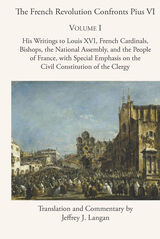
The writings of Pope Pius VI, head of the Catholic Church during the most destructive period of the French Revolution, were compiled in two volumes by M.N.S. Guillon and published in 1798 and 1800. But during the Revolution, the reign of Napoleon, and the various revolutionary movements of the 19th century, there were extraordinary efforts to destroy writings that critiqued the revolutionary ideology. Many books and treatises, if they survived the revolution or the sacking from Napoleon’s armies. To this day, no public copy of Guillon’s work exists in Paris.
Now, for the first time in English, these works comprising the letters, briefs, and other writings of Pius VI on the French Revolution are available. Volume I treats the first shock of the Revolution and the efforts of the Pope in 1790 and 1791 to oppose the Civil Constitution of the Clergy (which famous revolutionary and shrewd diplomat Talleyrand referred to as “the greatest fault of the National Assembly”). Volume II will be published later, and deals with the aftermath of the Civil Constitution through Pius’s death in exile). Editor and translator Jeffrey Langan presents the materials leading up to and directly connected with these decrees, in which the National Assembly attempted to set up a Catholic Church that would be completely submissive to the demands of the Assembly. Volume I also covers Pius’s efforts to deal with the immediate aftermath of the Constitution after the National Assembly implemented it, including his encyclical, Quod Aliquantum.
The letters will show how Pius chose to oppose the Civil Constitution. He did so not by a public campaign, for he had no real temporal power to oppose the violence, but by attempting to work personally with Louis XVI and various archbishops in France to articulate what were the points on which he could concede (matters dealing with the political structures of France) and what were the essential points in which he could not concede (matters dealing with the organization of dioceses and appointment of bishops).
Since the 1980s, with the writings and school that developed around François Furet, as well as Simon Schama’s Citizens, a new debate over the French Revolution has ensued, bringing forth a more objective account of the Revolution, one that avoids an excessively Marxist lens and that brings to light some of its defects and more gruesome parts – the destruction and theft of Church property, and the sadistic methods of torture and killing of priests, nuns, aristocrats, and fellow-revolutionaries.
An examination of the writings of Pius VI will not only help set the historical record straight for English-speaking students of the Revolution, it will also aid them to better understand the principles that the Catholic Church employs when confronted with chaotic political change. They will see that the Church has a principled approach to distinguishing, while not separating, the power of the Church and the power of the state. They will also see, as Talleyrand himself also saw, that one of the essential elements that makes the Church the Church is the right to appoint bishops and to discipline its own bishops. The Church herself recognizes that she cannot long survive without this principle that guarantees her unity.
Pius VI’s efforts were able to keep the Catholic Church intact (though badly bruised) so that she could reconstitute herself and build up a vibrant life in 19th-century France. (He did this in the face of the Church’s prestige having sunk to historic lows; some elites in Europe thought there would be no successor to Pius and jokingly referred to him as “Pius the Last.”) He began a process that led to the restoration of the prestige of the Papacy throughout the world, and he initiated a two-century process that led to the Church finally being able to select bishops without any interference from secular authorities. This had been at least a 1,000-year problem in the history of the Church. By 1990, only two countries of the world, China and Vietnam, were interfering in any significant way in the process that the Church used to select bishops.
Pius VI’s papacy, especially during the years of the French Revolution, was a pivotal point for the French Revolution and for the interaction between Church and state in Western history. All freedom-loving people will be happy to read his distinc-tions between the secular power and the spiritual power. His papacy also was important for the internal developments that the Church would make over the next 200 years with respect to its self-understanding of the Papacy and the role of the bishop.
But as Michael Leo Owens demonstrates in God and Government in the Ghetto, this alliance also serves as a means for black clergy to reaffirm their political leadership and reposition moral authority in black civil society. Drawing on both survey data and fieldwork in New York City, Owens reveals that African American churches can use these newly forged connections with public agencies to influence policy and government responsiveness in a way that reaches beyond traditional electoral or protest politics. The churches and neighborhoods, Owens argues, can see a real benefit from that influence—but it may come at the expense of less involvement at the grassroots.
Anyone with a stake in the changing strategies employed by churches as they fight for social justice will find God and Government in the Ghetto compelling reading.
Puritans did not find a life free from tyranny in the New World—they created it there. Massachusetts emerged a republic as they hammered out a vision of popular participation and limited government in church and state, spurred by Plymouth Pilgrims. Godly Republicanism underscores how pathbreaking yet rooted in puritanism’s history the project was.
Michael Winship takes us first to England, where he uncovers the roots of the puritans’ republican ideals in the aspirations and struggles of Elizabethan Presbyterians. Faced with the twin tyrannies of Catholicism and the crown, Presbyterians turned to the ancient New Testament churches for guidance. What they discovered there—whether it existed or not—was a republican structure that suggested better models for governing than monarchy.
The puritans took their ideals to Massachusetts, but they did not forge their godly republic alone. In this book, for the first time, the separatists’ contentious, creative interaction with the puritans is given its due. Winship looks at the emergence of separatism and puritanism from shared origins in Elizabethan England, considers their split, and narrates the story of their reunion in Massachusetts. Out of the encounter between the separatist Plymouth Pilgrims and the puritans of Massachusetts Bay arose Massachusetts Congregationalism.
President Obama has signaled a sharp break from many Bush Administration policies, but he remains committed to federal support for religious social service providers. Like George W. Bush’s faith-based initiative, though, Obama’s version of the policy has generated loud criticism—from both sides of the aisle—even as the communities that stand to benefit suffer through an ailing economy. God’s Economy reveals that virtually all of the critics, as well as many supporters, have long misunderstood both the true implications of faith-based partnerships and their unique potential for advancing social justice.
Unearthing the intellectual history of the faith-based initiative, Lew Daly locates its roots in the pluralist tradition of Europe’s Christian democracies, in which the state shares sovereignty with social institutions. He argues that Catholic and Dutch Calvinist ideas played a crucial role in the evolution of this tradition, as churches across nineteenth-century Europe developed philosophical and legal defenses to protect their education and social programs against ascendant governments. Tracing the influence of this heritageon the past three decades of American social policy and church-state law, Daly finally untangles the radical beginnings of the faith-based initiative. In the process, he frees it from the narrow culture-war framework that has limited debate on the subject since Bush opened the White House Office for Faith-Based and Community Initiatives in 2001.
A major contribution from an important new voice at the intersection of religion and politics, God’s Economy points the way toward policymaking that combines strong social support with a new moral focus on the protection of families and communities.
Winner of a Christianity Today Book Award
An incisive look at how evangelical Christians shaped—and were shaped by—the American criminal justice system.
America incarcerates on a massive scale. Despite recent reforms, the United States locks up large numbers of people—disproportionately poor and nonwhite—for long periods and offers little opportunity for restoration. Aaron Griffith reveals a key component in the origins of American mass incarceration: evangelical Christianity.
Evangelicals in the postwar era made crime concern a major religious issue and found new platforms for shaping public life through punitive politics. Religious leaders like Billy Graham and David Wilkerson mobilized fears of lawbreaking and concern for offenders to sharpen appeals for Christian conversion, setting the stage for evangelicals who began advocating tough-on-crime politics in the 1960s. Building on religious campaigns for public safety earlier in the twentieth century, some preachers and politicians pushed for “law and order,” urging support for harsh sentences and expanded policing. Other evangelicals saw crime as a missionary opportunity, launching innovative ministries that reshaped the practice of religion in prisons. From the 1980s on, evangelicals were instrumental in popularizing criminal justice reform, making it a central cause in the compassionate conservative movement. At every stage in their work, evangelicals framed their efforts as colorblind, which only masked racial inequality in incarceration and delayed real change.
Today evangelicals play an ambiguous role in reform, pressing for reduced imprisonment while backing law-and-order politicians. God’s Law and Order shows that we cannot understand the criminal justice system without accounting for evangelicalism’s impact on its historical development.
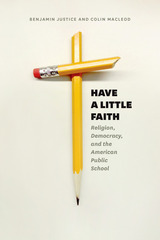
From Bible readings and school prayer to teaching evolution and cultivating religious tolerance, Justice and Macleod consider the key issues and colorful characters that have shaped the way American schools have attempted to negotiate religious pluralism in a politically legitimate fashion. While schools and educational policies have not always advanced tolerance and understanding, Justice and Macleod point to the many efforts Americans have made to find a place for religion in public schools that both acknowledges the importance of faith to so many citizens and respects democratic ideals that insist upon a reasonable separation of church and state. Finally, they apply the lessons of history and political philosophy to an analysis of three critical areas of religious controversy in public education today: student-led religious observances in extracurricular activities, the tensions between freedom of expression and the need for inclusive environments, and the shift from democratic control of schools to loosely regulated charter and voucher programs.
Altogether Justice and Macleod show how the interpretation of educational history through the lens of contemporary democratic theory offers both a richer understanding of past disputes and new ways of addressing contemporary challenges.
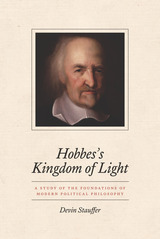
In Hobbes’s Kingdom of Light, Stauffer argues that Hobbes was engaged in a struggle on multiple fronts against forces, both philosophic and religious, that he thought had long distorted philosophy and destroyed the prospects of a lasting peace in politics. By exploring the twists and turns of Hobbes’s arguments, not only in his famous Leviathan but throughout his corpus, Stauffer uncovers the details of Hobbes’s critique of an older outlook, rooted in classical philosophy and Christian theology, and reveals the complexity of Hobbes’s war against the “Kingdom of Darkness.” He also describes the key features of the new outlook—the “Kingdom of Light”—that Hobbes sought to put in its place. Hobbes’s venture helped to prepare the way for the later emergence of modern liberalism and modern secularism. Hobbes’s Kingdom of Light is a wide-ranging and ambitious exploration of Hobbes’s thought.
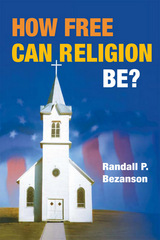
In tracking the evolution of the First Amendment's Free Exercise and Establishment Clause doctrine through Key Supreme Court decisions on religious freedom, legal scholar Randall P. Bezanson focuses on the court's shift from strict separation of church and state to a position where the government accommodates and even fosters religion. Beginning with samples from the latter half of the nineteenth century, the detailed case studies present new problems and revisit old ones as well: the purported belief of polygamy in the Mormon Church; state support for religious schools; the teaching of evolution and creationism in public schools; Amish claims for exemption from compulsory education laws; comparable claims for Native American religion in relation to drug laws; and rights of free speech and equal access by religious groups in colleges and public schools.
During the eighteenth-century Enlightenment, Scotland and England produced such well-known figures as David Hume, Adam Smith, and John Locke. Ireland’s contribution to this revolution in Western thought has received much less attention. Offering a corrective to the view that Ireland was intellectually stagnant during this period, The Irish Enlightenment considers a range of artists, writers, and philosophers who were full participants in the pan-European experiment that forged the modern world.
Michael Brown explores the ideas and innovations percolating in political pamphlets, economic and religious tracts, and literary works. John Toland, Francis Hutcheson, Jonathan Swift, George Berkeley, Edmund Burke, Maria Edgeworth, and other luminaries, he shows, participated in a lively debate about the capacity of humans to create a just society. In a nation recovering from confessional warfare, religious questions loomed large. How should the state be organized to allow contending Christian communities to worship freely? Was the public confession of faith compatible with civil society? In a society shaped by opposing religious beliefs, who is enlightened and who is intolerant?
The Irish Enlightenment opened up the possibility of a tolerant society, but it was short-lived. Divisions concerning methodological commitments to empiricism and rationalism resulted in an increasingly antagonistic conflict over questions of religious inclusion. This fracturing of the Irish Enlightenment eventually destroyed the possibility of civilized, rational discussion of confessional differences. By the end of the eighteenth century, Ireland again entered a dark period of civil unrest whose effects were still evident in the late twentieth century.
Fusing geography, legal scholarship, and religion in a potent analysis, Howe shows how seemingly routine questions about how to look at a sunrise or a plateau or how to assess what a mountain is both physically and ideologically, lead to complex arguments about the nature of religious experience and its implications for our lives as citizens. In American society—nominally secular but committed to permitting a diversity of religious beliefs and expressions—such questions become all the more fraught and can lead to difficult, often unsatisfying compromises regarding how to interpret and inhabit our public lands and spaces. A serious commitment to secularism, Howe shows, forces us to confront the profound challenges of true religious diversity in ways that often will have their ultimate expression in our built environment. This provocative exploration of some of the fundamental aspects of American life will help us see the land, law, and society anew.
Relating this religious dimension to Schmitt's support for National Socialism and his continuing anti-Semitism, Meier compels the reader to come to terms with the irreconcilable differences between political theology and political philosophy. His book will give pause to those who have tended to gloss over the troubling aspects of some of Schmitt's ideas.
With editions in German, French, Italian, and now English, Meier's two books on Schmitt have dramatically reoriented the international debate about Carl Schmitt and his significance for twentieth-century political thought.
"Standing far above the rest . . . is Heinrich Meier's new study, Die Lehre Carl Schmitts, which covers all of Schmitt's writings. . . . Meier's work has forced everyone to take a second look at the assumptions underlying Schmitt's better-known writings and reconsider some that have been ignored."—Mark Lilla, reviewing the German edition in The New York Review of Books
"This is a fascinating local story with major implications for studies of nationalism and regional identities throughout Europe more generally."
---Dennis Sweeney, University of Alberta
"James Bjork has produced a finely crafted, insightful, indeed, pathbreaking study of the interplay between religious and national identity in late nineteenth-century Central Europe."
---Anthony Steinhoff, University of Tennessee at Chattanooga
Neither German nor Pole examines how the inhabitants of one of Europe's most densely populated industrial districts managed to defy clear-cut national categorization, even in the heyday of nationalizing pressures at the turn of the twentieth century. As James E. Bjork argues, the "civic national" project of turning inhabitants of Upper Silesia into Germans and the "ethnic national" project of awakening them as Poles both enjoyed successes, but these often canceled one another out, exacerbating rather than eliminating doubts about people's national allegiances. In this deadlock, it was a different kind of identification---religion---that provided both the ideological framework and the social space for Upper Silesia to navigate between German and Polish orientations. A fine-grained, microhistorical study of how confessional politics and the daily rhythms of bilingual Roman Catholic religious practice subverted national identification, Neither German nor Pole moves beyond local history to address broad questions about the relationship between nationalism, religion, and modernity.

George W. Bush had planned to swear his oath of office with his hand on the Masonic Bible used by both his father and George Washington, however, due to the inclement weather, a family Bible was substituted. Almost immediately on taking office, President Bush made passage of "faith-based initiatives"—the government funding of religious charitable groups—a legislative priority. However, "inclement" weather storm-tossed his hopes for faith-based initiatives as well.
What happened? Why did these initiatives, which began with such vigor and support from a popular president, fail? And what does this say about the future role of religious faith in American public life? Amy Black, Douglas Koopman, and David Ryden—all prominent political scientists—utilize a framework that takes the issue through all three branches of government and analyzes it through three very specific lenses: a public policy lens, a political party lens, and a lens of religion in the public square.
Drawing on dozens of interviews with key figures in Washington, the authors tell a compelling story, revealing the evolution of the Bush faith-based strategy from his campaign for the presidency through congressional votes to the present. They show how political rhetoric, infighting, and poor communication shipwrecked Bush's efforts to fundamentally alter the way government might conduct social services. The authors demonstrate the lessons learned, and propose a more fruitful, effective way to go about such initiatives in the future.

The third volume in the Nobel Prize–winning writer’s epic story of medieval Norway, finely capturing Undset’s fluid, natural style in the first English translation in nearly a century
In the early fourteenth century, Norway is a kingdom in political turmoil, struggling with opposing forces within its own borders and drawn into strife with neighboring Sweden and Denmark. Bloody family vendettas and conflicting loyalties sparked by the irrepressible passion of a boy and his foster sister (also his betrothed) have now set in motion a series of terrible consequences—with a legacy of betrayal, murder, and disgrace that will echo down through the generations. Crossroads, the third of Olav Audunssøn’s four volumes, finds Olav heartbroken by loss and further estranged from his son. To escape his grief, Olav leaves his home estate of Hestviken and agrees to serve as captain on a small merchant ship headed to London. There, separated from everything familiar to him, Olav begins a visionary journey that will send him far into the forest and deep into his soul. Questioning past decisions and future plans, Olav must grapple with his own perceptions of love and guilt, sin and penitence, vengeance and forgiveness.
Set in a time and place where royalty and religion vie for power, and bloodlines and loyalties are law, Crossroads summons a powerful picture of Northern life in medieval times, as the Swedish Academy noted in awarding Sigrid Undset the Nobel Prize in 1928. Conveying both the intimate drama and epic sweep of Olav’s story as grief and guilt drive him to ever more desperate action, Crossroads is a moving and masterly re-creation of a vanished world tainted by bloodshed and haunted by sin and retribution.
As with Kristin Lavransdatter, her earlier medieval epic, Undset immersed herself in the legal, religious, and historical documents of the time while writing Olav Audunssøn to create astoundingly authentic and compelling portraits of Norwegian life in the Middle Ages. And as in her translation of Kristin Lavransdatter, Tiina Nunnally does full justice to Undset’s natural, fluid prose, in a style that delicately and lyrically conveys the natural world, the complex culture, and the fraught emotional territory against which Olav’s story inexorably unfolds.
In the beginning, they rallied behind Hitler in the national interest of Germany; in the end, they sacrificed their lives to assassinate him. A history of German resistance to Hitler in high places, this book offers a glimpse into one of the most intractable mysteries. Why did high-ranking army officers, civil servants, and religious leaders support Hitler? Why did they ultimately turn against him? What transformed these unlikely men, most of them elitist, militaristic, and fiercely nationalistic, into martyrs to a universal ideal?
The resisters in On the Road to the Wolf's Lair are not the singular souls doomed to failure by the massive Nazi machinery, but those who emerged from the Third Reich itself--those people whose cultural, administrative, and military positions allowed them, ultimately, to form a systematic, organized opposition to the Nazi regime. These were people with a vested interest in the Third Reich, and their slow and painful awakening to its evils makes a dramatic story, marked as much by temporizing and compromise, vacillation and reluctance--a resistance to conscience--as by the intrigue and heroics of political resistance that finally emerged. Hamerow follows these men as, one by one, they find themselves overwhelmed by guilt and contrition over their support of a murderous regime. He shows how their awakened moral reckonings and higher interests overrode lifetime habits and disciplines on the road to "the wolf's lair."
The result is an unsparing history of the German resistance to Hitler--one where the players emerge for the first time as real people with complex motives and evolving characters. Almost a history of the possibility of an emerging collective moral conscience within a destructive environment, the book adds to our understanding of the fall of the Third Reich and of the task of history itself.
Modern political life emerged when liberal movements sought to establish elections, constitutions, free markets, and religious liberty. Yet liberalism even at its height faced strong and often successful opposition from conservatives. What explains why liberals overcame their opponents in some countries but not in others? This book compares successful and unsuccessful attempts to build liberal political parties and establish liberal regimes in France, Belgium, Switzerland, and Germany from 1815 to World War I.
Andrew Gould argues that relations between states and churches set powerful conditions on any attempt at liberalization. Liberal movements that enhanced religious authority while reforming the state won clerical support and successfully built liberal institutions of government. Furthermore, liberal movements that organized peasant backing around religious issues founded or sustained mass movements to support liberal regimes.
Origins of Liberal Dominance offers striking new insights into the emergence of modern states and regimes. It will be of interest to political scientists, sociologists, comparative historians, and those interested in comparative politics, regime change and state-building, democratization, religion and politics, and European politics.
Andrew C. Gould is Assistant Professor of Government and Kellogg Institute Fellow, University of Notre Dame.
"[A] long-awaited book. . . . [It is] the most complete survey of confraternities and charity, not only for Florence, but for any Italian city state to date. . . . This book recovers more vividly than other recent works what it meant to be a member of a confraternity in the late middle ages."—Samuel K. Cohn, Jr., Economic History Review
"Henderson offers new and fascinating information. . . . A stimulating and suggestive book that deserves a wide readership." —Gervase Rosser, Times Higher Education Supplement
Douglass Sullivan Gonzalez examines the influence of religion on the development of nationalism in Guatemala during the period 1821-1871, focusing on the relationship between Rafael Carrera amd the Guatemalan Catholic Church. He illustrates the peculiar and fascinating blend of religious fervor, popular power, and caudillo politics that inspired a multiethnic and multiclass alliance to defend the Guatemalan nation in the mid-nineteenth century.
Led by the military strongman Rafael Carrera, an unlikely coalition of mestizos, Indians, and creoles (whites born in the Americas) overcame a devastating civil war in the late 1840s and withstood two threats (1851 and 1863) from neighboring Honduras and El Salvador that aimed at reintegrating conservative Guatemala into a liberal federation of Central American nations.
Sullivan-Gonzalez shows that religious discourse and ritual were crucial to the successful construction and defense of independent Guatemala. Sermons commemorating independence from Spain developed a covenantal theology that affirmed divine protection if the Guatemalan people embraced Catholicism. Sullivan-Gonzalez examines the extent to which this religious and nationalist discourse was popularly appropriated.
Recently opened archives of the Guatemalan Catholic Church revealed that the largely mestizo population of the central and eastern highlands responded favorably to the church’s message. Records indicate that Carrera depended upon the clerics’ ability to pacify the rebellious inhabitants during Guatemala’s civil war (1847-1851) and to rally them to Guatemala’s defense against foreign invaders. Though hostile to whites and mestizos, the majority indigenous population of the western highlands identified with Carrera as their liberator. Their admiration for and loyalty to Carrera allowed them a territory that far exceeded their own social space.
Though populist and antidemocratic, the historic legacy of the Carrera years is the Guatemalan nation. Sullivan-Gonzalez details how theological discourse, popular claims emerging from mestizo and Indian communities, and the caudillo’s ability to finesse his enemies enabled Carrera to bring together divergent and contradictory interests to bind many nations into one.
After the fall of the state socialist regime and the end of martial law in 1989, Polish society experienced both a sense of relief from the tyranny of Soviet control and an expectation that democracy would bring freedom. After this initial wave of enthusiasm, however, political forces that had lain concealed during the state socialist era began to emerge and establish a new religious-nationalist orthodoxy. While Solidarity garnered most of the credit for democratization in Poland, it had worked quietly with the Catholic Church, to which a large majority of Poles at least nominally adhered. As the church emerged as a political force in the Polish Sejm and Senate, it precipitated a rapid erosion of women’s reproductive rights, especially the right to abortion, which had been relatively well established under the former regime.
The Politics of Morality is an anthropological study of this expansion of power by the religious right and its effects on individual rights and social mores. It explores the contradictions of postsocialist democratization in Poland: an emerging democracy on one hand, and a declining tolerance for reproductive rights, women’s rights, and political and religious pluralism on the other. Yet, as this thoroughly researched study shows, women resist these strictures by pursuing abortion illegally, defying religious prohibitions on contraception, and organizing into advocacy groups. As struggles around reproductive rights continue in Poland, these resistances and unofficial practices reveal the sharp limits of religious form of governance.
Exploring the violent histories and alternate trajectories effaced through this banal backgrounding of a crucial aspect of French history and culture, this richly textured ethnography lays bare the profound nostalgia that undergirds Catholicism’s circulation in nonreligious sites such as museums, corporate spaces, and political debates. Oliphant’s aim is to unravel the contradictions of religion and secularism and, in the process, show how aesthetics and politics come together in contemporary France to foster the kind of banality that Hannah Arendt warned against: the incapacity to take on another person’s experience of the world. A creative meditation on the power of the taken-for-granted, The Privilege of Being Banal is a landmark study of religion, aesthetics, and public space.
Ben Fallaw argues that previous scholarship has not appreciated the pervasive influence of Catholics and Catholicism on postrevolutionary state formation. By delving into the history of four understudied Mexican states, he is able to show that religion swayed regional politics not just in states such as Guanajuato, in Mexico's central-west "Rosary Belt," but even in those considered much less observant, including Campeche, Guerrero, and Hidalgo. Religion and State Formation in Postrevolutionary Mexico reshapes our understanding of agrarian reform, federal schooling, revolutionary anticlericalism, elections, the Segunda (a second Cristero War in the 1930s), and indigenism, the Revolution's valorization of the Mesoamerican past as the font of national identity.
J. Judd Owen answers these questions with a remarkable critical analysis of four twentieth-century liberal and postliberal thinkers: John Dewey, John Rawls and, most extensively, Richard Rorty and Stanley Fish. His unique readings of these theorists and their approaches to religion lead him to conclusions that are meticulously constructed and surprising, arguing against the perception of liberalism as simple moral or religious neutrality, calling into question the prevailing justifications for separation of church and state, and challenging the way we think about the very basis of constitutional government.
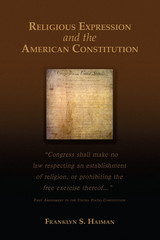
First Amendment rights have been among the most fiercely debated topics in the aftermath of 9/11. In the current environment and fervor for “homeland security,” personal freedoms in exchange for security are coming under more scrutiny. Among these guaranteed freedoms are the protection of religious expression given by the U.S. Constitution and the constitutional prohibitions against behaviors that violate the separation of church and state. The mandate that the government “shall make no law respecting an establishment of religion, or prohibiting the free exercise thereof” is a general principle that has guided American courts in interpreting the original intent of the First Amendment. In Religious Expression and the American Constitution, Haiman focuses on the current state of American law with respect to a broad range of controversial issues affecting religious expression, both verbal and nonverbal, along with a review of the recent history of each issue to provide a full understanding.
Religion has become a charged token in a politics of division. In disputes about faith-based social services, public money for religious schools, the Pledge of Allegiance, Ten Commandments monuments, the theory of evolution, and many other topics, angry contestation threatens to displace America's historic commitment to religious freedom. Part of the problem, the authors argue, is that constitutional analysis of religious freedom has been hobbled by the idea of "a wall of separation" between church and state. That metaphor has been understood to demand that religion be treated far better than other concerns in some contexts, and far worse in others. Sometimes it seems to insist on both contrary forms of treatment simultaneously. Missing has been concern for the fair and equal treatment of religion. In response, the authors offer an understanding of religious freedom called Equal Liberty.
Equal Liberty is guided by two principles. First, no one within the reach of the Constitution ought to be devalued on account of the spiritual foundation of their commitments. Second, all persons should enjoy broad rights of free speech, personal autonomy, associative freedom, and private property. Together, these principles are generous and fair to a wide range of religious beliefs and practices.
With Equal Liberty as their guide, the authors offer practical, moderate, and appealing terms for the settlement of many hot-button issues that have plunged religious freedom into controversy. Their book calls Americans back to the project of finding fair terms of cooperation for a religiously diverse people, and it offers a valuable set of tools for working toward that end.
The Founders understood religious liberty to be an inalienable natural right. Vincent Phillip Muñoz explains what this means for church-state constitutional law, uncovering what we can and cannot determine about the original meanings of the First Amendment’s Religion Clauses and constructing a natural rights jurisprudence of religious liberty.
Drawing on early state constitutions, declarations of religious freedom, Founding-era debates, and the First Amendment’s drafting record, Muñoz demonstrates that adherence to the Founders’ political philosophy would lead neither to consistently conservative nor consistently liberal results. Rather, adopting the Founders’ understanding would lead to a minimalist church-state jurisprudence that, in most cases, would return authority from the judiciary to the American people. Thorough and convincing, Religious Liberty and the American Founding is key reading for those seeking to understand the Founders’ political philosophy of religious freedom and the First Amendment Religion Clauses.
Such disputes, as Bruce T. Murray shows, are nothing new. For more than two hundred years Americans have disagreed about the proper role of religion in public life and where to draw the line between church and state. In this book, he reexamines these debates and distills the volumes of commentary and case law they have generated. He analyzes not only the changing contours of religious freedom but also the phenomenon of American civil religion, grounded in the notion that the nation's purpose is sanctified by a higher authority—an idea that can be traced back to the earliest New England colonists and remains deeply ingrained in the American psyche.
Throughout the book, Murray connects past and present, tracing the historical roots of contemporary controversies. He considers why it is that a country founded on the separation of church and state remains singularly religious among nations, and concludes by showing how the Supreme Court's thinking about the religious liberty clauses has evolved since the late eighteenth century.
Gedicks suggests that the Supreme Court’s inconsistent decisions mirror a divergence in American society between an increasingly secular public culture and the primarily devout private lives of the majority of Americans. He notes that while the Court is committed to principles of secular individualism, it has repeatedly endorsed government actions that violate those principles—actions that would be far more justifiable under the discourse of religious communitarianism. The impossibility of reconciling the two discourses leaves the Court no choice but to efface—often implausibly—the religious nature of practices it deems permissible. Gedicks concludes that the road to a coherent religion clause doctrine lies neither in a return to religious communitarianism nor in its complete displacement by secular individualism, but in a yet-to-be-identified discourse that would attract popular support while protecting a meaningful measure of religious freedom.
Familiar accounts of religious freedom in the United States often tell a story of visionary founders who broke from the centuries-old patterns of Christendom to establish a political arrangement committed to secular and religiously neutral government. These novel commitments were supposedly embodied in the religion clauses of the First Amendment. But this story is largely a fairytale, Steven D. Smith says in this incisive examination of a much-mythologized subject. He makes the case that the American achievement was not a rejection of Christian commitments but a retrieval of classic Christian ideals of freedom of the church and freedom of conscience.
Smith maintains that the distinctive American contribution to religious freedom was not in the First Amendment, which was intended merely to preserve the political status quo in matters of religion. What was important was the commitment to open contestation between secularist and providentialist understandings of the nation which evolved over the nineteenth century. In the twentieth century, far from vindicating constitutional principles, as conventional wisdom suggests, the Supreme Court imposed secular neutrality, which effectively repudiated this commitment to open contestation. Rather than upholding what was distinctively American and constitutional, these decisions subverted it. The negative consequences are visible today in the incoherence of religion clause jurisprudence and the intense culture wars in American politics.
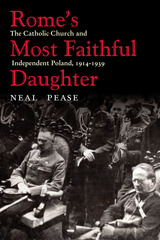
When an independent Poland reappeared on the map of Europe after World War I, it was widely regarded as the most Catholic country on the continent, as “Rome’s Most Faithful Daughter.” All the same, the relations of the Second Polish Republic with the Church—both its representatives inside the country and the Holy See itself—proved far more difficult than expected.
Based on original research in the libraries and depositories of four countries, including recently opened collections in the Vatican Secret Archives, Rome’s Most Faithful Daughter: The Catholic Church and Independent Poland, 1914–1939 presents the first scholarly history of the close but complex political relationship of Poland with the Catholic Church during the interwar period. Neal Pease addresses, for example, the centrality of Poland in the Vatican’s plans to convert the Soviet Union to Catholicism and the curious reluctance of each successive Polish government to play the role assigned to it. He also reveals the complicated story of the relations of Polish Catholicism with Jews, Freemasons, and other minorities within the country and what the response of Pope Pius XII to the Nazi German invasion of Poland in 1939 can tell us about his controversial policies during World War II.
Both authoritative and lively, Rome’s Most Faithful Daughter shows that the tensions generated by the interplay of church and state in Polish public life exerted great influence not only on the history of Poland but also on the wider Catholic world in the era between the wars.

Russian Orthodoxy under the Old Regime was first published in 1978. Minnesota Archive Editions uses digital technology to make long-unavailable books once again accessible, and are published unaltered from the original University of Minnesota Press editions.
In this book, which is especially suitable for course use, eleven scholars examine one of the most important institutions of imperial Russia, the Orthodox church in the two centuries before the Russian revolution. The material is arranged in two sections, the first devoted to Orthodoxy's role in Russian social and cultural life and the second dealing with the church's relationship to the tsarist regime.
Secret Dialogues uncovers an unexpected development in modern Latin American history: the existence of secret talks between generals and Roman Catholic bishops at the height of Brazil's military dictatorship. During the brutal term of Emílio Garrastazú Médici, the Catholic Church became famous for its progressivism. However, new archival sources demonstrate that the church also sought to retain its privileges and influence by exploring a potential alliance with the military. From 1970 to 1974 the secret Bipartite Commission worked to resolve church-state conflict and to define the boundary between social activism and subversion. As the bishops increasingly made defense of human rights their top pastoral and political goal, the Bipartite became an important forum of protest against torture and social injustice. Based on more than 60 interviews and primary sources from three continents, Secret Dialogues is a major addition to the historical narrative of the most violent yet, ironically, the least studied period of the Brazilian military regime. Its story is intertwined with the central themes of the era: revolutionary warfare, repression, censorship, the fight for democracy, and the conflict between Catholic notions of social justice and the anticommunist Doctrine of National Security.
Secret Dialogues is the first book of its kind on the contemporary Catholic Church in any Latin American country, for most work in this field is devoid of primary documentary research. Serbin questions key assumptions about church-state conflict such as the typical conservative-progressive dichotomy and the notion of church-state rupture during harsh authoritarian periods. Secret Dialogues is written for undergraduate and graduate students, professional scholars, and the general reader interested in Brazil, Latin America, military dictatorship, human rights, and the relationship between religion and politics.
Choper's guidelines are designed to provide maximum protection for religious freedom without granting anyone an advantage, inflicting a disadvantage, or causing an unfair burden. Though not calling for the wholesale overturning of judicial precedents or established social practices, the standards he proposes would result in significant—and controversial—modifications to existing doctrines and customs. Choper argues, for instance, that while vocal prayer and Bible reading in public schools should continue to be prohibited, we can and should allow for silent prayer and objective courses in creation science. His standards would also, among other things, eliminate the tax exemption on property used exclusively for religious purposes while allowing parochial schools to receive public funds for the non-religious component of their education.
Despite significant theoretical distinctions between securitization on the domestic and the international levels, he finds that the outcome of addressing religion within the context of security hinges upon partnerships. Whereas states may harness the power of international allies, they cannot often find analogous domestic allies; therefore, states that attempt to securitize religion at home are more vulnerable to counterattack and more likely to abandon their efforts. Securing the Sacred makes a significant contribution to the fields of political theory, international relations, Islamic studies, and security/military studies.

apostle of religious tolerance and a foe of religious establishments.
In Separating Church and State, Timothy Hall combines impressive
historical and legal scholarship to explore Williams's theory of religious
liberty and relate it to current debate. Williams's fierce religious dogmaticism,
Hall argues, is precisely what led to his religious tolerance, making
him one of the most articulate champions of the argument for the necessary
separation of church and state.
"Both timely and provocative. . . . Offers Williams's largely overlooked
but deeply important perspective on the peaceful coexistence of committed
believers of diverse faiths. The book also brings into question crucial
tenets of the United States Supreme Court's First Amendment religion clause
jurisprudence at a time when many are raising questions about it."
-- Marci A. Hamilton, Benjamin N. Cardozo School of Law, New York City
"Hall has the entire Williams corpus under his command, and he plays
the relevant texts like a master organist. He also has the legal corpus
equally at his fingertips. One of the great strengths of his book is that
it bridges the too often separate fields of history and jurisprudence."
-- Edwin Gaustad, author of Liberty of Conscience: Roger Williams in
America
In a powerful challenge to conventional wisdom, Philip Hamburger argues that the separation of church and state has no historical foundation in the First Amendment. The detailed evidence assembled here shows that eighteenth-century Americans almost never invoked this principle. Although Thomas Jefferson and others retrospectively claimed that the First Amendment separated church and state, separation became part of American constitutional law only much later.
Hamburger shows that separation became a constitutional freedom largely through fear and prejudice. Jefferson supported separation out of hostility to the Federalist clergy of New England. Nativist Protestants (ranging from nineteenth-century Know Nothings to twentieth-century members of the K.K.K.) adopted the principle of separation to restrict the role of Catholics in public life. Gradually, these Protestants were joined by theologically liberal, anti-Christian secularists, who hoped that separation would limit Christianity and all other distinct religions. Eventually, a wide range of men and women called for separation. Almost all of these Americans feared ecclesiastical authority, particularly that of the Catholic Church, and, in response to their fears, they increasingly perceived religious liberty to require a separation of church from state. American religious liberty was thus redefined and even transformed. In the process, the First Amendment was often used as an instrument of intolerance and discrimination.
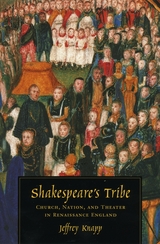
To be sure, Renaissance playwrights rarely sermonized in their plays, which seemed preoccupied with sex, violence, and crime. During a time when acting was regarded as a kind of vice, many theater professionals used their apparent godlessness to advantage, claiming that it enabled them to save wayward souls the church could not otherwise reach. The stage, they argued, made possible an ecumenical ministry, which would help transform Reformation England into a more inclusive Christian society.
Drawing on a variety of little-known as well as celebrated plays, along with a host of other documents from the English Renaissance, Shakespeare's Tribe changes the way we think about Shakespeare and the culture that produced him.
Winner of the Best Book in Literature and Language from the Association of American Publishers' Professional/Scholarly division, the Conference on Christianity and Literature Book Award, and the Roland H. Bainton Prize for Literature from the Sixteenth Century Society and Conference.
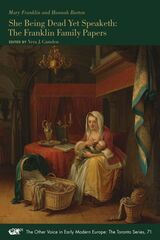
Collected for the first time, this volume of the Franklin Family Papers offers rare insight into the personal lives of three generations of dissenting women.
Winner of a Catholic Media Association Book Award
A revelatory account of the nouvelle théologie, a clerical movement that revitalized the Catholic Church’s role in twentieth-century French political life.
Secularism has been a cornerstone of French political culture since 1905, when the republic formalized the separation of church and state. At times the barrier of secularism has seemed impenetrable, stifling religious actors wishing to take part in political life. Yet in other instances, secularism has actually nurtured movements of the faithful. Soldiers of God in a Secular World explores one such case, that of the nouvelle théologie, or new theology. Developed in the interwar years by Jesuits and Dominicans, the nouvelle théologie reimagined the Church’s relationship to public life, encouraging political activism, engaging with secular philosophy, and inspiring doctrinal changes adopted by the Second Vatican Council in the 1960s.
Nouveaux théologiens charted a path between the old alliance of throne and altar and secularism’s demand for the privatization of religion. Envisioning a Church in but not of the public sphere, Catholic thinkers drew on theological principles to intervene in political questions while claiming to remain at arm’s length from politics proper. Sarah Shortall argues that this “counter-politics” was central to the mission of the nouveaux théologiens: by recoding political statements in the ostensibly apolitical language of doctrine, priests were able to enter into debates over fascism and communism, democracy and human rights, colonialism and nuclear war. This approach found its highest expression during the Second World War, when the nouveaux théologiens led the spiritual resistance against Nazism. Claiming a powerful public voice, they collectively forged a new role for the Church amid the momentous political shifts of the twentieth century.
We live in a world shaped by secularism—the separation of numinous power from political authority and religion from the political, social, and economic realms of public life. Not only has progress toward modernity often been equated with secularization, but when religion is admitted into modernity, it has been distinguished from superstition. That such ideas are continually contested does not undercut their extraordinary influence.
These divisions underpin this investigation of the role of religion in the construction of modernity and political power during the Nanjing Decade (1927–1937) of Nationalist rule in China. This book explores the modern recategorization of religious practices and people and examines how state power affected the religious lives and physical order of local communities. It also looks at how politicians conceived of their own ritual role in an era when authority was meant to derive from popular sovereignty. The claims of secular nationalism and mobilizational politics prompted the Nationalists to conceive of the world of religious association as a dangerous realm of “superstition” that would destroy the nation. This is the first “superstitious regime” of the book’s title. It also convinced them that national feeling and faith in the party-state would replace those ties—the second “superstitious regime.”
Newly revised and updated, To Serve God and Mammon is a classic in the field of religion and politics that provides an unbiased introduction and overview of church–state relations in the United States.
Jelen begins by exploring the inherent tension between the Establishment and Free Exercise clauses of the First Amendment. He then examines how different actors in American politics (e.g., the courts, Congress, the president, ordinary citizens) have different and conflicting values that affect their attitudes and actions toward the relationship between the sacred and the secular. Finally, he discusses how the fragmented nature of political authority in the United States provides the basis for continuing conflict concerning church–state relations.
This second edition includes analyses of various recent court cases and the implications of living in the post–9/11 era. It also features discussion questions at the end of each chapter, a glossary of terms, and synopses of selected court decisions bearing on religion and politics in the United States.
By far the most "historical" opera in the active repertoire, Tosca is set in a very specific time and place: Rome, from June 17 to 18, 1800. But as Nicassio demonstrates, history in Tosca is distorted by nationalism and by the vehement anticlerical perceptions of papal Rome shared by Sardou, Puccini, and the librettists. To provide the historical background necessary for understanding Tosca, Nicassio takes a detailed look at Rome in 1800 as each of Tosca's main characters would have seen it—the painter Cavaradossi, the singer Tosca, and the policeman Scarpia. Finally, she provides a scene-by-scene musical and dramatic analysis of the opera.
"[Nicassio] must be the only living historian who can boast that she once sang the role of Tosca. Her deep knowledge of Puccini's score is only to be expected, but her understanding of daily and political life in Rome at the close of the 18th century is an unanticipated pleasure. She has steeped herself in the period and its prevailing culture-literary, artistic, and musical-and has come up with an unusual, and unusually entertaining, history."—Paul Bailey, Daily Telegraph
"In Tosca's Rome, Susan Vandiver Nicassio . . . orchestrates a wealth of detail without losing view of the opera and its pleasures. . . . Nicassio aims for opera fans and for historians: she may well enthrall both."—Publishers Weekly
"This is the book that ranks highest in my estimation as the most in-depth, and yet highly entertaining, journey into the story of the making of Tosca."—Catherine Malfitano
"Nicassio's prose . . . is lively and approachable. There is plenty here to intrigue everyone-seasoned opera lovers, musical novices, history buffs, and Italophiles."—Library Journal
The first scholarly treatment of the strategies employed by the New Christian Right in litigating cases regarding religion
Trumping Religion provides a detailed analysis of the five major public-interest law firms that have litigated religion cases in the federal courts between 1980 and 2000. Allied with several highly vocal, evangelical ministries, such as those of Jerry Falwell and Pat Robinson, these legal organizations argue that religious expression is a form of protected speech and thereby gain a greater latitude of interpretation in the courts. The long-term agenda of the New Christian Right as illuminated by this study is to shape church-state jurisprudence in a way that permits free course for the Christian gospel.
Steven P. Brown presents his research and conclusions from a balanced viewpoint. In filling a distinct void in the literature, this book will be of considerable interest to political scientists, legal scholars, law schools and seminaries, and anyone concerned with the intersection of religion and judicial politics.
Cultural factions are an intrinsic part of the fabric of American politics. But does this mean that there is no room for compromise when groups hold radically different viewpoints on major issues? Not necessarily. For example, in a June 2003 Time/CNN poll, 49% of respondents identified themselves as pro-choice and 46% identified as pro-life. But in the same poll, 81% indicated that abortion should be "always legal" or "sometimes legal," suggesting that "pro-life" and "pro-choice" are not discrete positions but allow room for compromise.
How do legislators legislate policy conflicts that are defined in explicitly cultural terms such as abortion, gay marriage, and school prayer? American political institutions are frequently challenged by the significant conflict between those who embrace religious traditionalism and those who embrace progressive cultural norms. Uncompromising Positions: God, Sex, and the U.S. House of Representatives investigates the politics of that conflict as it is manifested in the proceedings of the U.S. House of Representatives. Oldmixon traces the development of these two distinct cultures in contemporary American politics and discusses the decision-making and leadership tactics used by legislators to respond to this division of values. She argues that cultural conflict produces an absolutist politics that draws on religious values not amenable to compromise politics. One possible strategy to address the problem is to build bipartisan coalitions. Yet, interviews with House staffers and House members, as well as roll calls, all demonstrate that ideologically driven politicians sacrifice compromise and stability to achieve short-term political gain. Noting polls that show Americans tend to support compromise positions, Oldmixon calls on House members to put aside short-term political gain, take their direction from the example of the American public, and focus on finding viable solutions to public policy—not zealous ideology.
The First Amendment to the United States Constitution begins: “Congress shall make no law respecting an establishment of religion or prohibiting the free exercise thereof.” Taken as a whole, this statement has the aim of separating church and state, but tensions can emerge between its two elements—the so-called Nonestablishment Clause and the Free Exercise Clause—and the values that lie beneath them.
If the government controls (or is controlled by) a single church and suppresses other religions, the dominant church’s “establishment” interferes with free exercise. In this respect, the First Amendment’s clauses coalesce to protect freedom of religion. But Kent Greenawalt sets out a variety of situations in which the clauses seem to point in opposite directions. Are ceremonial prayers in government offices a matter of free exercise or a form of establishment? Should the state provide assistance to religious private schools? Should parole boards take prisoners’ religious convictions into account? Should officials act on public reason alone, leaving religious beliefs out of political decisions? In circumstances like these, what counts as appropriate treatment of religion, and what is misguided?
When Free Exercise and Nonestablishment Conflict offers an accessible but sophisticated exploration of these conflicts. It explains how disputes have been adjudicated to date and suggests how they might be better resolved in the future. Not only does Greenawalt consider what courts should decide but also how officials and citizens should take the First Amendment’s conflicting values into account.
Since World War II, Protestant sermons have been an influential tool for defining American citizenship in the wake of national crises.
In the aftermath of national tragedies, Americans often turn to churches for solace. Because even secular citizens attend these services, they are also significant opportunities for the Protestant religious majority to define and redefine national identity and, in the process, to invest the nation-state with divinity. The sermons delivered in the wake of crises become integral to historical and communal memory—it matters greatly who is mourned and who is overlooked.
Melissa M. Matthes conceives of these sermons as theo-political texts. In When Sorrow Comes, she explores the continuities and discontinuities they reveal in the balance of state power and divine authority following the bombing of Pearl Harbor, the assassinations of JFK and MLK, the Rodney King verdict, the Oklahoma City bombing, the September 11 attacks, the Newtown shootings, and the Black Lives Matter movement. She argues that Protestant preachers use these moments to address questions about Christianity and citizenship and about the responsibilities of the Church and the State to respond to a national crisis. She also shows how post-crisis sermons have codified whiteness in ritual narratives of American history, excluding others from the collective account. These civic liturgies therefore illustrate the evolution of modern American politics and society.
Despite perceptions of the decline of religious authority in the twentieth century, the pulpit retains power after national tragedies. Sermons preached in such intense times of mourning and reckoning serve as a form of civic education with consequences for how Americans understand who belongs to the nation and how to imagine its future.
This first paperback edition includes two new introductory pieces in which the authors discuss the Mormon emphasis on settling disputes outside the court, a practice that foreshadows current trends toward arbitration and mediation.
READERS
Browse our collection.
PUBLISHERS
See BiblioVault's publisher services.
STUDENT SERVICES
Files for college accessibility offices.
RECENTLY PUBLISHED
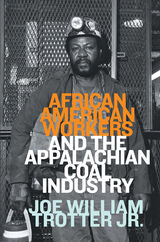


UChicago Accessibility Resources
home | accessibility | search | about | contact us
BiblioVault ® 2001 - 2024
The University of Chicago Press