front cover of Body and Face in Chinese Visual Culture
Body and Face in Chinese Visual Culture
Hung Wu
Harvard University Press, 2005

Traditionally the "Chinese body" was approached as a totality and explained by sweeping comparisons of the differences that distinguished Chinese examples from their Western counterparts. Recently, scholars have argued that we must look at particular examples of Chinese images of the body and explore their intrinsic conceptual complexity and historical specificity.

The twelve contributors to this volume adopt a middle position. They agree that Chinese images are conditioned by indigenous traditions and dynamics of social interaction, but they seek to explain a general Chinese body and face by charting multiple, specific bodies and faces. All of the chapters are historical case studies and investigate particular images, such as Han dynasty tomb figurines; Buddhist texts and illustrations; pictures of deprivation, illness, deformity, and ghosts; clothing; formal portraiture; and modern photographs and films. From the diversity of art forms and historical periods studied, there emerges a more complex picture of ways that the visual culture of the body and face in China has served to depict the living, memorialize the dead, and present the unrepresentable in art.

[more]

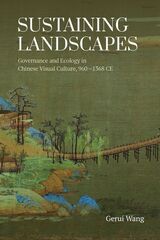
front cover of Sustaining Landscapes
Sustaining Landscapes
Governance and Ecology in Chinese Visual Culture, 960–1368 CE
Gerui Wang
Hong Kong University Press, 2025
Before climate policy, there was landscape painting—how visual culture illustrated ecological concerns in imperial China.

Sustaining Landscapes: Governance and Ecology in Chinese Visual Culture, 960–1368 CE examines ecological thought contested amid the rise of the Chinese landscape genre, tracing its intersections with infrastructure governance, natural resource management, and geospatial knowledge. It traces the pre-industrial notion of “sustainability” in policy debates, legal regulations, and arts. Landscape imagery on paintings, maps, as well as mass-produced artifacts such as fans and ceramic pillows documented both appropriate and exploitative use of natural resources, and critiqued on social inequity and political turmoil. This book breaks new ground by bringing together research on visual and material culture with analysis of politics and ecology. Wang argues that the Chinese landscape genre embodied a holistic approach to negotiating debates on human-nature interdependence and people-state relationships. It joins the increasing literature on ecocriticism and offers alternative perspectives to address contemporary challenges, ranging from environmental crisis to global governance.

[more]


Send via email Share on Facebook Share on Twitter