front cover of Carrying a Secret in My Heart
Carrying a Secret in My Heart
Children of the Victims of the Reprisals after the Hungarian Revolution in 1956 - An Oral History
Zsuzsanna Korösi
Central European University Press, 2003
For a decade now, the authors have been conducting interviews for Hungary's Oral History Archives, with the children of those Hungarians - national heroes, as they are generally seen today - who were imprisoned or executed for their involvement in the 1956 revolution. The vast body of material that has been collected, and is now at the disposal of sociologists, psychologists and others in the academic community, forms the basis of this volume. This is a documentation of memories of the revolt and, more particularly, its aftermath. The virtually spontaneous twelve-day uprising exerted a lasting effect on the fates of the families of the more than 20,000 who were imprisoned and 229 executed by the régime in the harsh reprisals that followed the crushing of the revolution (the last of them as late as the early 1960s), with active police surveillance extended to tens of thousands more. This intimidation, and the attendant social and economic devastation that it wrought, bore especially hard on the psyches, upbringing and education, and hence the subsequent opportunities and life courses of the children who grew up within those families. The material is grouped by theme: e.g. the effects on communication within families, changes in social status, how relatives and friends reacted, and what sorts of problems these children encountered in pursuing their studies, in trying to assimilate into society as adults, and in relating to those fathers who did return. In an appendix, the editors present detailed biographies of the people most directly affected, offering an unparalleled glimpse into the fates of those they interviewed. The documentation includes letters that the children wrote to their imprisoned fathers and the farewell letters of the executed to their families.
[more]

front cover of Fatherhood Arrested
Fatherhood Arrested
Parenting from Within the Juvenile Justice System
Anne M. Nurse
Vanderbilt University Press, 2002
Crime and young fatherhood have generally been viewed as separate social problems. Increasingly, researchers are finding that these problems are closely related and highly concentrated in low-income communities. Fatherhood Arrested is an in-depth study of these issues and the difficulties of parenting while in prison and on parole.

By taking us inside the prison system, Nurse shows how its structure actively shapes an inmate's relationship with his children. For example, visitation is sometimes restricted to blood relatives and wives. Because relationships between unmarried men and the mothers of their children are often strained, some mothers are unwilling to allow their children to go to the prison with the inmate's family. Or the father may be allowed to receive visits from only one "girlfriend," which forces a man with multiple relationships, or with children by different women, to make impossible choices. Special attention is paid to the gendered nature of prison, its patriarchal and punitive structure, and its high-stress environment. The book then follows newly paroled men as they are released and return to their children.

The author spent four years doing research at the California Youth Authority, during which time she surveyed 258 paroled fathers. The group included young white, black, and Latino men, ages sixteen to twenty-five. She conducted in-depth interviews with men selected from this group, participated in forty parenting class sessions, and observed visiting hours at three different institutions. The data provide fascinating information about the characteristics of the men, their attitudes toward fatherhood, and the ways they are involved with their children. The diversity of the fathers allows for an analysis of racial and ethnic variation in their attitudes and involvement. The study concludes with a series of policy suggestions, especially important in light of the large number of fathers now living under the care and control of the juvenile justice system.

[more]

front cover of Mean Lives, Mean Laws
Mean Lives, Mean Laws
Oklahoma's Women Prisoners
Sharp, Susan F
Rutgers University Press, 2014
 Oklahoma has long held the dubious honor of having the highest female incarceration rate in the country, nearly twice the national average. In this compelling new book, sociologist Susan Sharp sets out to discover just what has gone so wrong in the state of Oklahoma—and what that might tell us about trends in female incarceration nationwide.

The culmination of over a decade of original research, Mean Lives, Mean Laws exposes a Kafkaesque criminal justice system, one that has no problem with treating women as collateral damage in the War on Drugs or with stripping female prisoners of their parental rights. Yet it also reveals the individual histories of women who were jailed in Oklahoma, providing intimate portraits of their lives before, during, and after their imprisonment. We witness the impoverished and abusive conditions in which many of these women were raised; we get a vivid portrait of their everyday lives behind bars; and we glimpse the struggles that lead many ex-convicts to fall back into the penal system.

Through an innovative methodology that combines statistical rigor with extensive personal interviews, Sharp shows how female incarceration affects not only individuals, but also families and communities. Putting a human face on a growing social problem, Mean Lives, Mean Laws raises important questions about both the state of Oklahoma and the state of the nation.
[more]

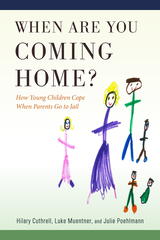
front cover of When Are You Coming Home?
When Are You Coming Home?
How Young Children Cope When Parents Go to Jail
Hilary Cuthrell
Rutgers University Press, 2023
As the United States approaches its 50th year of mass incarceration, more children than ever before have experienced the incarceration of a parent. The vast majority of incarceration occurs in locally operated jails and disproportionately impacts families of color, those experiencing poverty, and rural households. However, we are only beginning to understand the various ways in which children cope with the incarceration of a parent – particularly the coping of young children who are most at risk for the adversity and also the most detrimentally impacted. When Are You Coming Home?  helps answer questions about how young ones are faring when a parent is incarcerated in jail. Situated within a resilience model of development, the book presents findings related to children’s stress, family relationships, health, home environments, and visit experiences through the eyes of the children and families. This humanizing, social justice-oriented approach discusses the paramount need to support children and their families before, during, and after a parent’s incarceration while the country simultaneously grapples with strategies of reform and decarceration.
 
[more]


Send via email Share on Facebook Share on Twitter