
 A SCHOLARLY BOOK REPOSITORY
Judith Malina’s newly restored diaries from a critical early decade in her personal, artistic, and political development
Judith Malina’s diaries from 1947 to 1957 are brought back into print in this volume, which charts her cofounding of The Living Theatre with husband and lifelong artistic partner Julian Beck. In these diaries, she narrates her developing political commitments and her expansive collaborations and personal relationships, as well as a moving account of her time in prison with activist Dorothy Day. This new edition features Kate Bredeson’s comprehensive introduction, which offers a detailed examination of Malina’s life and work in this period, along with additional historical context of these years and never-before-published photographs from Malina’s personal archives.
The Diaries of Judith Malina is a four-volume set that publishes for the first time together the edited diaries of radical theater director, actor, and activist Judith Malina from 1947 to 1971, the most influential period of her remarkable and storied career. A committed anarchist and pacifist, Malina made theater as a way to stoke revolutionary action. Her diaries showcase her political and social observations, cultural commentary, self-reflection, and wit. This expertly prepared set invites us to recognize Malina for her accomplishments not only as an artist and an activist but as one of the great literary diarists.
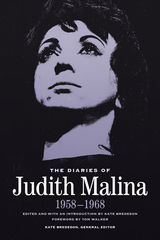
A previously unpublished volume of diaries recording Judith Malina’s extraordinary life and career in a moment of cultural revolution
Judith Malina’s diaries from the pivotal years of 1958 to 1968 are presented here in print for the first time. Meticulously edited and with an essential introduction by Kate Bredeson that offers a detailed discussion of Malina’s life and works during this period, the volume includes additional historical context and never-before-published photographs from Malina’s personal archives, as well as an illuminating foreword by Living Theatre archivist and longtime company member Tom Walker. This decade covers some of the most important years of Malina’s life and in the history of The Living Theatre, from career-defining productions of The Connection and The Brig to the company’s self-imposed European exile, when they created their signature works, including Paradise Now, Antigone, and Frankenstein.
The Diaries of Judith Malina is a four-volume set that publishes for the first time together the edited diaries of radical theater director, actor, and activist Judith Malina from 1947 to 1971, the most influential period of her remarkable and storied career. A committed anarchist and pacifist, Malina made theater as a way to engage in revolutionary action. Her diaries showcase her political and social observations, cultural commentary, self-reflection, and wit. This expertly prepared set invites us to recognize Malina for her accomplishments not only as an artist and an activist but as one of the great literary diarists.

A newly restored edition of Judith Malina’s legendary diaries narrating a key moment of social, political, and cultural upheaval
Originally published by Judith Malina as The Enormous Despair, this slim, gripping collection of diaries from a pivotal period between 1968 and 1969 follows The Living Theatre’s return to the United States after their years of self-exile in Europe, their increasing notoriety and frequent arrests, and their cross-country touring. In these pages, Malina wrestles with the company’s artistic and political efforts during a moment of societal crisis and grapples with their future. Kate Bredeson’s introduction contextualizes Malina’s life and work in this period, while additional historical context and never-before-published photographs add new detail and depth to a stirring account of American social and political history.
The Diaries of Judith Malina is a four-volume set that publishes for the first time together the edited diaries of radical theater director, actor, and activist Judith Malina from 1947 to 1971, the most influential period of her remarkable and storied career. A committed anarchist and pacifist, Malina made theater as a way to engage in revolutionary action. Her diaries showcase her political and social observations, her cultural commentary, her self-reflection, and her wit. This expertly prepared set invites us to recognize Malina for her accomplishments not only as an artist and an activist but as one of the great literary diarists.

Judith Malina’s never-before-published diaries describing a period of profound personal and professional transformation
The years 1969 to 1971 saw The Living Theatre’s greatest rupture, reckoning with its desire to leave its defining productions from the 1960s behind and move forward with new artistic works and practices. In these previously unpublished diaries, Judith Malina recounts these pivotal years, describing her transformative time in Brazil, including her experiences of daily life in jail while awaiting trial with her company members. This meticulously edited volume includes Kate Bredeson’s introduction, examining Malina’s life and work in this period, as well as additional historical context and never-before-published photographs. Living Theatre member Ilion Troya offers a foreword that provides new context for understanding the volume’s historical significance.
The Diaries of Judith Malina is a four-volume set that publishes for the first time together the edited diaries of radical theater director, actor, and activist Judith Malina from 1947 to 1971, the most influential period of her remarkable and storied career. A committed anarchist and pacifist, Malina made theater as a way to engage in revolutionary action. Her diaries showcase her political and social observations, cultural commentary, self-reflection, and wit. This expertly prepared set invites us to recognize Malina for her accomplishments not only as an artist and an activist but as one of the great literary diarists.

The first English-language translation of the 1968 activist play about inequality and access to education
In The Inheritor, surrealist imagery and experimental forms convey the radically different experience of two students, the Inheritor and the Non-Inheritor, as they prepare for a high-stakes exam. Revealing a world of privilege where “there is no such thing as luck,” the play features a beheaded knight, a talking record player, and a boisterous chorus of professors depicted as a flock of squawking birds.
Based on sociologists Pierre Bourdieu and Jean-Claude Passeron’s The Inheritors: French Students and Their Relations to Culture, the play was collectively created by Théâtre de l’Aquarium, a company then composed entirely of students. It proved a powerful success when it premiered in May 1968 amid student and worker protests in Paris, and it continues to speak forcefully to education inequity on campuses across anglophone countries today.
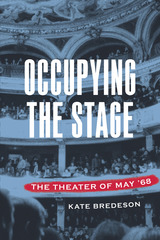
The book shows how French theater artists during this period used a strategy of occupation-occupying buildings, streets, language, words, traditions, and artistic processes-as their central tactic of protest and transformation. It further proposes that the Theater of May '68 has left imprints on contemporary artists and activists, and that this theater offers a scaffolding on which to build a meaningful analysis of contemporary protest and performance in France, North America, and beyond.
At the book's heart is an inquiry into how artists of the period used theater as a way to engage in political work and, concurrently, questioned and overhauled traditional theater practices so their art would better reflect the way they wanted the world to be. Occupying the Stage embraces the utopic vision of May '68 while probing the period's many contradictions. It thus affirms the vital role theater can play in the ongoing work of social change.
READERS
Browse our collection.
PUBLISHERS
See BiblioVault's publisher services.
STUDENT SERVICES
Files for college accessibility offices.
RECENTLY PUBLISHED





UChicago Accessibility Resources
home | accessibility | search | about | contact us
BiblioVault ® 2001 - 2025
The University of Chicago Press