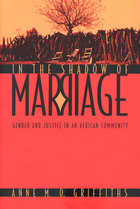
front cover of In the Shadow of Marriage
In the Shadow of Marriage
Gender and Justice in an African Community
Anne M. O. Griffiths
University of Chicago Press, 1997
Anne Griffiths originally went to Botswana to establish a university course in family law. But independent fieldwork in Botswana convinced her of the central role of the traditional customary legal system that stands alongside the colonial common law of courts and magistrates she was examining in her course. In the first comparative work on these two systems, Griffiths shows how the structure of both legal institutions is based on power and gender relations that heavily favor males.

Griffiths's analysis is based on careful observation of how people actually experience the law as well as the more standard tools of statutes and cases familiar to Western legal scholars. She explains how women's access to law is determined by social relations over which they have little control. In this powerful feminist critique of law and anthropology, Griffiths shows how law and custom are inseparable for Kwena women. Both colonial common law and customary law pose comparable and constant challenges to Kwena women's attempts to improve their positions in society.
[more]

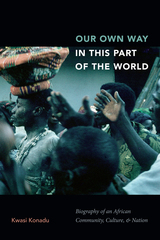
front cover of Our Own Way in This Part of the World
Our Own Way in This Part of the World
Biography of an African Community, Culture, and Nation
Kwasi Konadu
Duke University Press, 2019
Kofi Dᴐnkᴐ was a blacksmith and farmer, as well as an important healer, intellectual, spiritual leader, settler of disputes, and custodian of shared values for his Ghanaian community. In Our Own Way in This Part of the World Kwasi Konadu centers Dᴐnkᴐ's life story and experiences in a communography of Dᴐnkᴐ's community and nation from the late nineteenth century through the end of the twentieth, which were shaped by historical forces from colonial Ghana's cocoa boom to decolonization and political and religious parochialism. Although Dᴐnkᴐ touched the lives of thousands of citizens and patients, neither he nor they appear in national or international archives covering the region. Yet his memory persists in his intellectual and healing legacy, and the story of his community offers a non-national, decolonized example of social organization structured around spiritual forces that serves as a powerful reminder of the importance for scholars to take their cues from the lived experiences and ideas of the people they study.

[more]


Send via email Share on Facebook Share on Twitter