
 A SCHOLARLY BOOK REPOSITORY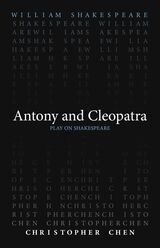
In Antony and Cleopatra, Christopher Chen tackles the sweeping epic of love and betrayal at the center of the story of the rulers Antony of Rome and Cleopatra of Egypt. In this contemporary translation of the play, Chen brings the political intrigue and historical storytelling of Shakespeare to modern audiences while preserving the poetic foundation of the play’s language.
This translation of Antony and Cleopatra was written as part of the Oregon Shakespeare Festival’s Play On! project, which commissioned new translations of thirty-nine Shakespeare plays. These translations present the work of “The Bard” in language accessible to modern audiences while never losing the beauty of Shakespeare’s verse. Enlisting the talents of a diverse group of contemporary playwrights, screenwriters, and dramaturges from diverse backgrounds, this project reenvisions Shakespeare for the twenty-first century. These volumes make these works available for the first time in print—a new First Folio for a new era.

Invectives against Antony.
Cicero (Marcus Tullius, 106–43 BC), Roman advocate, orator, politician, poet, and philosopher, about whom we know more than we do of any other Roman, lived through the stirring era that saw the rise, dictatorship, and death of Julius Caesar in a tottering republic. In Cicero’s political speeches and in his correspondence we see the excitement, tension, and intrigue of politics and the part he played in the turmoil of the time. Of about 106 speeches, 58 survive (a few incompletely), 29 of which are addressed to the Roman people or Senate, the rest to jurors. In the fourteenth century Petrarch and other Italian humanists discovered manuscripts containing more than 900 letters, of which more than 800 were written by Cicero, and nearly 100 by others to him. This correspondence affords a revelation of the man, all the more striking because most of the letters were not intended for publication. Six works on rhetorical subjects survive intact and another in fragments. Seven major philosophical works are extant in part or in whole, and there are a number of shorter compositions either preserved or known by title or fragments.
The Loeb Classical Library edition of Cicero is in twenty-nine volumes.

Invectives against Antony.
Cicero (Marcus Tullius, 106–43 BC), Roman advocate, orator, politician, poet, and philosopher, about whom we know more than we do of any other Roman, lived through the stirring era that saw the rise, dictatorship, and death of Julius Caesar in a tottering republic. In Cicero’s political speeches and in his correspondence we see the excitement, tension, and intrigue of politics and the part he played in the turmoil of the time. Of about 106 speeches, 58 survive (a few incompletely), 29 of which are addressed to the Roman people or Senate, the rest to jurors. In the fourteenth century Petrarch and other Italian humanists discovered manuscripts containing more than 900 letters, of which more than 800 were written by Cicero, and nearly 100 by others to him. This correspondence affords a revelation of the man, all the more striking because most of the letters were not intended for publication. Six works on rhetorical subjects survive intact and another in fragments. Seven major philosophical works are extant in part or in whole, and there are a number of shorter compositions either preserved or known by title or fragments.
The Loeb Classical Library edition of Cicero is in twenty-nine volumes.
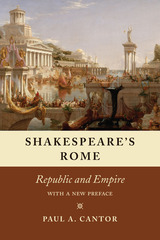
In Shakespeare’s Rome, Cantor examines the political settings of Shakespeare’s Roman plays, Coriolanus and Antony and Cleopatra, with references as well to Julius Caesar. Cantor shows that Shakespeare presents a convincing portrait of Rome in different eras of its history, contrasting the austere republic of Coriolanus, with its narrow horizons and martial virtues, and the cosmopolitan empire of Antony and Cleopatra, with its “immortal longings” and sophistication bordering on decadence.
READERS
Browse our collection.
PUBLISHERS
See BiblioVault's publisher services.
STUDENT SERVICES
Files for college accessibility offices.
RECENTLY PUBLISHED




UChicago Accessibility Resources
home | accessibility | search | about | contact us
BiblioVault ® 2001 - 2026
The University of Chicago Press