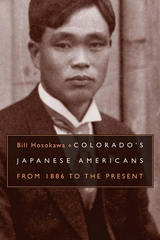
front cover of Colorado's Japanese Americans
Colorado's Japanese Americans
From 1886 to the Present
Bill Hosokawa
University Press of Colorado, 2005
In Colorado's Japanese Americans, renowned journalist and author Bill Hosokawa pens the first history of this significant minority in the Centennial State. From 1886, when the young aristocrat Matsudaira Tadaatsu settled in Denver, to today, when Colorado boasts a population of more than 11,000 people of Japanese ancestry, Japanese Americans have worked to build homes, businesses, families, and friendships in the state.

Hosokawa traces personal histories, such as Bob Sakata's journey from internment in a relocation camp to his founding of a prosperous truck farm; the conviction of three sisters for assisting the escape of German POWs; and the years of initiative and determination behind Toshihiro Kizaki's ownership of Sushi Den, a beloved Denver eatery. In addition to personal stories, the author also relates the larger history of the interweave of cultures in Colorado, from the founding of the Navy's Japanese language school at the University of Colorado to the merging of predominantly white and Japanese American congregations at Arvada's Simpson United Methodist Church.

With the author's long view and sharp eye, Colorado's Japanese Americans creates a storied document of lasting legacy about the Issei and Nisei in Colorado.
[more]

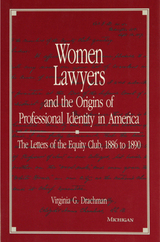
front cover of Women Lawyers and the Origins of Professional Identity in America
Women Lawyers and the Origins of Professional Identity in America
The Letters of the Equity Club, 1886 to 1890
Virginia G. Drachman
University of Michigan Press, 1993
The first women lawyers in America, like many of their twentieth-century counterparts, had to reconcile the traditional roles assigned to women with their roles as lawyers. In 1886, a group of women students and recent alumnae of the University of Michigan Law School founded the Equity Club, a correspondence club for women lawyers and law students across the country who were trying to overcome geographic isolation. The Equity Club became the first organization in the United States to forge professional links between women lawyers, and its founding marks the origins of a collective identity among these new professionals. The letters reprinted in Women Lawyers and the Origins of Professional Identity in America reveal the challenges the first women lawyers faced and reflect the diverse opinions they held on the common issues confronting them. Some contended that women should be lawyers on the same terms as men, while others argued that they could bring something special to the profession—like morality, purity, ethics, and humanity—in contrast to the purely business and commercial qualities of law as practiced by men. The discovery and publication of these letters fill a void in the documentary history of the legal profession and the history of women in America. The introductory essay and the biographical information provided about the lives of the members of the Equity Club help to place the letters in the larger contexts of those histories. Women Lawyers and the Origins of Professional Identity in America will prove enlightening to practicing lawyers, who will find that even a hundred years later, many of the letters have remarkable relevance. Scholars and students in women's history, American studies, sociology, and legal history will also find it a valuable resource.
[more]


Send via email Share on Facebook Share on Twitter