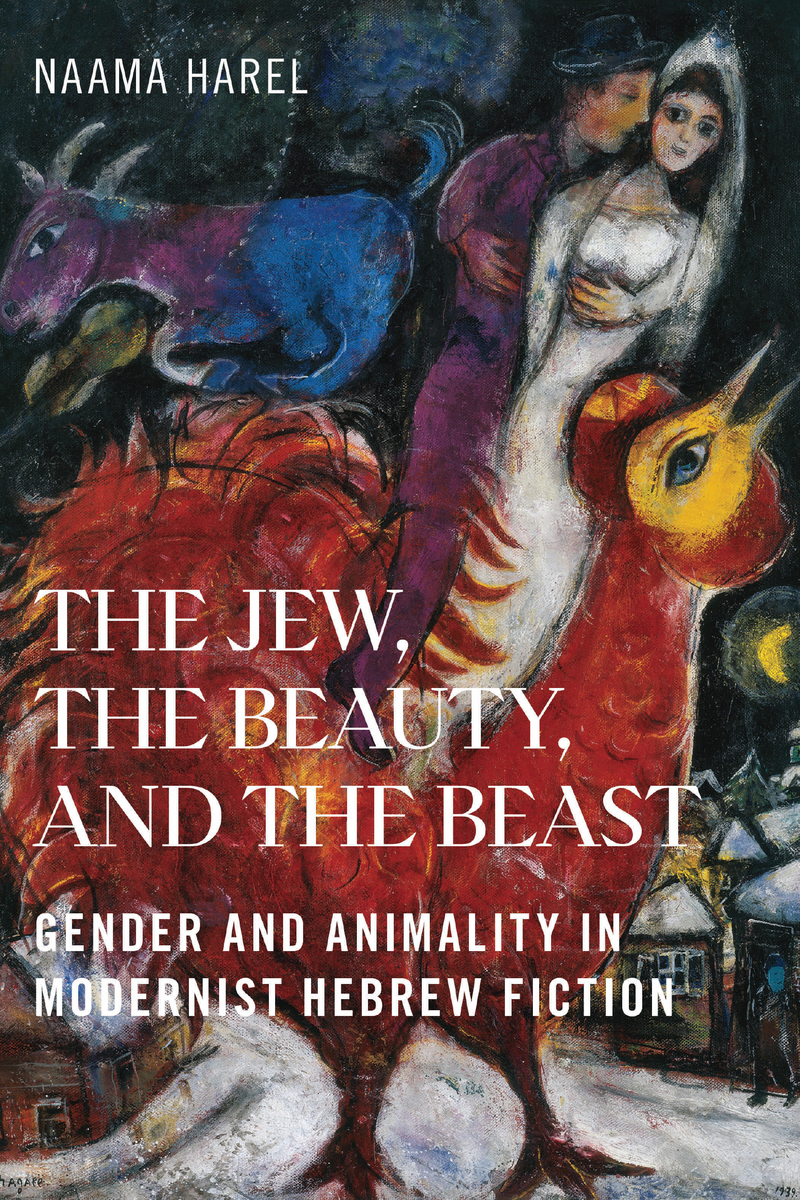
The Jew, the Beauty, and the Beast: Gender and Animality in Modernist Hebrew Fiction
Rutgers University Press, 2026
Cloth: 978-1-9788-4173-4 | Paper: 978-1-9788-4172-7 | eISBN: 978-1-9788-4174-1 (ePub) | eISBN: 978-1-9788-4175-8 (PDF)
Library of Congress Classification PJ5030.W65H37 2025
Dewey Decimal Classification 892.437093521
Cloth: 978-1-9788-4173-4 | Paper: 978-1-9788-4172-7 | eISBN: 978-1-9788-4174-1 (ePub) | eISBN: 978-1-9788-4175-8 (PDF)
Library of Congress Classification PJ5030.W65H37 2025
Dewey Decimal Classification 892.437093521
ABOUT THIS BOOK | AUTHOR BIOGRAPHY | REVIEWS | TOC
ABOUT THIS BOOK
Jews, women, and animals have been notoriously considered in Western thought as antithetical to the “civilized,” and therefore parallel. The trope of the womanized Jewish man has been widely recognized as a staple in otherizing portrayals of European Jews, as well as their self-perception. Similarly, ecofeminist critique has addressed the ubiquitous depiction of the animalized woman throughout history. Yet, the interconnection between the effeminization of Jews and the animalization of women has been overlooked.
The Jew, the Beauty, and the Beast critically explores the tangled interplay between Jewishness, gender, and animality and its manifestation in modernist Hebrew fiction. Through interdiscursive analysis and close readings, the effeminate Jew is examined vis-à-vis the animalized woman. Intertwining cutting-edge theoretical frameworks of posthumanism and animal studies with established scholarship of Hebrew literature, Jewish studies, and gender studies, Naama Harel offers new Hebrew literary historiography and innovative perspectives on canonical works by Shmuel Yosef Agnon, Devorah Baron, Micha Yosef Berdichevsky, Yosef Haim Brenner, Uri Nissan Gnessin, and David Vogel.
The Jew, the Beauty, and the Beast critically explores the tangled interplay between Jewishness, gender, and animality and its manifestation in modernist Hebrew fiction. Through interdiscursive analysis and close readings, the effeminate Jew is examined vis-à-vis the animalized woman. Intertwining cutting-edge theoretical frameworks of posthumanism and animal studies with established scholarship of Hebrew literature, Jewish studies, and gender studies, Naama Harel offers new Hebrew literary historiography and innovative perspectives on canonical works by Shmuel Yosef Agnon, Devorah Baron, Micha Yosef Berdichevsky, Yosef Haim Brenner, Uri Nissan Gnessin, and David Vogel.
See other books on: Beast | Beauty | Hebrew literature, Modern | Jew | Women in literature
See other titles from Rutgers University Press