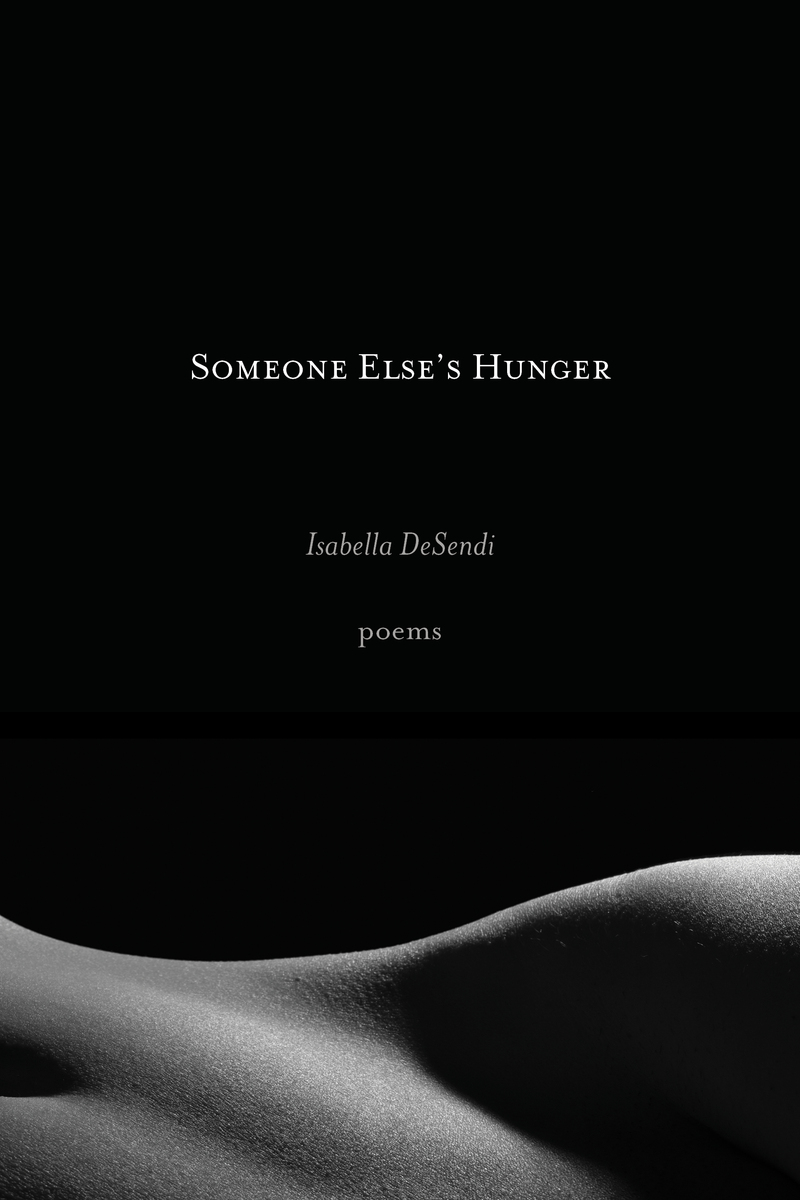
Someone Else's Hunger
Four Way Books, 2025
Paper: 978-1-961897-58-8 | eISBN: 978-1-961897-59-5
Library of Congress Classification PS3604.E75728
Dewey Decimal Classification 811.6
Paper: 978-1-961897-58-8 | eISBN: 978-1-961897-59-5
Library of Congress Classification PS3604.E75728
Dewey Decimal Classification 811.6
ABOUT THIS BOOK | AUTHOR BIOGRAPHY | REVIEWS
ABOUT THIS BOOK
Dislocated in her own skin after a sexual assault, Isabella DeSendi wrestles with the thorny border between desire and appetite in her incandescent debut collection. Poised between her Cuban matrilineage and her first-generation adolescence in America, between assimilation and reclamation, between owning her own cravings and becoming a sacrifice to "someone else's hunger," these poems dissect our human obsession with beauty and the body. The poems in this collection use the lyric form to enact destruction and reparation as they attempt to reverse the vector of aesthetic power toward grace. Because Someone Else's Hunger is beautiful, devastatingly so, it surveys violence, romance, eating disorders, structural racism, and socioeconomic inequality, all while yearning to still find beauty everywhere. At the nail salon, the speaker chooses red lacquer and the tech "paints the color of / anger or desire across the long lake of [her] nail"; in the city, where she feels like "an animal caught / in the sewer of [her] life" with "spring's pink garbage / strewn into the streets while petals performed / their daily adagio down the avenue"; and behind her mother's house, where she used to vomit at the lip of the reservoir, "where the water would congeal / then break like dough under [her] body's simple rot."
The expansive mercy of DeSendi's breath-taking images is never more apparent than the moment they turn, as when she heralds the avian frenzy "in the moment right after a purge": "always the miracle of birds arriving," "a messy flurry…curious if any piece of me could be salvaged, was still good enough to be taken home to the other starlings to eat." This speaker's ability to see the tenacious tenderness that drives the scavenger, to recognize its creative intelligence for nourishment, belies the resuscitative artistry that never abandons her as she turns carrion into continuance, coming alive again. Someone Else's Hunger subverts the revenge to recovery plot, arguing that the truest testament to the speaker's inner strength is the resilience it took to survive. DeSendi formally moves between restraint and excess, illustrating the great courage required to relinquish the control she won back when she became the master of her suffering. But the reward of risking exposure, daring to open herself to the world and let herself feed off it? Abundance. The arrival of spring and "with it the audacious dirt," this realization that "sometimes / in the breaking I am bettering / and in the bettering I am free."
The expansive mercy of DeSendi's breath-taking images is never more apparent than the moment they turn, as when she heralds the avian frenzy "in the moment right after a purge": "always the miracle of birds arriving," "a messy flurry…curious if any piece of me could be salvaged, was still good enough to be taken home to the other starlings to eat." This speaker's ability to see the tenacious tenderness that drives the scavenger, to recognize its creative intelligence for nourishment, belies the resuscitative artistry that never abandons her as she turns carrion into continuance, coming alive again. Someone Else's Hunger subverts the revenge to recovery plot, arguing that the truest testament to the speaker's inner strength is the resilience it took to survive. DeSendi formally moves between restraint and excess, illustrating the great courage required to relinquish the control she won back when she became the master of her suffering. But the reward of risking exposure, daring to open herself to the world and let herself feed off it? Abundance. The arrival of spring and "with it the audacious dirt," this realization that "sometimes / in the breaking I am bettering / and in the bettering I am free."
See other books on: Death, Grief, Loss | Hispanic & Latino | Poetry | Subjects & Themes | Women Authors
See other titles from Four Way Books