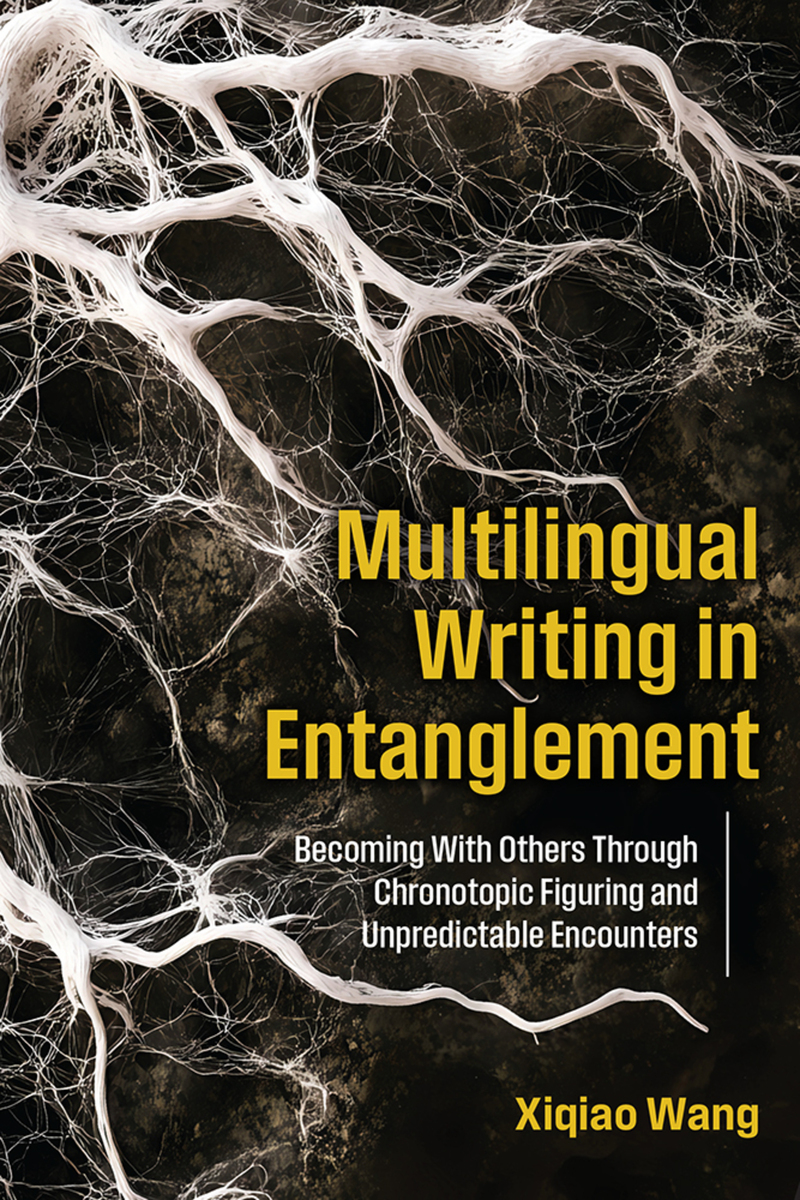
Multilingual Writing in Entanglement: Becoming With Others Through Chronotopic Figuring and Unpredictable Encounters
Utah State University Press, 2025
Cloth: 978-1-64642-760-4 | Paper: 978-1-64642-761-1 | eISBN: 978-1-64642-762-8
Library of Congress Classification P301.5.A27
Dewey Decimal Classification 808.066378
Cloth: 978-1-64642-760-4 | Paper: 978-1-64642-761-1 | eISBN: 978-1-64642-762-8
Library of Congress Classification P301.5.A27
Dewey Decimal Classification 808.066378
ABOUT THIS BOOK | AUTHOR BIOGRAPHY | REVIEWS | REQUEST ACCESSIBLE FILE
ABOUT THIS BOOK
Multilingual Writing in Entanglement offers deep, behind-the-scenes insight into multilingual writing processes through ethnographically constructed case studies of two Chinese international students navigating first-year writing assignments. Drawing on fungi studies to develop ecology-informed metaphors, Xiqiao Wang traces how these students’ writing unfolds alongside multilingual living, revealing the thickets of relationships with both human participants (peers, teachers, writing consultants) and nonhuman elements (trees, rivers, digital texts, writing technologies) that create opportunities for negotiating across differences.
This longitudinal qualitative study follows Morgan and Leo through their undergraduate careers, collecting rich ethnographic data across private, academic, and digital spaces. The resulting theoretical framework conceptualizes multilingual writing as simultaneously strategic, agentive, creative, diffused, contingent, and messy—a phenomenon shaped by dynamic interplay between ephemeral encounters and established practices. Employing chronotopic figuring as a methodological tool, Wang illuminates aspects of multilingual writing often elided in research: fleeting encounters that energize composition, reciprocal relationships that distribute writing labor, unexpected detours that redirect the writing process, and the layering of writing and identity practices across multiple historical trajectories. This approach moves beyond examining writing in isolated moments to trace how meaning emerges across languages, modes, and spacetimes.
Multilingual Writing in Entanglement offers crucial insights into how international students strategically and improvisationally reconfigure their semiotic and rhetorical repertoires to write multilingual lives into meaning. This work is influential for scholars and educators in composition, literacy studies, multilingual education, ESL, and linguistics.
This longitudinal qualitative study follows Morgan and Leo through their undergraduate careers, collecting rich ethnographic data across private, academic, and digital spaces. The resulting theoretical framework conceptualizes multilingual writing as simultaneously strategic, agentive, creative, diffused, contingent, and messy—a phenomenon shaped by dynamic interplay between ephemeral encounters and established practices. Employing chronotopic figuring as a methodological tool, Wang illuminates aspects of multilingual writing often elided in research: fleeting encounters that energize composition, reciprocal relationships that distribute writing labor, unexpected detours that redirect the writing process, and the layering of writing and identity practices across multiple historical trajectories. This approach moves beyond examining writing in isolated moments to trace how meaning emerges across languages, modes, and spacetimes.
Multilingual Writing in Entanglement offers crucial insights into how international students strategically and improvisationally reconfigure their semiotic and rhetorical repertoires to write multilingual lives into meaning. This work is influential for scholars and educators in composition, literacy studies, multilingual education, ESL, and linguistics.
See other books on: Academic writing | Becoming | College freshmen | Language Arts | Multilingual education
See other titles from Utah State University Press