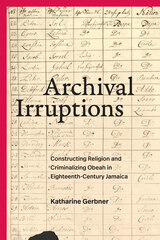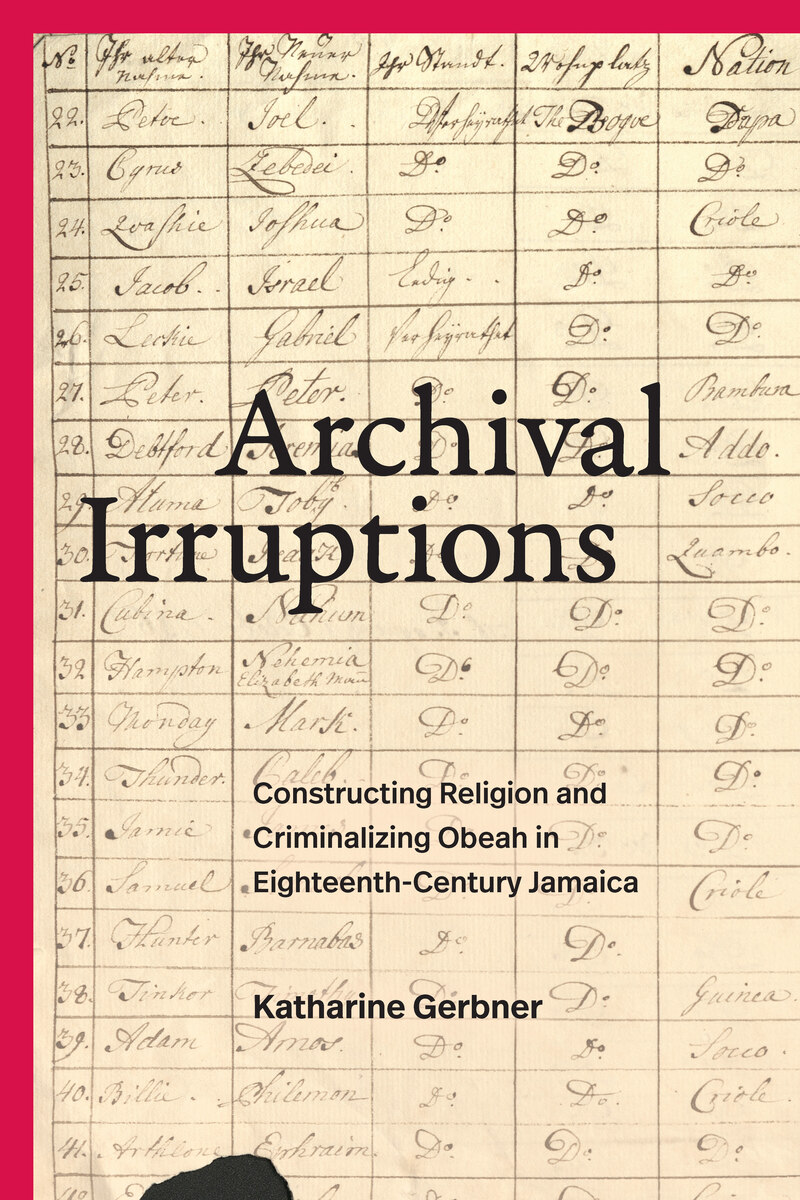
Archival Irruptions: Constructing Religion and Criminalizing Obeah in Eighteenth-Century Jamaica
Duke University Press, 2025
Cloth: 978-1-4780-2903-8 | Paper: 978-1-4780-3240-3 | eISBN: 978-1-4780-9436-4 (OA) | eISBN: 978-1-4780-6125-0 (standard)
Library of Congress Classification BL2532.O23G47 2025
See other books on: Cults | Jamaica | Religion and sociology | Religions | Witchcraft
See other titles from Duke University Press
Cloth: 978-1-4780-2903-8 | Paper: 978-1-4780-3240-3 | eISBN: 978-1-4780-9436-4 (OA) | eISBN: 978-1-4780-6125-0 (standard)
Library of Congress Classification BL2532.O23G47 2025
ABOUT THIS BOOK | AUTHOR BIOGRAPHY | REVIEWS | TOC | REQUEST ACCESSIBLE FILE
ABOUT THIS BOOK
In 1760, following the largest slave revolt in the eighteenth-century British Empire, the Afro-Caribbean word Obeah first appeared in British colonial law. In Archival Irruptions, Katharine Gerbner traces how British authorities in Jamaica came to criminalize Obeah, a practice that was variously seen as a healing method, an Africana religion, a science, and a form of witchcraft. Gerbner shows that in the years directly preceding its criminalization, for enslaved Africans and Maroons, Obeah was a prophetic practice tied to healing and death rites. Drawing on Moravian missionary archives, Gerbner theorizes these descriptions of African religious beliefs, rituals, and concepts as “irruptions”: moments when Africana epistemologies break the narrative of a European-authored archival document. In these irruptions, we see European assertions of authority through the lens of Obeah. Moreover, we find that the modern category of religion is rooted in the histories of slavery, rebellion, and the criminalization of Black religious practices. Gerbner’s search for archival irruptions not only creates an opportunity to write an alternative narration about Obeah; it provides a new methodology for all those conducting archival research.
See other books on: Cults | Jamaica | Religion and sociology | Religions | Witchcraft
See other titles from Duke University Press