Duke University Press, 2025 Cloth: 978-1-4780-2891-8 | Paper: 978-1-4780-3217-5 | eISBN: 978-1-4780-6113-7 (standard) Library of Congress Classification ML3556.R23 2025
ABOUT THIS BOOK | AUTHOR BIOGRAPHY | REVIEWS | TOC | REQUEST ACCESSIBLE FILE
ABOUT THIS BOOK
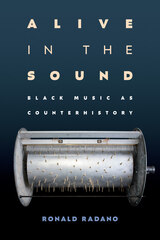
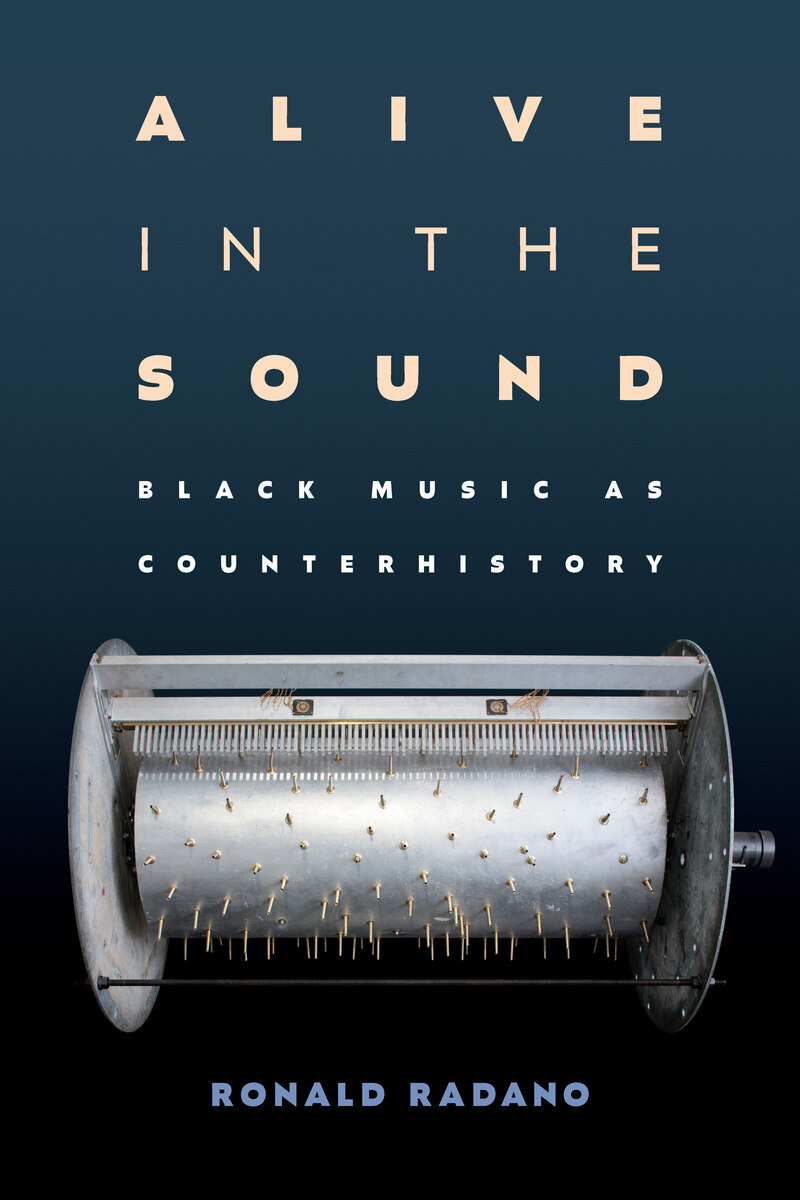
In Alive in the Sound, Ronald Radano proposes a new understanding of US Black music by focusing on the key matter of value, manifested musically in its seemingly embodied qualities—spirit, soul, and groove. While acknowledging these qualities are always embedded in Black music, Radano shows they developed not simply from performance but from musicians’ status as laborers inhabiting an enduring racial-economic contradiction: Black music originated publicly as an exchangeable property owned by people whose subhuman status granted them—as “natural” musicians—indelible properties of sound. As a contradiction of the rules of ownership, wherein enslaved property was forbidden the right to own, modern Black music emerges after emancipation as a primary possession, moving dialectically into commercial markets and counterhistorically back into Black worlds. Slavery’s seminal contests of ownership underlie modern musical sensations of aliveness, which become the chief measure of value in popular music. By reconceiving US Black music history as a history of value, Radano rethinks the music’s place in US and global culture.
AUTHOR BIOGRAPHY
Ronald Radano is Professor Emeritus of African Cultural Studies and Music at the University of Wisconsin–Madison. Among his books is Audible Empire: Music, Global Politics, Critique, also published by Duke University Press.
REVIEWS
“Uncovering striking and novel parallels across various forms of African American music while challenging conventional formulations of identity and historical periodization, Ronald Radano upends settled wisdom around African American music and presents a new historical and critical model for its development.”
-- George E. Lewis, author of A Power Stronger Than Itself: The AACM and American Experimental Music
“Ronald Radano’s ambitious, well-researched book challenges some assumptions of the distinctness of Black music in the United States. Through careful scholarship and compelling argument, Radano demonstrates that the critical production of Black music as distinct from other US music produces notions of US culture, and produces the frameworks through which notions of music-in-general develop. Alive in the Sound is a significant achievement and a major book.”
-- Anthony Reed, author of Soundworks: Race, Sound, and Poetry in Production
TABLE OF CONTENTS
Preface ix Acknowledgments xv Introduction. Black Labor, Value, and the Anomalies of Enlivened Sound 1 First Metamorphosis: Property’s Properties of Reconstructive Possibility 1. Slave Labor and the Emergence of a Peculiar Music 41 Second Metamorphosis: Free Labor and the Racial-Economic Transaction of Animated Form 2. Scabrous Sounds of a Vagrant Proletariat 81 3. Minstrelsy’s Incredible Corporealities 118 Third Metamorphosis: Contests of Ownership in Early National Markets 4. Ragtime’s Double-Time Accumulation 159 5. New Coalescences of Spectacular Form: Stride Piano and Ragtime Piano Rolls 189 6. Commodity Circuits and the Making of a Jazz Counterhistory 223 Fourth Metamorphosis: Racialized Embodiments of Hypercapitalized Pop 7. Swing: Black Music’s New Modern Becoming 283 8. Living Forms, Imagined Truths: Aesthetic Breakthroughs in Jazz at Midcentury 331 9. Apotheosis of a New Black Music 365 Afterword: Modernity’s Ghosts 424 Notes 429 Bibliography 493 Index 535
REQUEST ACCESSIBLE FILE
If you are a student who cannot use this book in printed form, BiblioVault may be able to supply you
with an electronic file for alternative access.
Please have the accessibility coordinator at your school fill out this form.