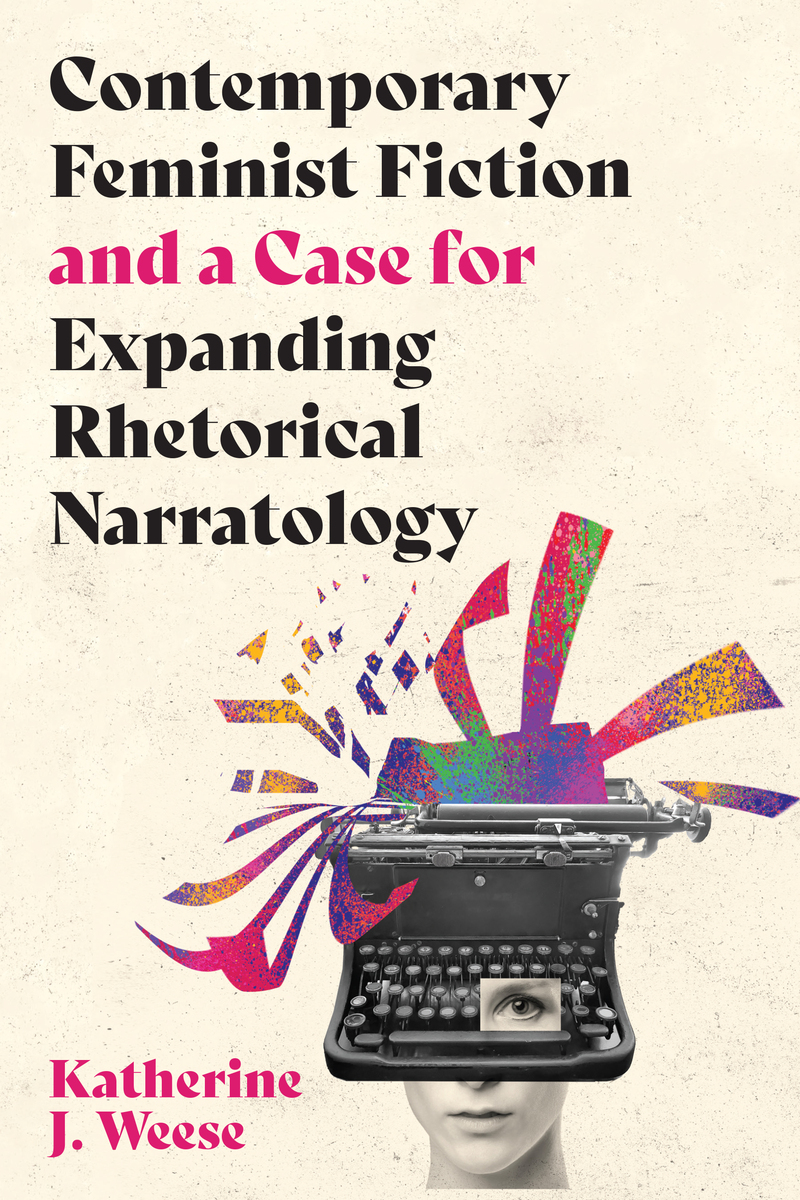
Contemporary Feminist Fiction and a Case for Expanding Rhetorical Narratology
The Ohio State University Press, 2025
Cloth: 978-0-8142-1599-9 | eISBN: 978-0-8142-8445-2 (individual) | eISBN: 978-0-8142-8460-5 (institutional)
Library of Congress Classification PN3401.W44 2025
See other books on: 21st Century | Discourse analysis, Narrative | Feminist criticism | Feminist fiction | Narration (Rhetoric)
See other titles from The Ohio State University Press
Cloth: 978-0-8142-1599-9 | eISBN: 978-0-8142-8445-2 (individual) | eISBN: 978-0-8142-8460-5 (institutional)
Library of Congress Classification PN3401.W44 2025
ABOUT THIS BOOK | AUTHOR BIOGRAPHY | REVIEWS | TOC
ABOUT THIS BOOK
In Contemporary Feminist Fiction and a Case for Expanding Rhetorical Narratology, Katherine J. Weese explores intersections among rhetorical, unnatural, and feminist narrative theories and post-postmodern theory to argue that an expanded rhetorical poetics offers the most comprehensive model for illuminating recent works that employ unnatural devices for feminist purposes. This pluralist narratological framework is a vital counterpoint to theorists’ tendency to read twentieth- and twenty-first-century novels through a post-postmodernist or metamodernist lens that overlooks unnatural, feminist, and rhetorical narrative theories.
Examining Ali Smith’s The Accidental and Hotel World, Barbara Kingsolver’s The Poisonwood Bible, Toni Morrison’s Beloved, Kate Atkinson’s A God in Ruins and Life After Life, and Ruth Ozeki’s A Tale for the Time Being, Weese demonstrates how various narratological theories inform rather than compete with one another. Through an expanded rhetorical poetics, including a refined version of James Phelan’s MTS (mimetic, thematic, synthetic) model, she reframes post-postmodern theorists’ concerns with communicative function through a narratological lens to make the case that exploring the rhetorical function of unnatural devices challenges and extends the claims of narrow metamodern readings.
Examining Ali Smith’s The Accidental and Hotel World, Barbara Kingsolver’s The Poisonwood Bible, Toni Morrison’s Beloved, Kate Atkinson’s A God in Ruins and Life After Life, and Ruth Ozeki’s A Tale for the Time Being, Weese demonstrates how various narratological theories inform rather than compete with one another. Through an expanded rhetorical poetics, including a refined version of James Phelan’s MTS (mimetic, thematic, synthetic) model, she reframes post-postmodern theorists’ concerns with communicative function through a narratological lens to make the case that exploring the rhetorical function of unnatural devices challenges and extends the claims of narrow metamodern readings.
See other books on: 21st Century | Discourse analysis, Narrative | Feminist criticism | Feminist fiction | Narration (Rhetoric)
See other titles from The Ohio State University Press