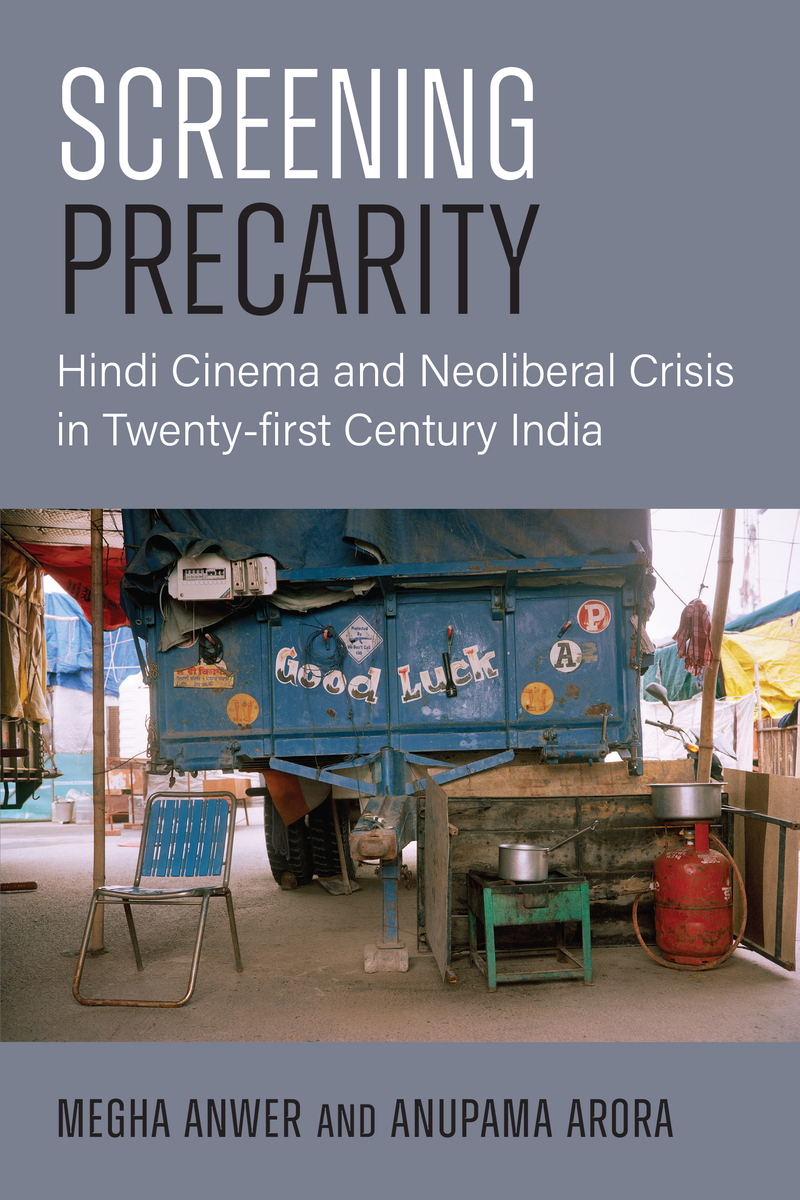
Screening Precarity: Hindi Cinema and Neoliberal Crisis in Twenty-first Century India
University of Michigan Press, 2025
Cloth: 978-0-472-07764-9 | Paper: 978-0-472-05764-1 | eISBN: 978-0-472-90523-2 (OA)
See other books on: Anwer, Megha | Arora, Anupama | Asian Studies | Hindi Cinema | Neoliberal Crisis
See other titles from University of Michigan Press
Cloth: 978-0-472-07764-9 | Paper: 978-0-472-05764-1 | eISBN: 978-0-472-90523-2 (OA)
ABOUT THIS BOOK | AUTHOR BIOGRAPHY | REVIEWS | TOC | REQUEST ACCESSIBLE FILE
ABOUT THIS BOOK
Screening Precarity explores the role that Hindi films play in how precarity is mediated by film, and what that mediation reveals about both contemporary India and the social life of the movies. This study moves away from the history of Hindi cinema’s articulation of precariousness, focusing instead on filmic renderings of precarity: a distinct and historically contingent condition produced by neoliberalism. The authors argue that post-2010 Hindi films may be thought of as contentious cinematic terrains that record India’s transition from the glee and gusto of liberalization in the 1990s, to a nation contending with the failures and inadequacies of neoliberalism’s promises, and the ascendency of the material-affective redressals offered by Hindu nationalism. Incorporating film and media studies, cultural studies, gender studies, and South Asian studies, Screening Precarity is an intervention in the politics of representation, particularly, of how marginal identities are shaped, scripted, and screened when neoliberalism and authoritarianism enmesh.
See other books on: Anwer, Megha | Arora, Anupama | Asian Studies | Hindi Cinema | Neoliberal Crisis
See other titles from University of Michigan Press