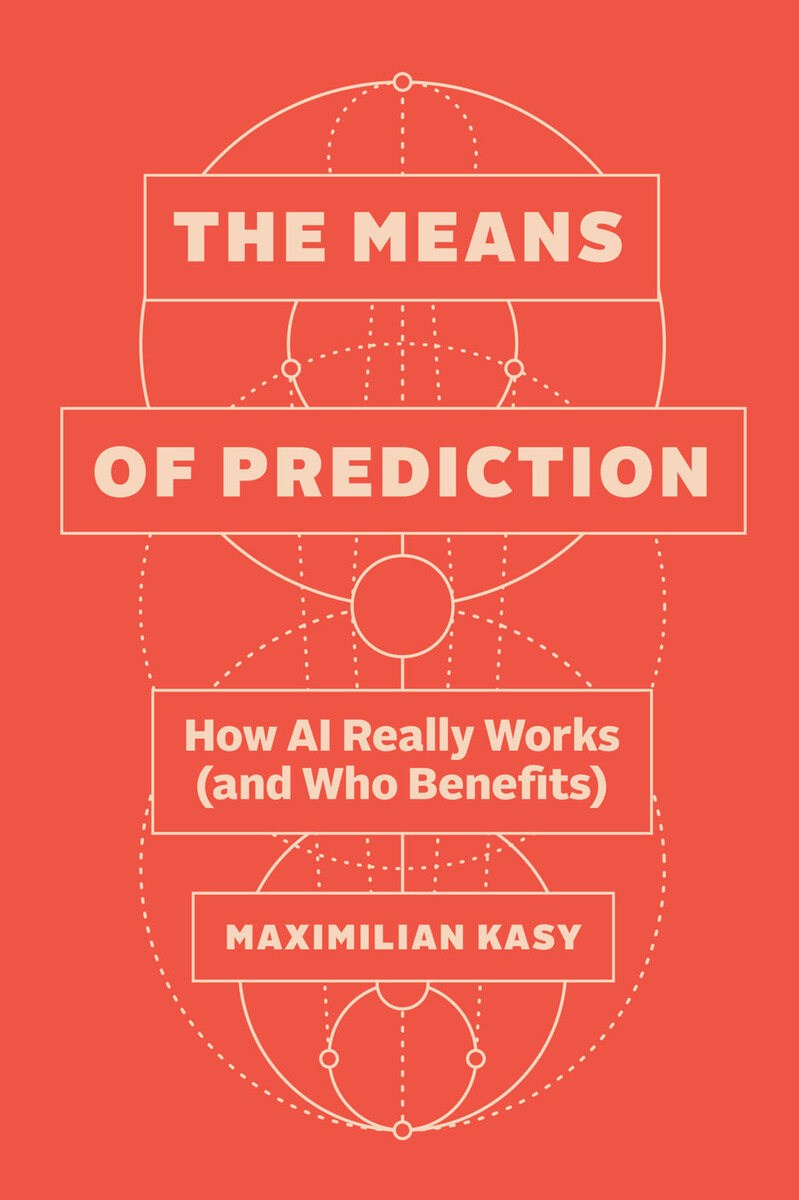
The Means of Prediction: How AI Really Works (and Who Benefits)
University of Chicago Press, 2025
Cloth: 978-0-226-83953-0 | eISBN: 978-0-226-83954-7
Library of Congress Classification Q335.M369 2025
Dewey Decimal Classification 303.4834
Cloth: 978-0-226-83953-0 | eISBN: 978-0-226-83954-7
Library of Congress Classification Q335.M369 2025
Dewey Decimal Classification 303.4834
ABOUT THIS BOOK | AUTHOR BIOGRAPHY | REVIEWS | TOC | REQUEST ACCESSIBLE FILE
ABOUT THIS BOOK
An eye-opening examination of how power—not technology—will define life with AI.
AI is inescapable, from its mundane uses online to its increasingly consequential decision-making in courtrooms, job interviews, and wars. The ubiquity of AI is so great that it might produce public resignation—a sense that the technology is our shared fate.
As economist Maximilian Kasy shows in The Means of Prediction, artificial intelligence, far from being an unstoppable force, is irrevocably shaped by human decisions—choices made to date by the ownership class that steers its development and deployment. Kasy shows that the technology of AI is ultimately not that complex. It is insidious, however, in its capacity to steer results to its owners’ wants and ends. Kasy clearly and accessibly explains the fundamental principles on which AI works, and, in doing so, reveals that the real conflict isn’t between humans and machines, but between those who control the machines and the rest of us.
The Means of Prediction offers a powerful vision of the future of AI: a future not shaped by technology, but by the technology’s owners. Amid a deluge of debates about technical details, new possibilities, and social problems, Kasy cuts to the core issue: Who controls AI’s objectives, and how is this control maintained? The answer lies in what he calls “the means of prediction,” or the essential resources required for building AI systems: data, computing power, expertise, and energy. As Kasy shows, in a world already defined by inequality, one of humanity’s most consequential technologies has been and will be steered by those already in power.
Against those stakes, Kasy offers an elegant framework both for understanding AI’s capabilities and for designing its public control. He makes a compelling case for democratic control over AI objectives as the answer to mounting concerns about AI's risks and harms. The Means of Prediction is a revelation, both an expert undressing of a technology that has masqueraded as more complicated and a compelling call for public oversight of this transformative technology.
AI is inescapable, from its mundane uses online to its increasingly consequential decision-making in courtrooms, job interviews, and wars. The ubiquity of AI is so great that it might produce public resignation—a sense that the technology is our shared fate.
As economist Maximilian Kasy shows in The Means of Prediction, artificial intelligence, far from being an unstoppable force, is irrevocably shaped by human decisions—choices made to date by the ownership class that steers its development and deployment. Kasy shows that the technology of AI is ultimately not that complex. It is insidious, however, in its capacity to steer results to its owners’ wants and ends. Kasy clearly and accessibly explains the fundamental principles on which AI works, and, in doing so, reveals that the real conflict isn’t between humans and machines, but between those who control the machines and the rest of us.
The Means of Prediction offers a powerful vision of the future of AI: a future not shaped by technology, but by the technology’s owners. Amid a deluge of debates about technical details, new possibilities, and social problems, Kasy cuts to the core issue: Who controls AI’s objectives, and how is this control maintained? The answer lies in what he calls “the means of prediction,” or the essential resources required for building AI systems: data, computing power, expertise, and energy. As Kasy shows, in a world already defined by inequality, one of humanity’s most consequential technologies has been and will be steered by those already in power.
Against those stakes, Kasy offers an elegant framework both for understanding AI’s capabilities and for designing its public control. He makes a compelling case for democratic control over AI objectives as the answer to mounting concerns about AI's risks and harms. The Means of Prediction is a revelation, both an expert undressing of a technology that has masqueraded as more complicated and a compelling call for public oversight of this transformative technology.
See other books on: Artificial intelligence | Means | Prediction | Science & Technology Policy | Who Benefits
See other titles from University of Chicago Press